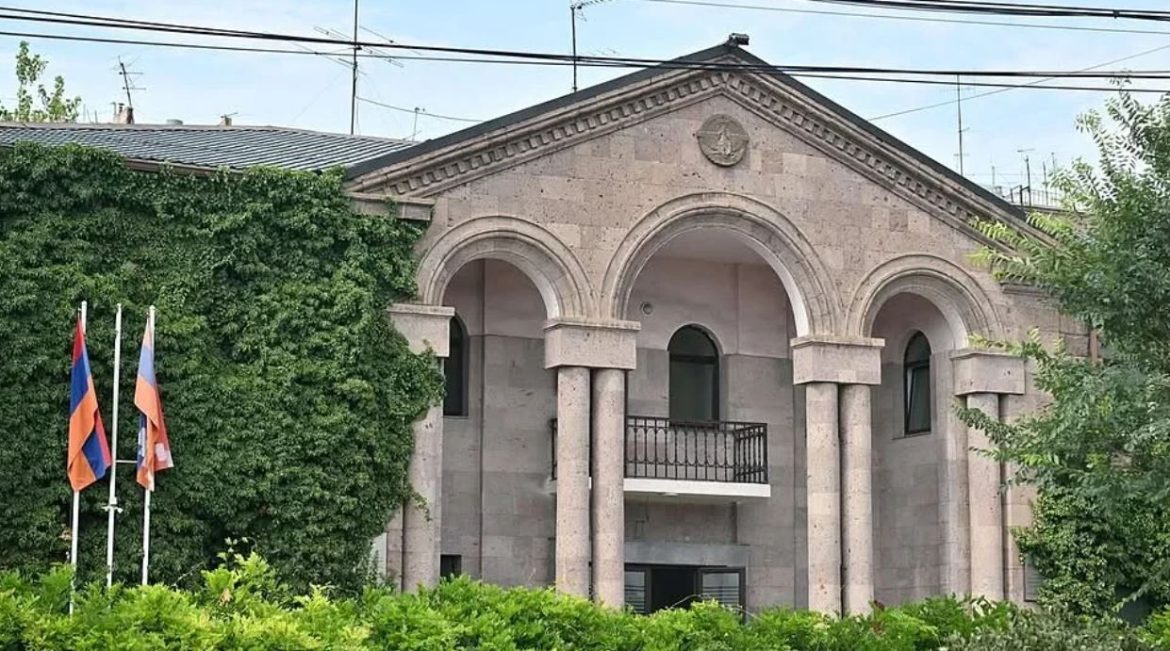
An Armenian court has cleared the way for authorities to seize the building of the permanent representation of Artsakh in Yerevan, following Prime Minister Nikol Pashinyan’s latest public attack against the exiled leadership of Nagorno-Karabakh’s ethnic Armenian population.
The building has served as Artsakh’s representation in Armenia since the early 1990s. Its ownership, however, was formally registered only in 2017. Armenia’s Prosecutor-General’s Office filed a lawsuit last year seeking to invalidate that ownership, and the court of first instance has now ruled in favor of the authorities.
The decision comes amid Pashinyan’s escalating campaign against Artsakh’s political institutions and representatives, who have continued to present themselves as the legitimate voice of a people forcibly displaced from their homeland after Azerbaijan’s 2023 military assault. Pashinyan has repeatedly denounced them for maintaining the existence of Artsakh’s state structures in exile and has threatened punitive action against them.
His rhetoric intensified again on May 18, during an election campaign event in Yerevan, when he clashed with Artsakh activist Artur Osipyan. Osipyan, who has also been a critic of the former authorities in Stepanakert, was arrested after the incident. During the confrontation, Pashinyan shouted insults and threats directed not only at Osipyan but also at what he called “Karabakh pseudo-elites.”
“Don’t you dare say that there is a Karabakh National Assembly or government in Armenia. I’ll root out all of you,” Pashinyan declared.
The court ruling regarding the Artsakh representation building was announced this week and immediately drew condemnation from Artsakh officials and refugee advocates.
Ashot Danielyan, speaker of the Artsakh parliament and acting president, described the move as “another shameful, illegal and immoral step against the Republic of Artsakh and its people.”
Artak Beglaryan, a former Artsakh state minister who now advocates for the rights of Artsakh refugees in Armenia, said the decision was plainly political.
“They made the decision based on clear political considerations,” Beglaryan told RFE/RL’s Armenian Service. “They want to destroy everything related to Artsakh, and through that, to put our identity and memory under attack.”
Beglaryan also accused Pashinyan of acting in coordination with Azerbaijani President Ilham Aliyev, whose regime has sought to erase all political and historical traces of Armenian Artsakh following the ethnic cleansing of its indigenous Armenian population.
Lawyers representing Artsakh’s leadership say they will appeal the ruling. They have also stated that no eviction orders have yet been received from the relevant authorities.
Despite the government’s pressure, Artsakh refugees and activists continue to gather periodically outside the representation building, where they raise concerns over housing, social hardship, and their right to return to their homeland. For many displaced Artsakh Armenians, the building is not merely an office but one of the few remaining public symbols of their national rights, collective memory, and political existence.
Pashinyan’s government, meanwhile, has refused to raise the issue of Artsakh Armenians’ right of return on the international stage. The prime minister has repeatedly told refugees that they should abandon hopes of returning to Artsakh and instead “settle down” in Armenia.
The seizure of the representation building is therefore being viewed by many Artsakh Armenians not as a narrow property dispute, but as part of a broader political effort to dismantle Artsakh’s institutions, silence its representatives, and normalize the consequences of Azerbaijan’s ethnic cleansing.