
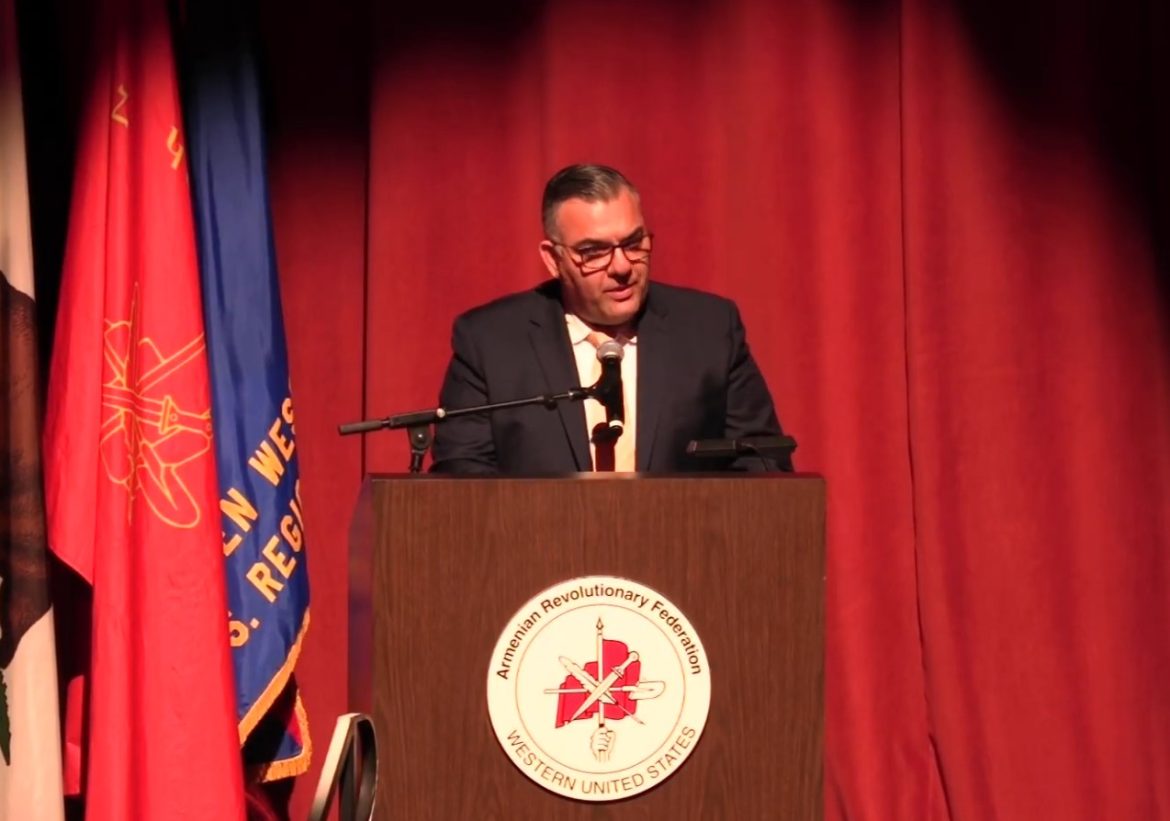
By Levon Baronian
Our people are living through one of the hardest chapters of modern Armenian history. Artsakh has been emptied. Our prisoners remain in Baku’s jails. The Armenian Apostolic Church, our culture, our history, and the cause of Genocide justice are treated inside Armenia not as pillars of identity, but as obstacles to a false peace. And the regime that seized power in Yerevan continues, point by point, to serve agendas hostile to Armenian statehood and the Armenian nation.
This is not a season for comfort. It is a season for resilience.
The 60th Regional Convention of the ARF Western United States convened under precisely these fateful circumstances, at a time when our homeland and our Diaspora face existential threats, and when an anti-national government advances a policy of unconditional concession. The Convention’s public declaration was clear: we stand with every national and patriotic force resisting this course; with our Artsakh sisters and brothers driven from their ancestral land; with the political and military leaders of Artsakh held hostage; and with those persecuted for refusing to surrender Armenian identity. That declaration was not rhetoric. It was a charge.
Resilience, for us, is not a mood. It is a discipline. It means refusing to accept defeat as destiny. It means refusing to redefine survival as submission. It means continuing the struggle when exhaustion is precisely what our adversaries are counting on.
History has already taught us the cost of that exhaustion, and the opposite of it.
There was a generation of Armenian youth who understood that a nation’s freedom is not purchased by comfort, calculation, or career. They chose self-sacrifice over self-preservation. They chose the Cause over the marketplace. Their names live in our collective memory not because they sought glory, but because they answered a moral claim larger than themselves. In an age when a materialistic and treasonous government in Yerevan markets capitulation as “realism,” that example stands as a quiet indictment. One path empties the Armenian soul for temporary safety. The other insists that a people without memory, dignity, and struggle is already half-buried.
As Nikol Aghbalian asked at Aram Manoukian’s funeral in 1919: “When night comes, enter the room of your soul, speak with your conscience, and ask: Have you worked for the Armenian people as Aram has? Have you been as self-sacrificing as Aram? Have you given your entire life to the Armenian people, as Aram has?”
That question has not expired. It confronts us still.
Today’s regime would have us forget it. It asks Armenians to treat national identity as negotiable, our martyrs as inconvenient, and our rights as disposable. It advances an ideology that seeks to turn Armenia into a province of Turkish design, a state administered, in substance if not in name, by those who function as implants of Ankara’s and Baku’s strategic will. That is not “peace.” It is the internal demolition of Armenian sovereignty.
Which is why the Diaspora’s burden has never been heavier, and never more decisive.
When the institutions of the homeland are captured by an anti-Armenian project, we in the Diaspora cannot treat our work as supplemental. We are not a sideshow. We are a vanguard of Armenian identity as we know it: of language, church, history, political consciousness, and the unfinished Cause. That means we must work not once, but twice and three times as hard: to defend our institutions from division and penetration; to keep Artsakh’s right of return alive; to pursue justice for the Genocide; to form the next generation politically; and to ensure that the Armenian voice in the world is not reduced to the talking points of a regime that has abandoned the nation’s historic mission.
This is not nostalgia. It is continuity. The Armenian people have been persecuted, scattered, and brought to the edge of disappearance before, and they have returned. Resilience is how that return begins: in the daily refusal to surrender identity, in organized political work, and in the stubborn conviction that Armenia’s story is not finished.
The struggle continues. It must. Because if we stop, if we allow exhaustion, materialism, or false peace to define us, there will be nothing left of the nation worth saving.


