
By Maya Balmanukyan and Amaras Mehrabian
For small countries, geopolitics has often outweighed principle. This is exemplified by Armenia’s situation.
Western governments frequently claim to uphold democracy, human rights, adherence to international law, and the protection of vulnerable peoples. European leaders regularly present themselves as defenders of these universal values. Americans, in particular, officially insist that moral values remain at the heart of foreign policy. International organizations emphasize peace, stability, and accountability.
Yet when those principles clash with strategic interests, Armenians have repeatedly discovered which one takes precedence.
Why do some governments speak more openly about Armenian concerns while others respond with caution? Why do some condemn aggressive injustice head-on while others make bland and diluted statements?
What differentiates these governments if they all claim to uphold the same principles?
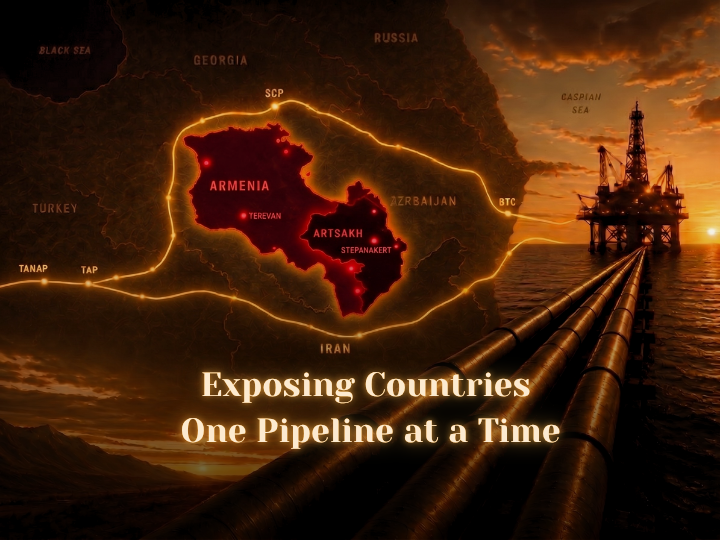
The answer may lie beneath the ground, in the network of pipelines that has quietly reshaped the region’s modern geopolitics.
The Armenian Question has evolved ever since its inception, but at its core is the same fundamental question: What happens when the rights and security of the Armenian people collide with the interests of more powerful states?
It is often discussed through the lens of history, war, diplomacy, and geopolitics. Yet another story runs beneath all of them: that of energy. For more than a century, oil and gas have helped showcase the strategic importance of the South Caucasus region. Subsequently, they have also helped dictate how outside powers respond when Armenian interests collide with their own.
The origins of modern Armenia’s geopolitical isolation can be traced all the way back to 1871, when Armenian industrialist Hovanes Mirzoyan, also known as Ivan Mirzoev, drilled one of the first mechanically operated oil wells in Baku. Within a few decades, Baku rapidly became one of the most important oil-producing centers in the world, attracting governments, investors, and corporations, all eager to secure access to its vast reserves.
After the collapse of the Soviet Union, newly independent Azerbaijan possessed enormous energy reserves but needed a route to international markets to put them to use. The solution emerged in the form of the Baku-Tbilisi-Ceyhan pipeline, or BTC. Completed in 2006, the BTC pipeline connected the Caspian Sea to the Mediterranean through Georgia and Turkey. While countries connected to these networks gained leverage, Armenia was left on the outside looking in.
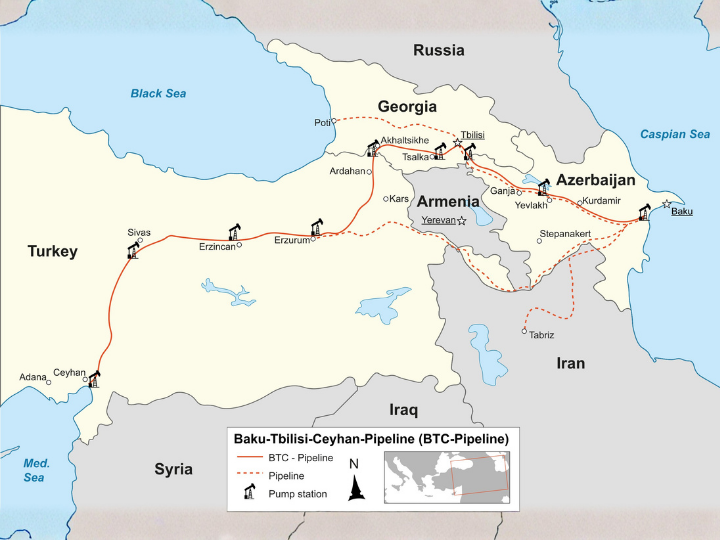
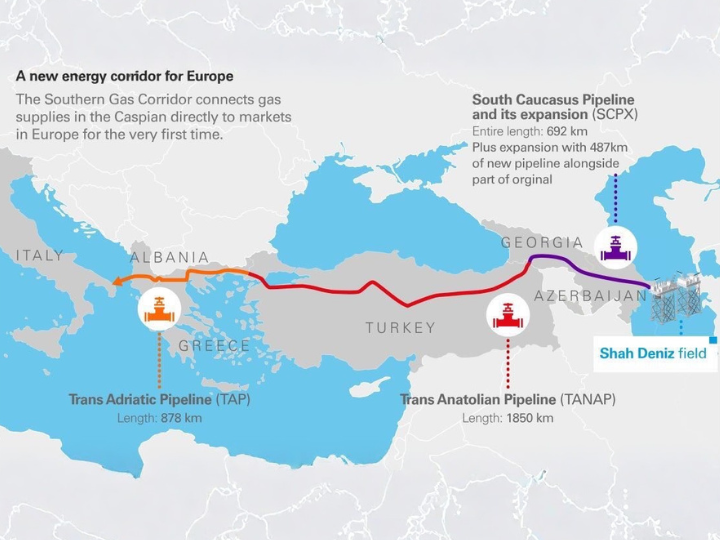
The South Caucasus Pipeline, or SCP, also known as the Baku-Tbilisi-Erzurum pipeline, was built alongside the BTC route, carrying Azerbaijani natural gas westward. It later became the first section of the Trans-Anatolian Natural Gas Pipeline, or TANAP, across Turkey and the Trans Adriatic Pipeline, or TAP, into Europe. Together, they formed the Southern Gas Corridor, extending the route first pioneered by the BTC pipeline.
The exclusion of Armenia from these energy corridors was not accidental. It was a deliberate geopolitical strategy. Azerbaijani President Ilham Aliyev openly argued that the success of these projects would deepen Armenia’s isolation, making clear that the pipelines were intended to do more than transport energy. They were designed to reshape the regional balance of power.
As pipelines multiplied, so did international investment. According to British Petroleum, the company and its co-venturers had invested approximately $84 billion in the major oil and gas projects it operates in Azerbaijan, including the Shah Deniz gas field, the BTC pipeline, the SCP, and more.
Companies from Great Britain, Italy, France, Turkey, Norway, the United States, and Azerbaijan itself all became stakeholders in the region’s energy future. With every new investment, Azerbaijan became more than an energy supplier. It became a strategic partner that many governments could no longer afford to alienate.
Capitalizing on the strategic geopolitical leverage generated by its pipelines, Azerbaijani forces launched attacks inside the internationally recognized sovereign territory of Armenia on September 12, 2022. Just three months later, the Lachin Corridor, the only road connecting Artsakh, or Nagorno-Karabakh, to Armenia, was blockaded.
By September 2023, more than 150,000 Armenians had fled Artsakh, bringing five millennia of continuous Armenian presence there to an end.
This was the moment when many governments that routinely presented themselves as defenders of democracy and human rights were forced to choose between principle and strategic interest. Their confident declarations about universal values gave way to carefully worded statements urging restraint, dialogue, and de-escalation.
Even as Armenia reported attacks on its internationally recognized territory, much of the international response centered on renewed negotiations rather than meaningful consequences for Azerbaijan. The contrast was difficult to ignore. Values that are presented as universal can become conditional when they collide with geopolitical and energy interests.
This contradiction is visible through the lens of Europe’s changing energy landscape. Following the Fukushima nuclear disaster in 2011, Germany voted to phase out nuclear power, increasing its dependence on imported energy. Russia’s invasion of Ukraine forced Europe to reduce its dependence on Russian gas through sweeping sanctions and diversification efforts.
In searching for alternatives, European governments turned to Azerbaijan. Almost overnight, Azerbaijan’s strategic importance grew dramatically, not because its values had changed, but because Europe’s energy needs had.
In July 2022, the European Union signed a Memorandum of Understanding with Azerbaijan, committing to more than double the Southern Gas Corridor’s capacity by 2027. Less than two months later, Azerbaijani forces crossed into the internationally recognized territory of Armenia.
No single energy agreement explains the international response to Armenia. But together, these developments reveal a pattern. As dependence on Azerbaijani energy increased, so too did the political cost of confronting Azerbaijan over its aggression and ethnic cleansing.
The timing was no coincidence. Governments that loudly defended democracy and human rights elsewhere became far more cautious when those values collided with Europe’s need for alternative energy.
France offers the clearest example. Unlike many of its European neighbors, France generates most of its electricity through nuclear power. According to the International Energy Agency, nuclear energy remains the foundation of the French electricity system, accounting for approximately 67 percent of the country’s electricity generated in 2024. This makes France significantly less dependent on imported natural gas than countries such as Germany.
Although that difference alone does not single-handedly explain French foreign policy, it may help explain why France has often been among Armenia’s strongest advocates within Europe. With fewer energy constraints, the Élysée has had greater freedom to criticize Azerbaijan’s genocidal ethnic cleansing, recognize humanitarian concerns, and openly support Armenia without risking the same level of energy disruption faced by many of its European partners.
The Bundestag tells a different story. Following Germany’s decision to phase out nuclear power, securing alternative energy imports became increasingly difficult.
Taken together, France and Germany reveal the broader pattern. The less dependent a country is on Azerbaijani energy, the more freely it invokes the language of democracy, human rights, and international law. The more dependent it becomes, the more those principles are overshadowed by strategic interests and carefully worded appeals for restraint.
The same dynamic extends beyond continental Europe. Through BP, the United Kingdom has made one of the largest foreign investments in Azerbaijan’s energy sector. Companies from Italy, Turkey, and across Europe also held major stakes in the pipeline network carrying Azerbaijani energy westward.
When governments become financially invested in a country’s energy exports, confronting that country becomes more than a moral decision. It becomes an economic, pragmatic, and strategic one.
Critics are correct to point out that pipelines do not explain everything. Military alliances, domestic politics, and regional security all weigh in on how governments respond to Armenia and Azerbaijan. Yet energy deserves far more attention than it often receives.
The pattern is difficult to ignore: Countries with fewer energy ties to Azerbaijan have generally been more willing to speak on Armenia’s side. Those whose economies and energy security have become increasingly intertwined with Azerbaijani exports have more often favored caution, balance, and restraint.
Energy alone does not determine foreign policy; it changes the price of acting on principle. Foreign policy is rarely driven by values alone. It is driven by interests.
For Armenians, this reality carries an uncomfortable lesson. International support is often represented as a reflection of universal principles. In practice, it is frequently filtered through economic, energy-security, and strategic-necessity lenses.
The story began in Baku, where an Armenian industrialist named Hovanes Mirzoyan helped unlock the oil wealth that would transform the South Caucasus. More than 150 years later, those same resources have become the foundation of a geopolitical order in which energy security, more often than not, outweighs the importance of Armenia’s sovereignty.
It is one of history’s great ironies: Armenia launched the industry that would eventually underpin a network built around Armenia rather than through it, without the explicit goal of erasing it from the map once more.
The lesson for Armenians is not that principles do not matter. It is that principles alone rarely determine foreign policy. International support cannot be measured just by the values governments claim to uphold. It must also be measured by the interest they are unwilling to sacrifice.
The Armenian Question is ultimately a test of whether governments are willing to bear a strategic cost for the principles they often proclaim. It is easy to defend human rights when there is little to lose. The true measure of those principles is whether they survive when economic interests point in the opposite direction.
The story of Armenia in the twenty-first century is usually told through wars, diplomacy, and geopolitics. It should also be communicated through pipelines. Because sometimes the shortest route to understanding a country’s policy toward Armenia is not through its speeches.
It is through its energy map.
Maya Balmanukyan and Amaras Mehrabian are Armenian National Committee of America – Western Region 2026 Summer interns.


