
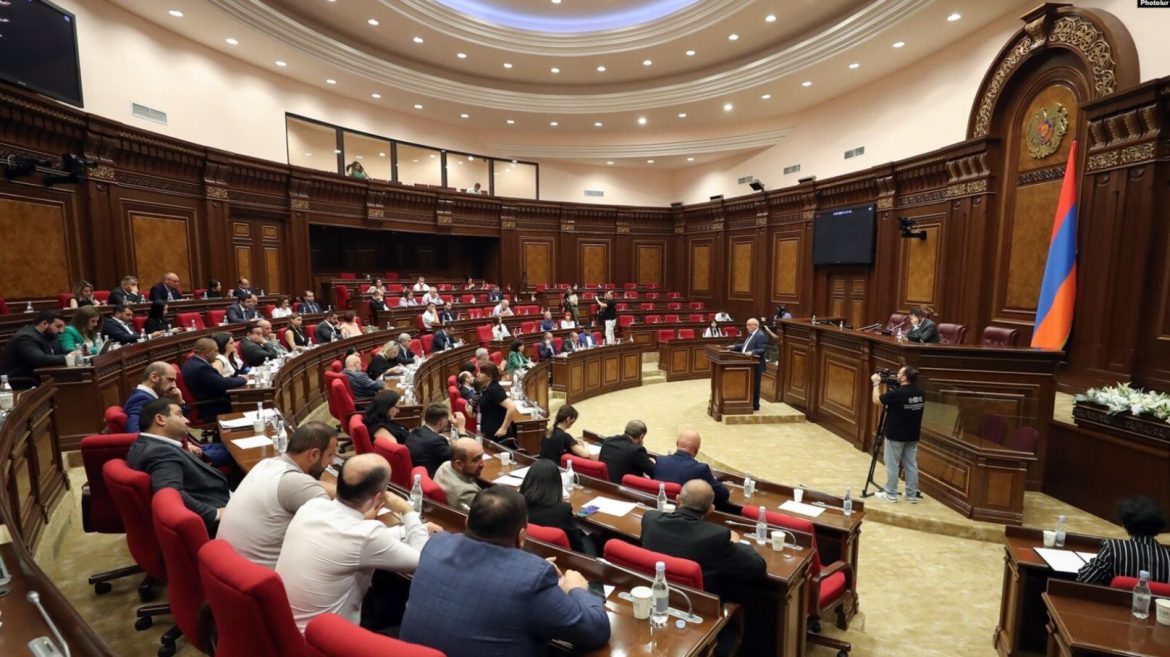
YEREVAN — Armenia’s two parliamentary opposition forces have decided to accept their mandates in the newly elected National Assembly, while pledging to coordinate their efforts against Prime Minister Nikol Pashinyan’s government both inside parliament and through public mobilization.
The Strong Armenia alliance, which will hold 29 seats, and the Armenia Alliance, which secured 12 seats, will form the opposition in the new 105-member legislature. The ruling Civil Contract party will control 64 seats.
Both opposition forces have challenged the legitimacy of the June 7 parliamentary elections, alleging widespread violations and the misuse of state resources. Although their legal challenges did not overturn the official results, opposition representatives say accepting their mandates does not amount to recognizing the election as free or legitimate.
Edgar Ghazaryan, a representative of Strong Armenia, said the alliance’s central political objective remains the removal of Pashinyan and his government.
“We participated in the elections with that agenda and received the people’s trust,” Ghazaryan said, maintaining that some of the opposition’s votes had been taken from it. He said the mandates that Strong Armenia did secure create an obligation to represent its voters and continue pursuing its campaign promises.
The Armenia Alliance, led by former President Robert Kocharyan, has adopted a similar position. Kocharyan himself will not take a parliamentary seat, repeating his decision following the 2021 elections. The next 12 candidates on the alliance’s electoral list are expected to accept their mandates.
Ten of the alliance’s incoming deputies served in the previous National Assembly. The faction will also include two newcomers: Vagharshapat municipal council member Sevak Khachatryan and Mesrop Manukyan of the opposition Mother Armenia faction in the Yerevan City Council.
Among those returning to parliament is Levon Kocharyan, the younger son of the former president.
Former Labor and Social Affairs Minister Aghvan Vardanyan has also announced that he will accept his mandate, despite previously saying he would step aside if Pashinyan remained in power and he found himself in the opposition.
“A promise is a promise, but the awareness of duty is more important,” Vardanyan wrote, explaining that he believes his responsibility at this stage is to remain with his political team, particularly alongside Ishkhan Saghatelyan and Narek Karapetyan.
Strong Armenia has not yet announced its final parliamentary roster. Of the first 29 candidates on its electoral list, Artur Danielyan is currently the only individual known to have declined a mandate.
The two opposition blocs together will hold 41 seats. While this will give them a substantial parliamentary presence, it will not be enough to remove the prime minister through a parliamentary vote. Armenian law also prevents the initiation of a no-confidence process during the government’s first year in office.
Opposition leaders nevertheless argue that parliament remains an important platform for confronting the government, exposing its policies and attempting to prevent further concessions affecting Armenia’s sovereignty and national security.
ARF Supreme Council representative Ishkhan Saghatelyan said refusing the mandates would have been the easier but less responsible course. He warned that Armenia could face new constitutional, territorial and security challenges under the current government.
According to Saghatelyan, the government may attempt to amend Armenia’s Constitution under pressure from Azerbaijan and could make further territorial concessions through the border delimitation process or negotiations involving so-called enclaves.
“We must be able to prevent this through every possible means,” Saghatelyan said.
He made clear that the opposition’s strategy would not be confined to parliamentary speeches and votes. Street demonstrations and other forms of public resistance will remain part of its political toolkit.
Saghatelyan also confirmed that discussions are underway between the Armenia Alliance and Strong Armenia at several levels. He did not deny reports that Robert Kocharyan and Strong Armenia founder Samvel Karapetyan had personally met.
“There is contact. It would be abnormal if there were no contact,” he said, adding that discussions and communication are taking place at different levels.
The two alliances are expected to cooperate on parliamentary matters, including the nomination of an opposition candidate for deputy speaker. Saghatelyan said the Armenia Alliance would support a candidate nominated by Strong Armenia, although the latter has not yet made a final decision.
Neither bloc has announced who will lead its parliamentary faction or whether it will seek the chairmanships of parliamentary committees. Those decisions are expected after the mandates are formally distributed and the new factions are constituted.
The first session of the new National Assembly is scheduled to begin on August 2. The number and structure of parliamentary committees, along with the distribution of leadership positions between the government and opposition, will be determined during the opening session.
Meanwhile, the ruling Civil Contract party has signaled that the new parliament could begin in an atmosphere of intense confrontation.
Ruben Rubinyan, Civil Contract’s candidate for speaker of the National Assembly, said the governing faction was eagerly awaiting opposition figures who had strongly criticized the authorities and declared that Civil Contract would “politically destroy” them in parliament.
The Central Electoral Commission is expected to confirm the initial membership of the new National Assembly on July 21, following the deadline for candidates to decline their mandates.
The emerging political landscape leaves Armenia with a parliament divided among three forces: Civil Contract, Strong Armenia and the Armenia Alliance. Although the ruling party will retain a majority, the opposition’s combined 41-seat presence and stated commitment to coordinated parliamentary and street action could make the new legislature considerably more contentious than its predecessor.


