By Levon Baronian
September 27 should have told Armenians everything they need to know about the two governments that emerged from the 2020 war. In Baku, Ilham Aliyev and Azerbaijan’s first lady went to Victory Park, where Aliyev laid a wreath at the Victory Monument. Senior state officials participated in official commemorations, and Azerbaijan once again marked September 27 as a national Remembrance Day honoring those killed in the war.
In Armenia, Nikol Pashinyan issued no public statement commemorating the sixth anniversary of the war and made no publicly announced visit to Yerablur. His official website instead recorded a September 27 congratulatory message to the president of Turkmenistan on that country’s Independence Day. That evening, Armenia’s Public Television broadcast a Tata Simonyan entertainment concert. After an immediate public uproar, the broadcaster apologized, called the decision a “mistake,” and promised to review its procedures. Tata Simonyan himself said the broadcast was unacceptable and that the concert had been used without his consent.
One should not believe for a moment that this was simply an innocent programming error. This is Public Television in a political system where the state broadcaster is just a propaganda tool for Pashinyan’s government. International election observers reported this year that many of their interlocutors viewed the Public Broadcaster as supporting the government, while independent media monitors have documented concerns about political influence and pro-government bias at H1. Whether someone eventually produces a written order showing who selected that particular concert is almost beside the point. The programming perfectly reflected the political atmosphere Pashinyan has created: Artsakh is to disappear from Armenia’s political consciousness, the 2020 war is to become an uncomfortable relic, and Armenians are expected to move quietly into the regional order created by Turkey and Azerbaijan.
The contrast with Baku could not have been clearer. Azerbaijan memorializes its victory and teaches its population that the war transformed the nation. Pashinyan’s government increasingly treats the same war, Artsakh, and everything that followed as subjects Armenia must leave behind in order to embrace his version of “peace.”
Only days before the anniversary, Pashinyan stood before the United Nations and declared that peace between Armenia and Azerbaijan had been established. A day earlier, he met Recep Tayyip Erdoğan in New York, where, according to Pashinyan’s own office, they discussed accelerating Armenian-Turkish normalization, expanding trade, restoring the Ani Bridge, implementing the TRIPP transportation project, and unblocking regional transportation links.
Meanwhile, Armenia’s Security Council Secretary has declared that Turkey presents “no threat at all.” This is the same Turkey that remains Azerbaijan’s closest strategic ally, supported Azerbaijan during the 2020 war, continues to deny the Armenian Genocide, and openly coordinates its Armenia policy with Baku. The question is not what has changed in Turkey or Azerbaijan. Almost nothing has. What has changed is Armenia.
Pashinyan has spent years weakening Armenia’s relationship with Russia, freezing participation in the CSTO and dismantling much of the security architecture that once constrained Turkey and Azerbaijan, without securing an equivalent military guarantee from anyone else. There is no NATO Article 5 for Armenia, no American defense treaty, no French obligation to defend Armenia militarily, and no equivalent Western security umbrella. The Armenian-Azerbaijani agreement itself bars third-party forces from deployment along the common border.
At the same time, Azerbaijan continues to make demands of Armenia. As recently as July, senior Azerbaijani officials were still insisting that Armenia amend its constitution before a final peace agreement could be completed. Yet Pashinyan’s government speaks as though the strategic problem has already been solved and the only remaining task is to convince Armenians to accept the new regional reality.
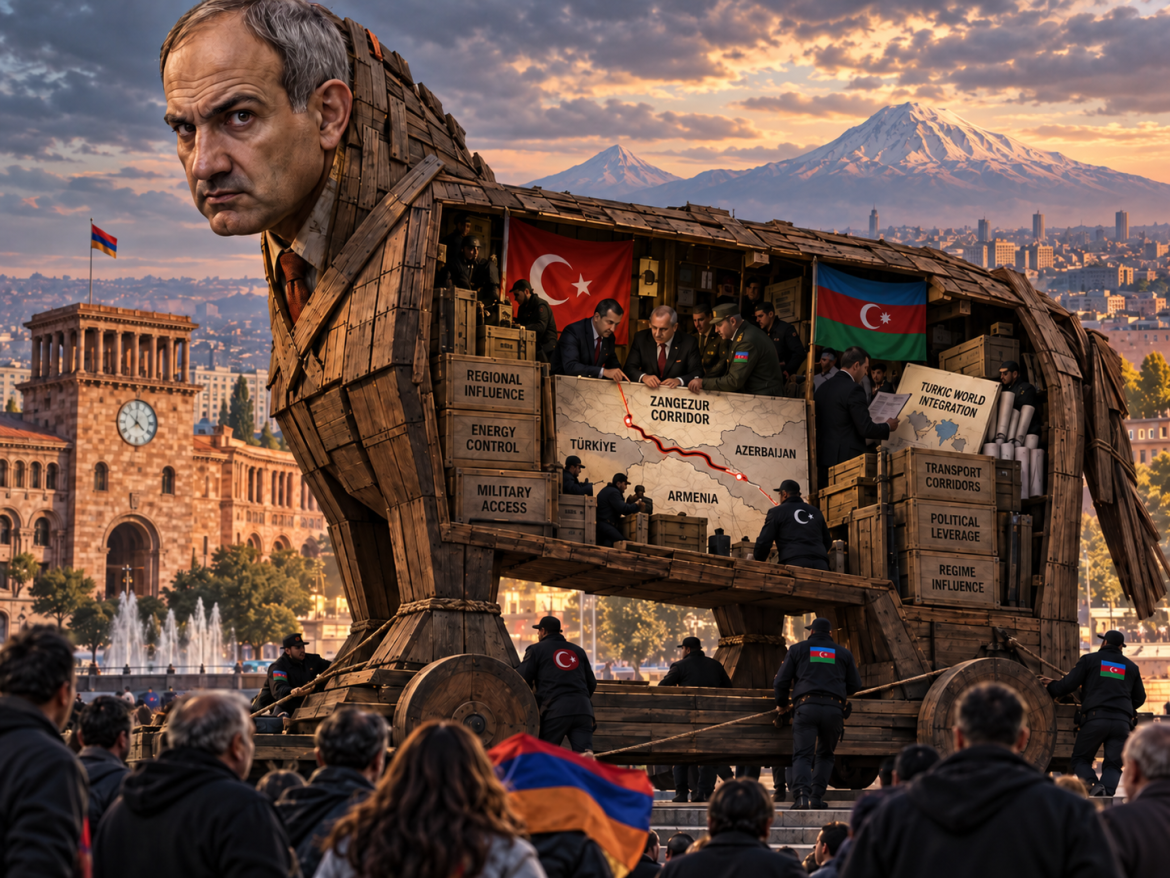
This is where the image of a Trojan horse becomes impossible to ignore. Turkey wants diminished Russian influence in the South Caucasus, and Pashinyan has systematically reduced Armenia’s ties to Russia. Turkey and Azerbaijan want east-west transportation connectivity through Armenia, and Pashinyan champions TRIPP and regional unblocking. Azerbaijan wanted third-party forces removed from the Armenian border, and the agreement provides for exactly that. Now Armenia’s own leadership tells the public that Turkey is no longer even a threat.
Again and again, Armenia gives up strategic leverage while Turkey and Azerbaijan preserve theirs. Again and again, Ankara and Baku emerge stronger from arrangements that Yerevan markets as peace. And again and again, Armenians are told that questioning this process means living in the past.
September 27 exposed the deeper political project behind all of it. In Azerbaijan, the state preserves the memory of the war because victory strengthens its national identity, its political narrative, and its negotiating position. In Pashinyan’s Armenia, memory itself has become inconvenient because the dead remind Armenians what was lost, Artsakh reminds Armenians what Azerbaijan did, and the Armenian Genocide reminds Armenians what Turkey still refuses to acknowledge.
Those memories interfere with Pashinyan’s attempt to sell the Turkish-Azerbaijani regional order as Armenia’s peaceful future. So they are diminished, reinterpreted, or pushed aside. That is why the sight of Aliyev laying a wreath in Baku while Armenian Public Television aired a pop concert in Yerevan was not simply an embarrassing television mistake. It was a perfect symbol of two governments moving in opposite directions.
Aliyev is consolidating the consequences of victory while Pashinyan is normalizing the consequences of defeat. A Trojan horse does not defeat a nation from beyond its borders. It succeeds when the gates are opened from within.