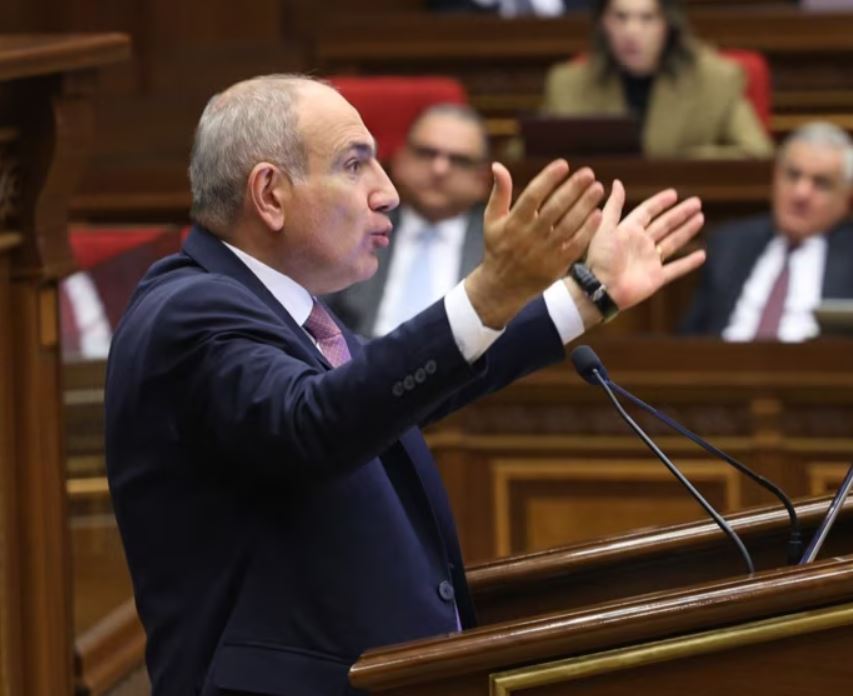
YEREVAN — Armenian Prime Minister Nikol Pashinyan intensified pressure on parliamentary opposition forces on Wednesday, November 18, threatening to pursue early parliamentary elections if opposition lawmakers refuse to facilitate a constitutional referendum. He also offered to resign following the referendum, regardless of its outcome, in an attempt to secure opposition cooperation.
During a heated question-and-answer session in the National Assembly, Pashinyan declared that his administration would proceed with its plans to replace Armenia’s Constitution, either by mobilizing public pressure against opposition lawmakers or by initiating political developments that would remove the current opposition factions from parliament.
Pashinyan proposed that opposition lawmakers provide the necessary votes to enable the referendum in exchange for his eventual departure from office. Should voters reject the new constitution, he said he would resign. Should they approve it, he pledged to resign after signing and ratifying a peace agreement with Azerbaijan.
“I will step down in either case,” Pashinyan declared.
Opposition lawmakers categorically rejected the proposal, questioning both the credibility of Pashinyan’s promises and the legitimacy of rewriting Armenia’s Constitution under Azerbaijani pressure.
Anna Grigoryan, head of the Hayastan parliamentary faction, dismissed the offer, stating that neither Pashinyan nor Azerbaijani President Ilham Aliyev could be trusted. She reiterated the opposition’s determination to prevent the adoption of what opposition forces have termed “Aliyev’s Constitution.”
Narek Karapetyan, leader of the Strong Armenia parliamentary faction, similarly rejected the proposal, emphasizing that Armenia’s Constitution is the foundation of its sovereignty and cannot be rewritten at the direction of Azerbaijan’s leadership.
Pashinyan Lacks the Necessary Parliamentary Votes
The confrontation stems from Pashinyan’s failure to secure a constitutional majority in the June 7 parliamentary elections. His ruling Civil Contract party controls 64 of the National Assembly’s 105 seats, six short of the 70 votes required under Article 202 of Armenia’s Constitution to submit a new constitution to a national referendum.
Despite lacking the necessary parliamentary support, Pashinyan expressed confidence that an overwhelming majority of Armenian citizens would approve the proposed constitution, the text of which has yet to be made public.
The two parliamentary opposition alliances, together with ten extra-parliamentary political forces, have launched a coordinated campaign against the initiative, mobilizing citizens in defense of Armenia’s existing constitutional foundations.
Azerbaijan’s Demands Target Armenia’s Founding Document
Azerbaijan has repeatedly made constitutional changes in Armenia a prerequisite for signing the bilateral peace agreement initialed in Washington in August 2025.
Baku specifically objects to the preamble of Armenia’s Constitution, which references the country’s August 23, 1990, Declaration of Independence. That historic document invokes the December 1, 1989, decision on the reunification of Armenia and Artsakh.
The Declaration of Independence also explicitly commits the Republic of Armenia to pursuing international recognition of the Armenian Genocide in Ottoman Turkey and Western Armenia.
Armenian government officials have previously indicated that the proposed constitution would eliminate references to the Declaration of Independence altogether.
While Pashinyan continues to present the constitutional overhaul as a domestic initiative necessary to secure lasting peace, Azerbaijan has openly acknowledged that it will not sign a peace treaty until its constitutional demands are met.
Opposition forces maintain that abandoning the principles enshrined in Armenia’s founding document would undermine Armenian statehood, weaken the country’s sovereignty, and invite further unilateral demands from Azerbaijan.
Wednesday’s parliamentary confrontation marks a significant escalation in the struggle over Armenia’s constitutional future, with Pashinyan now raising the prospect of dissolving a parliament elected less than six months ago in order to advance the constitutional changes demanded by Baku.