YEREVAN SILENT ON SECOND AZERI BORDER BREACH
MIRZOYAN CONCEDES EFFORTS TO FREE HOSTAGES HAVE FAILED
BAKU ANNOUNCES “NATIONAL PARK” ON DEPOPULATED ARTSAKH ARMENIAN LANDS
The Center for Armenian Research and Analysis (CARA) gathers and analyzes critical information on activities occurring in occupied Artsakh by state and non-state actors, and produces a weekly brief, with actionable data, to public and private stakeholders. Keeping Artsakh alive and in the public consciousness is part and parcel of CARA’s mission of providing clear and unfettered research and analysis pertaining to indigenous Armenian rights and cultural survival.
TOP ARTSAKH HEADLINES, OCTOBER 19-25, 2026
Yerevan Will Neither Confirm or Deny Second Azeri Breach of Armenian Border in One Month
Armenia’s National Security Service (NSS) has neither confirmed nor denied reports of a second border breach in one month by an Azerbaijani national. Media outlets said anAzeri individua crossed into Tavush Province near Aygedzor in the Berd region, where shepherds spotted him carrying a white flag. Residents guessed he was a “lost” shepherd, and Military Police found him in Berd and moved him to Yerevan.
Armenian Foreign Minister Ararat Mirzoyan claimed he learned of the breach from news reports and urged that “lost” individuals simply be returned home rather than treated as security threats. Kristine Vardanyan of the opposition Armenia Alliance condemned the official silence as proof of critical flaws in Armenia’s national security. She suggested that state agencies may be coordinating with Baku before they speak.
The Pashinyan regime’s Foreign Minister has asked that Azeri trespassers be sent home rather than treated as security threats, while Artsakh Armenian leaders are held hostage in Baku.
Trans border penetration by entities classified as “civilian” are standard tactics used by encroaching states as part of creating an image of “porous and un-demarcated borders,” putting into question issues of sovereign territory. These tactics are usually choreographed precursors to greater, more organized, and dangerous border penetrations usually part of larger and longer term offensives carried out by belligerent government special services. Precedents of such activities are manifold not only in the case of Artsakh and Syunik, but in a multitude of regions globally, particularly in Palestine.
These acts often signal future settler movement, territorial targeting, and security systems “testing, as well as surveillance and intelligence gathering operations. (Sources: Asbarez Article, JAM News Article, OC Media Article, Caucasian Knot Article, Armenian Report Article)
Mirzoyan Claims “Third-Country” Efforts to Free Armenian Hostages Have Failed
Armenian Foreign Minister Ararat Mirzoyan announced that Yerevan’s attempts to enlist third countries in guaranteeing the release of the Armenian hostages held in Azerbaijan have failed. He said the governments approached either declined to intervene or were told by Azerbaijani authorities to stay out of the processes.
Siranush Sahakyan, the hostages’ attorney before the European Court of Human Rights, said the Armenian government has given no specifics about the initiative. She asked whether Switzerland, which had agreed to mediate, was ever formally approached. She also said that HayPost, Armenia’s national postal operator, refuses to process mail and packages from the hostages’ families.
Mirzoyan replied that the hostages have an “undeniable right” to communication and visits and that correspondence “should be delivered.” He claimed Armenia’s efforts to free them “never cease,” though outcomes, purportedly, lie “beyond Yerevan’s control,” and added that Baku’s continued detention of the hostages hinders regional peace.
Baku holds the hostages, and Yerevan’s own state postal operator, according to the hostages’ attorney, refuses to handle their families’ mail, despite Mirzoyan’s public statements saying that the mail “should be delivered.”. The Pashinyan regime now concedes that its appeal to third countries has produced nothing. (Source: Asbarez Article)
Documentary “There’s No Place Like Home” Brings Artsakh’s Ethnic Cleansing to Glendale
“There’s No Place Like Home,” a documentary directed by Diana Madison and produced with Ruzanna Kegeyan, Gohar Khojabagyan, and Shant Petrossian, chronicles the forced displacement and ethnic cleansing of Artsakh’s indigenous Armenians in 2023. Winner of Best First Feature at the Croatia International Film Festival, it played a limited run at the Glendale Laemmle from October 16th to 22nd. It is presented by Diana Madison Productions, 374Collective Productions, and People of AR Productions as an AVA Films and Real Production Inc. release.
The filmmakers traveled across Armenia to gather firsthand accounts from survivors, activists, veterans, and mothers who were forced to leave centuries-old villages, hillside churches, ancestral graves, and family homes in a matter of days. Their testimony bears witness to a merciless ten-month blockade of Artsakh, the forced expulsion of its indigenous Armenian population, and the work of rebuilding lives far from their millennial home.
The witnesses are among the 150,000 indigenous Armenians forced out of Artsakh since September 2020, 120,000 of them expelled in the September 2023 ethnic cleansing. Baku is already rezoning and settling the land they left with Azeri and other settlers as part of a large scale erasure and appropriation program. (Source: Asbarez Article)
Azeri Forces Strip Armenia’s Shikahogh Reserve While Yerevan Hosts COP17
As COP17, the 17th Conference of the Parties to the UN Convention on Biological Diversity, meets in Yerevan, Armenian officials face criticism for failing to address the destruction of the Shikahogh State Nature Reserve. Established in 1958, the reserve covers nearly 30,000 acres, 94% of it forest. It shelters 1,100 plant species, 70 of them in the “Red Book” of endangered species and flora, and rare wildlife, including the Caucasian leopard and Bezoar ibex.
After the 2022 Azeri military incursions into Syunik Province, near Nerkin Hand, the reserve was forced into a militarized zone by Azeri aggression and violence. Azeri forces illegally occupying sovereign Armenian territory there have carried out systematic deforestation, built 26-foot-wide roads, and constructed fortified military positions across about 225 acres, including 150 acres of dense forest. Satellite imagery and Global Forest Watch data show Armenia has, thus far, lost roughly 250 acres of natural forest between 2021 and 2023, nearly 200 of them in 2023, in step with the illegal and violent incursions.
Armenian state institutions have stayed largely silent or answered evasively. The administration of the Zangezur (Syunik) Biosphere Complex declined to clarify the situation, and Armenia’s Ministry of Environmental Protection claims precise damage assessments are impossible because the affected areas “remain under direct line of fire.” Experts and those close to this travesty say the destruction of protected natural resources and species is a clear case of unabated and deliberate “ecocide”.
Baku publicly decrees “green growth” in Artsakh while its troops cut down Armenian forests in Syunik. (Source: Asbarez Article)
“On the Ground” in Occupied Artsakh
Baku Settles 44 More Families in Occupied Ivanyan and Martakert as Part of Demographic Takeover of Ethnically Cleansed Artsakh
On October 22nd, Baku settled another 176 people in 44 settler families in occupied Ivanyan (Azeri “Khojaly”) and Martakert (Azeri “Aghdara”) under its illegal “Great Return” Settler Offensive program. Azeri state media claim they are Azeri “former internally displaced persons (IDPs)” who had purportedly and formerly lived in dormitories, sanatoriums, and administrative buildings.
In occupied Ivanyan, 4 Azeri settler families (23 people) went to Ivanyan itself, 5 families (27 people) to Aygestan (Azeri “Ballıca”), 3 families (7 people) to Ptretsik (Azeri “Badara”), 1 family (2 people) to Astghashen (Azeri “Dashbulag”), and 2 families (5 people) to Khnatsakh (Azeri “Khanyurdu”). In occupied Martakert, 6 families (29 people) were sent to occupy Vank (Azeri “Vangli”) and 23 families (83 people) were deployed by Azerbaijan to Drmbon (Azeri “Heyvalı”).
Armenians lived in each of these places for millenia until the September 2023 ethnic cleansing of 150,000 indigenous Armenians of Artsakh. These 176 settlers are the latest deployment of the “Settlers Offensive,” Baku’s systematic program of erasure and replacement of indigenous Armenians. (Source: Relocation to Occupied Ivanyan and Martakert)
Baku Decrees a “Karabakh National Park” and “Green Energy Zones” on Ethnically Cleansed Artsakh Lands
On October 20th, Azeri dictator Ilham Aliyev signed a decree creating a so-called “Karabakh National Park” across 88,418 hectares of what the decree calls state-owned land in the occupied districts of Martakert (Azeri “Aghdara”), Ivanyan (Azeri “Khojaly”), Karvachar (Azeri “Kalbajar”), Shushi (Azeri “Shusha”), and Berdzor (Azeri “Lachin”). The decree says the park will protect “rich ecosystems and biodiversity,” restore “natural heritage,” promote ecotourism, and turn the region into a “green growth” zone under the Cabinet of Ministers. It cites “severe environmental harm” caused during what Baku calls “the occupation.”
The decree fits Baku’s “Long-term low-carbon development strategy,” approved by Prime Minister Ali Asadov, which targets net-zero emissions by 2060 and a 40% cut in greenhouse gases by 2035 from 1990 levels. Its central pillar is “green energy zones” in occupied Artsakh, where Baku claims it will scale up solar and wind power and restore forests.
Much of Artsakh’s lush and ancient forests and pristine natural environs were destroyed and mutilated by the Azeri armed forces using, among other toxic and banned weapons, “White Phosphorous” partially procured from Ukraine and deployed against Armenian Artsakh civilian populations and the forest environments during Azerbaijan’s multilateral , multi-frontal genocidal aggression against Artsakh and its indigenous Armenian population.
The Azeri Ministry of Ecology and Natural Resources drafted the “Green Zone” texts for the UNFCCC Secretariat as a gestural follow-through on the contrived COP29 Baku outcomes. The Azeri strategy claims that “success” ultimately depends on international climate finance, technology transfer, concessional loans, and private investment.
A “national park” and “green energy zones” on land depopulated of its indigenous Armenians are part of settlement infrastructure with a green label. It being paid for with “international climate finance” is clear-cut participation in genocide. (Sources: New National Park, Green Energy Zone in Occupied Artsakh)
Baku Brings a So-Called “Smart Governance” Forum to Occupied Stepanakert
On October 23rd, the DOST Agency, under Azerbaijan’s Ministry of Labor and Social Protection of the Population, held a forum entitled, “SOCGOV 2026: Digital Analytics for Smart Governance” in occupied Stepanakert (Azeri “Khankendi”). Azeri Minister Anar Aliyev stressed the “symbolic location” and claimed that over 90% of DOST center services are digitized and that artificial intelligence is applied to disability assessments and employment services. He announced a sixth “social reform package” on the instructions of Azeri dictator Ilham Aliyev, following five since 2018 that Baku claims required an extra AZN 8 billion (USD 4.7 billion) a year.
Turkish Minister Vedat Işıkhan presented Turkey’s “e-Government Gateway,” and Azeri State Agency Chairman Ulvi Mehdiyev presented the ASAN Khidmet model. A panel, including delegates from Moldova, Greece, Azerbaijan, and Luxembourg, participated in a joint session with the former Artsakh State University, which Baku has renamed “Qarabakh University.” The forum adopted a declaration to make SOCGOV an institutional platform. Delegations from Turkey and Uzbekistan afterward toured Baku’s so-called “Victory Park” and what Baku has renamed “Qarabakh University.”
The “citizens” served by this system are settlers in the most destructive and vile sense of the term. AI and digital services in depopulated Stepanakert are settlement infrastructure of the most sinister and durable kind. (Sources: SOCGOV Forum in Occupied Stepanakert, Social Reform Package)
Baku Claims a Quadrupled “Karabakh Economy” in Occupied Artsakh
On October 23rd, Azeri officials claimed that the “Karabakh economy” has quadrupled and a so-called “East Zangezur” economy has grown 30-fold. Baku claims it allocated AZN 26 billion (USD 15.29 billion) from the state budget, “entirely” from its own resources, under the “First State Program on the ‘Great Return,’” which it describes as restoring “long-occupied, destroyed areas” for the “safe return” of “internally displaced persons.”
Baku claims production in occupied Artsakh rose from nearly AZN 1.55 billion (USD 910.6 million) in 2020 to AZN 6 billion (USD 3.53 billion). By Baku’s count, industrial output in occupied Akna (Azeri “Aghdam”) supposedly reached AZN 1 billion (USD 589 million) in 2025, a “17.4-fold” jump from 2024. Baku says goods from occupied Artsakh are now “actively exported” to Georgia, Moldova, Uzbekistan, Kazakhstan, and Russia.
Baku says it paid “entirely” from its own resources, yet its climate strategy asks the world for “international climate finance” for the same land. Its buyers in Georgia, Moldova, Uzbekistan, Kazakhstan, and Russia are trading in the products of occupation and genocide, financing the conquest of ethnically cleansed Armenian lands. (Source: Economic Boom in Occupied Artsakh)
Baku Stages a “City Day” in Occupied Kovsakan and Celebrates the “Liberation” of Kashunik
On October 20th, occupied Kovsakan (Azeri “Zangilan”) held a “City Day” in the city itself for the first time. The program included a “Pilaf Festival,” demonstrations of kurama (patchwork) and mat weaving, a photo exhibition by the Union of Photographers of Azerbaijan, and a closing concert by soloists of the Muslim Magomayev Azerbaijan State Academic Philharmonic Society and the Fikret Amirov Azerbaijan State Song and Dance Ensemble.
On October 25th, Azerbaijan marked the sixth anniversary of what it calls the “liberation” of occupied Kashunik (Azeri “Gubadli”). Azeri state media claim the city and district endured Armenian “occupation” from August 31, 1993, with supposed destruction of infrastructure, desecration of monuments, and the “burning and cutting down of rare forests,” all war crimes of which Azerbaijan is solely guilty and was the orchestrator. However, the Azeris ignore these facts and instead emphasize that their forces took the city on October 25, 2020, in what Baku calls the “Second Karabakh War,” after a “counter-offensive” launched on September 27, 2020, with breakthroughs in Jrakan (Azeri “Jabrayil”) and Kovsakan opening the way–all done with the aid of multiple foreign state, including Turkey, Israel, Ukraine and Pakistan, as well as thousands of fundamentalist mercenaries.
Both towns were in Artsakh until Baku seized them in the 2020. The “counter-offensive” was Azerbaijan’s own unilateral violent attack of September 27, 2020, and the “liberation” it celebrates was the expulsion of Kashunik’s Armenians. (Sources: Kovsakan City Day, Occupation of Kashunik)
Foreign Interests and Actions in Occupied Artsakh
Baku and Ankara Toast the “Karabakh Victory” at an “International Azerbaijan Congress” in Eskişehir
On October 19th, the so-called “International Azerbaijan Congress” in Eskişehir, Turkey, turned to occupied Artsakh, with what was Artsakh State University, now bearing the Azeri occupation nomenclature of “Qarabakh University,” as a co-organizer. Valeh Hajiyev, First Deputy Chairman of the Azeri State Committee, stressed the “historical significance” of the “Karabakh Victory” and the “strategic importance” of the “Shushi Declaration” signed by the Azeri and Turkish leaderships. He said Azeri and Turkish diaspora communities “collaborated closely to counter disinformation campaigns” during what they call the “44-day war.” Yücel Karauz, a former Turkish military attaché, continued the state propaganda barrage by projecting ideas of the so-called “broader impacts” of the “victory,” citing the integration of modern military technology (Israeli and Turkish, among others) into the Azerbaijani Army.
The “disinformation” they boast of countering is the record of who launched the 2020 war and with whose help. The Shushi Declaration binds Baku and Ankara in a military alliance. (Source: International Azerbaijan Congress)
EU-Funded Report Counts a Growing Number of European Firms in Occupied Artsakh
The “EU Business Climate Report Azerbaijan 2025/26,” funded by the European Union and prepared by the VM Europe Consortium, reports “growing investment interest” among European companies in occupied Artsakh. Comparing 2024 and 2025, the share of European firms “actively operating” there rose from 8% to 19.4%, although the 2025 survey widened its scope to include occupied Nakhichevan. Direct EU participation in “reconstruction” remains modest, as Turkish firms win the main construction contracts and European companies mostly handle freight or work as subcontractors introduced by Turkish partners. The report advises finance companies to make “informative, business-oriented visits” to assess the market.
A report paid for by the European Union is coaching European finance companies on how to enter occupied and ethnically cleansed Artsakh. Credit extended on lands forcibly depopulated of its native Armenian population by Azerbaijan and its allies is participation in genocide. (Source: EU Investment Interest in Occupied Artsakh)
State-Funded “Karabakh Families of Missing Persons” Take Baku’s 4,010 Claim to Brussels
On October 21st, members of the so-called “Karabakh Families of Missing Persons” Azeri public association met EU representatives at the European External Action Service (EEAS) in Brussels. Chairperson Konul Behbudova and relatives met Okke Bouwman, Political Adviser to the EU Special Representative for the South Caucasus, and Marco Cardinali, Coordinator for Relations with Azerbaijan. They claimed Armenia has given “no information” on the fate of missing Azerbaijanis, bears “direct responsibility,” and must disclose the coordinates of mass graves, of which they falsely claim 32 have already been found in occupied Artsakh. They vowed to keep protesting “regularly” and not to “remain silent.”
The meeting followed a protest on October 20th in front of the European Parliament, where a statement was adopted, and a rally the same day as the meeting at Schuman Square. Organizers claimed Armenia is withholding information on 4,010 missing Azerbaijanis and accused the European Parliament of “consistently supporting Armenia” while never raising the issue. The rally was part of the “Echo of Absence” project, which won a 2026 grant competition run by Azerbaijan’s Agency for State Support to Non-Governmental Organizations.
The “Echo of Absence” campaign is paid for by the Azeri state, which holds Armenian hostages in Baku and ignores at least 80 forcibly disappeared Armenians and more than 200 more unaccounted for, all to cover-up its own heinous war crimes and crimes against humanity while blaming the victims of its savage violence. In the Artsakh Self Defense War (First Nagorno Karabakh War), Azeri special military and intelligence units were “notorious for killing, torturing, and disappearing their own.” (Sources: Meeting with EU Representatives, Rally in Brussels)
Baku-Funded “World Without Mines” Photo Tour Propaganda Campaign Reaches Milan
On October 22nd, the “World Without Mines” campaign, organized by Azerbaijan’s “Gilavar Photo Club” Public Association, held a photo exhibition in Milan, Italy, one stop on an October tour that also took in seven other European cities, including Geneva and Rome. The club won a 2026 grant competition on mines, with support from the Agency for State Support to Non-Governmental Organizations, the Karabakh Revival Fund, and the Azerbaijan National Agency for Mine Action (ANAMA). Organizers once again demanded that Armenia supply “accurate minefield maps” and claimed the hazards remain in “populated areas, cemeteries, and mass grave sites.” In tandem, the “Karabakh Missing Families” public association protested in Brussels, claiming 4,010 missing Azerbaijanis, including 71 children, 288 women, and 319 elderly individuals.
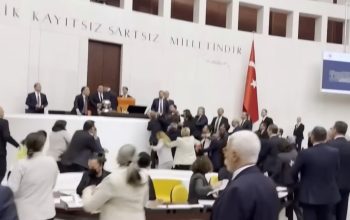
Every funder named here is a Baku institution, and the “Gilavar Photo Club” is another of Baku’s front groups touring Europe with a state script. Azeris continue to turn the tables on Armenians concerning human rights, violations, war crimes, mass graves, and still untold savageries and barbarism, while Armenians turn tables and chairs upon each other in their circus clown parliament in Yerevan/Irevan. (Source: Photo Exhibition in Milan)
The Center for Armenian Research and Analysis (CARA) is a trans-national research institute that provides investigative, analytic, and informational resources to public and private entities across the Armenian experiential spectrum.