YEREVAN — Armenia’s political climate deteriorated further this week as Prime Minister Nikol Pashinyan threatened increased pressure against parliamentary opposition forces, defended members of his ruling party following a violent confrontation in the National Assembly, and faced renewed criticism over legal proceedings involving the Armenian Apostolic Church and former government officials.
The developments, unfolding between October 29 and 30, have intensified concerns among opposition leaders about political intimidation, judicial independence, and the government’s increasingly confrontational approach toward its critics.
Pashinyan Threatens Opposition Over Constitutional Changes
Speaking at an October 29 news conference, Pashinyan warned that his government could mobilize public pressure against the opposition if lawmakers refuse to support a proposed new constitution, a central demand of Azerbaijan in negotiations over a final peace agreement.
The proposed constitution requires the support of at least two-thirds of parliament before being submitted to a national referendum. Pashinyan’s ruling Civil Contract party does not possess the necessary majority without opposition support.
Pashinyan suggested that government supporters could organize demonstrations against opposition lawmakers and raised the possibility of snap parliamentary elections intended to remove the current opposition from the legislature.
“If the opposition decides to vote against it, a political process will ensue,” Pashinyan declared, adding that authorities themselves could organize protests outside parliament.
He further suggested that early elections could follow if opposition lawmakers continued resisting, provided there was a guarantee that the existing parliamentary opposition would not return to the National Assembly.
The opposition Strong Armenia and Hayastan alliances have rejected the constitutional initiative, arguing that Armenia’s fundamental law must not be rewritten to satisfy Azerbaijani President Ilham Aliyev.
Strong Armenia parliamentary leader Narek Karapetian characterized the proposed changes as an attempt to impose Azerbaijan’s demands on Armenia.
“The leader of a neighboring country cannot dictate our constitution,” Karapetian said.
Hayastan lawmaker Anna Grigorian likewise maintained that her parliamentary group had received a public mandate to resist the initiative and would not support advancing the proposed constitution to a referendum.
Opposition lawmakers also questioned whether constitutional changes would actually secure a peace agreement with Azerbaijan. Pashinyan acknowledged that he could not guarantee Baku would sign such an agreement even if Armenia adopted the proposed constitution.
The admission reinforced opposition arguments that the government is pursuing concessions without obtaining binding assurances from Azerbaijan.
Violence Erupts in National Assembly as Pashinyan Defends Ruling Party Lawmakers
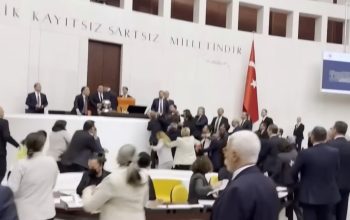
Political tensions spilled into physical violence on October 29 when lawmakers from Civil Contract and Strong Armenia engaged in a prolonged confrontation inside the National Assembly.
The fighting, which lasted approximately 30 minutes, involved dozens of lawmakers exchanging punches and kicks. Several participants sustained visible injuries, while Deputy Speaker Vahagn Aleksanyan of Civil Contract reportedly threw a chair toward opposition deputies.
The confrontation began during remarks by ruling-party lawmaker Taron Chakhoyan, who directed personal attacks against Narek Karapetian and his family following opposition allegations of government corruption.
Rather than immediately suspending proceedings, presiding parliamentary official Ruben Rubinyan initially allowed the session to continue as the confrontation intensified. Security personnel eventually intervened, although fighting subsequently continued outside the parliamentary chamber.
Opposition representatives accused the parliamentary leadership of permitting the confrontation to escalate and blamed ruling-party provocations for triggering the violence.
Pashinyan, however, publicly defended his party’s lawmakers and mocked the opposition following the incident.
In a social media statement, he questioned the physical strength of opposition deputies. At a subsequent news conference, he described the conduct of government lawmakers, including the throwing of a chair, as proportionate and justified.
His response prompted additional criticism from opposition figures, who argued that the prime minister’s remarks encouraged rather than condemned violence inside Armenia’s legislature.
Judge Faces Disciplinary Proceedings After Recusing Himself From Catholicos Trial
In a separate development, Armenia’s Justice Ministry initiated disciplinary proceedings against Judge Hakob Manukyan, who had withdrawn from the criminal case against Catholicos Karekin II and six senior clergymen of the Armenian Apostolic Church.
The proceedings against the Catholicos and the bishops stem from their involvement in the defrocking of Gevorg Saroyan, a former bishop who has openly supported Pashinyan’s campaign against the Church leadership.
The clergymen face accusations connected to the alleged obstruction of a court order concerning Saroyan’s reinstatement.
Church representatives and defense attorneys maintain that Armenia’s secular courts lack jurisdiction over internal ecclesiastical disciplinary decisions.
Manukyan recused himself shortly after the trial opened on August 7, citing a potential conflict of interest involving the Catholicos’s attorney, Ara Zohrabyan, who previously headed Armenia’s Chamber of Advocates.
The Justice Ministry subsequently requested disciplinary action against the judge. Armenia’s Supreme Judicial Council is scheduled to examine the matter on November 16, although the precise sanctions being sought have not been publicly clarified.
Following Manukyan’s withdrawal, the case was reassigned to Judge Serzh Rushanyan, who initially ruled that the proceedings should be transferred to Yerevan. The Court of Cassation subsequently returned the case to him.
The next court hearing, initially scheduled for October 30, was postponed until November 6.
The proceedings come amid Pashinyan’s continuing confrontation with the Armenian Apostolic Church, including his efforts to remove Catholicos Karekin II from leadership.
The disciplinary case against Manukyan has raised further questions about the pressure judges may face when handling politically sensitive proceedings involving the Church.
Seriously Ill Former Finance Minister Remains in Detention
Meanwhile, a Yerevan court extended the detention of former Armenian Finance Minister and State Revenue Committee chief Gagik Khachatryan by another two months despite concerns about his deteriorating health.
Khachatryan, 70, suffers from a serious spinal condition and has appeared at court hearings lying on a medical stretcher.
He previously headed Armenia’s State Revenue Committee from 2008 to 2014 and served as finance minister between 2014 and 2016.
Initially charged with corruption in 2019, Khachatryan was detained in 2020 and subsequently released on bail. He was arrested again on September 1, 2026, following additional corruption allegations, which he denies.
His attorneys have repeatedly argued that his medical condition makes continued imprisonment inappropriate and that detention authorities cannot provide the necessary treatment.
Defense attorney Yerem Sargsyan called for house arrest, explaining that Khachatryan requires medical supervision, family assistance, and physical rehabilitation.
Law-enforcement authorities have rejected claims that his condition prevents detention, while Pashinyan has publicly questioned the severity of his illness.
The former minister’s defense team has also challenged the authorities’ handling of property confiscated during a September search of his residence, including jewelry, luxury watches, and approximately 70 paintings. The paintings were subsequently displayed at Armenia’s National Art Gallery despite the absence of a criminal conviction.
His lawyers denounced the exhibition as a violation of his property rights and the presumption of innocence.
Mounting Questions Over Armenia’s Democratic Institutions
Taken together, the week’s developments underscore the widening confrontation between Pashinyan’s government and its political, religious, and institutional opponents.
The prime minister’s threats to mobilize pressure against elected opposition lawmakers, his public defense of violence inside parliament, disciplinary proceedings involving a judge assigned to the Catholicos’s case, and the continued imprisonment of an ailing former official have placed renewed attention on the conduct of Armenia’s governing authorities.
Opposition leaders maintain that the constitutional controversy is particularly consequential because it concerns Armenia’s sovereignty and Azerbaijan’s influence over the country’s future political and legal framework.
With the government pursuing constitutional changes that the parliamentary opposition refuses to endorse, legal proceedings against senior Church leaders continuing, and political tensions increasingly spilling beyond parliamentary debate, Armenia faces a period of growing institutional confrontation.
The central questions now extend beyond individual political disputes to the independence of the judiciary, the authority of the Armenian Apostolic Church over its internal affairs, the rights of parliamentary opposition forces, and the limits of executive power.