Prime Minister Nikol Pashinyan has escalated his confrontation with the exiled leadership of the Republic of Artsakh, declaring that the Artsakh Permanent Representation in Yerevan will be placed under Armenian government control and threatening the “toughest measures” against efforts to maintain Artsakh state institutions in Armenia.
Speaking during a National Assembly question-and-answer session on September 16, Pashinyan said that there could not be “two states” or “two governments” in Armenia and rejected the continued existence of a structure operating as the Artsakh representation.
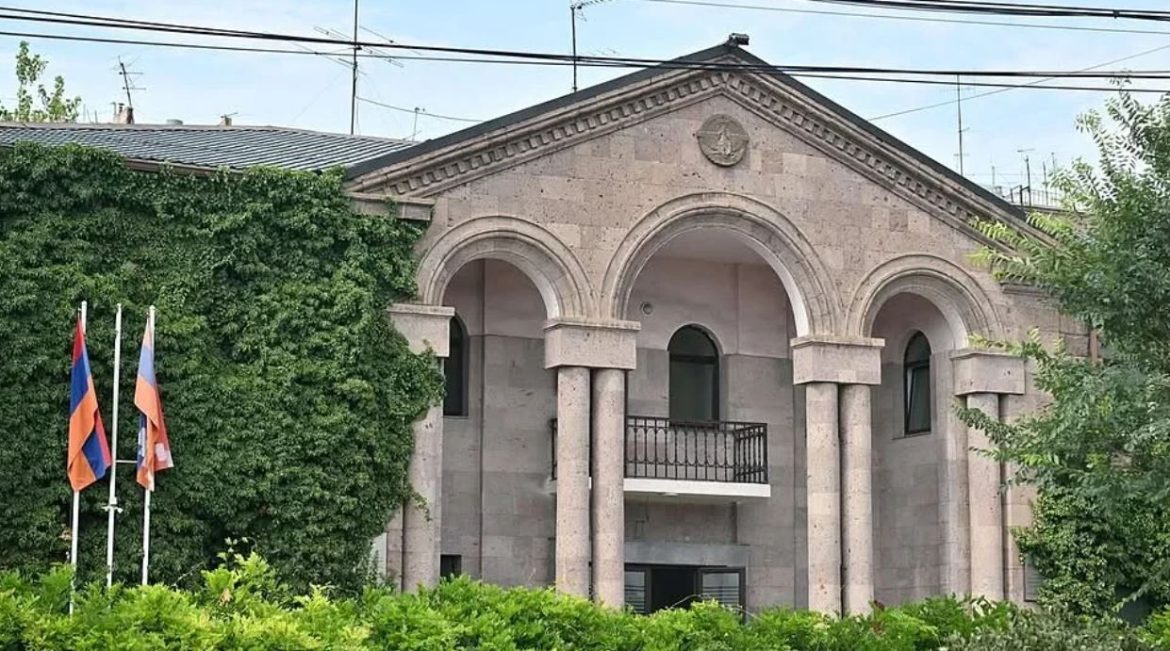
“The building will come under the control of the Republic of Armenia,” Pashinyan said. He went further, declaring that as prime minister he would use the “toughest measures” to stop attempts to establish what he described as “a second state, a second government or a second parliament” inside Armenia.
The remarks were made in response to Strong Armenia faction MP Arega Hovsepyan, who raised the housing difficulties facing Armenians forcibly displaced from Artsakh and referred to families moving into the representation building because of rising rents.
Pashinyan responded by challenging Artsakh’s former leadership and accusing former officials of possessing buildings and hotels that could instead be made available to displaced families. During the same exchange, however, his comments moved beyond the question of housing and directly addressed the continued institutional existence of Artsakh’s authorities in exile.
The confrontation over the representation is the latest stage of a dispute that began well before this week’s parliamentary exchange.
Following Azerbaijan’s September 2023 military assault and the displacement of Artsakh’s Armenian population, officials of the Republic of Artsakh continued working from Yerevan. Artsakh President Samvel Shahramanyan said in March 2024 that the republic’s presidential, legislative and judicial offices continued to function in exile and that Artsakh lawmakers could assemble in Yerevan.
Pashinyan responded days later by portraying the continued operation of an Artsakh government-in-exile as a national-security issue.
At a March 28, 2024 government meeting, Pashinyan said that “certain circles” displaced from Artsakh were taking steps that could threaten Armenia’s national security and specifically cited declarations concerning a “government in exile.” He warned that “appropriate steps” and “appropriate measures” could be taken and insisted that no government other than the government of the Republic of Armenia could operate in the country.
The dispute has since moved from political warnings to control of the physical headquarters from which Artsakh’s institutions have continued to operate.
The building at 17/2 Nairi Zaryan Street, formerly listed as 17A, has served for decades as the Permanent Representation of the Republic of Artsakh in Armenia.
On April 15, 1997, the Armenian government adopted Decision No. 78 providing for the building to be donated to the government of the Nagorno-Karabakh Republic. The decision instructed Yerevan authorities to complete the necessary documentation concerning the donation and land use.
Nearly three decades later, Armenian prosecutors challenged Artsakh’s ownership.
The Prosecutor General’s Office filed suit against the Cadastre Committee in July 2025, arguing that although the 1997 government decision called for the property to be donated, a separate donation agreement had never been executed. The prosecution therefore argued that the subsequent registration of the Artsakh government’s ownership rights lacked the necessary legal basis.
On May 22, 2026, Armenia’s Administrative Court accepted that argument and invalidated the registration of the Nagorno-Karabakh Republic government’s ownership of the building, as well as its right to use the underlying land.
The court also declined requests to include the Republic of Artsakh or its government as a third party in the proceedings. According to the court’s reasoning as reported at the time, the applications did not adequately identify the applying entity or establish the representatives’ authority to act on behalf of the Nagorno-Karabakh government.
Artsakh representatives have challenged the ruling.
Attorney Roman Yeritsyan, representing Artsakh interests in the dispute, called the decision unfounded and said it would be appealed. He has argued that the Armenian government’s 1997 decision itself demonstrated that Armenia had transferred the property to the Artsakh government and relinquished its claim over it.
That appeal remains pending. The Administrative Court of Appeal has scheduled its ruling for November 2026, while Yeritsyan has said the Prosecutor General’s Office has sought to accelerate the proceedings even further.
Pashinyan’s September 16 declaration makes clear that the dispute extends beyond ownership of one Yerevan building. His government is challenging the continued institutional presence of Artsakh itself in Armenia.
What began in 2024 with warnings directed at an Artsakh government-in-exile has been followed by a state lawsuit against its headquarters, a court decision stripping its registered property rights, and now an explicit declaration by Armenia’s prime minister that attempts to maintain an Artsakh government, parliament or other state structures will be stopped through the “toughest measures.”
For the displaced people of Artsakh and their remaining institutions, the battle is therefore no longer taking place only over the homeland from which they were expelled. The future of Artsakh’s political and institutional presence is now being contested inside Armenia itself.