As Armenia enters the final days before the June 7 parliamentary elections, the campaign has been marked by an alarming combination of opposition arrests, raids on campaign offices, physical attacks against government critics, foreign pressure, and massive opposition rallies warning that the vote may determine the future of Armenia’s sovereignty and territorial integrity.
The developments have further intensified a political atmosphere already defined by widespread public anger toward Prime Minister Nikol Pashinyan’s government, accusations of selective prosecution, and growing concern that state institutions are being used not to protect the electoral process, but to influence it.
On Tuesday, Armenian law-enforcement authorities arrested Aleksan Aleksanian, a senior figure in Samvel Karapetyan’s Strong Armenia bloc, five days before the vote. Aleksanian was charged with large-scale vote buying and money laundering after investigators alleged that approximately 1,400 people employed through an organization connected to the movement were effectively being paid to attend opposition rallies. The authorities claimed that more than 763 million drams, approximately $2 million, had been used for this purpose, though they did not publicly explain why the legally registered jobs were considered fictitious or substantiate the claim that the money was obtained through criminal activity.
Strong Armenia rejected the charges as politically motivated. In a video recorded before his arrest and released afterward, Aleksanian described the case as the result of the government’s “fears, weakness and ineptness,” expressing confidence that Pashinyan and his Civil Contract party would be defeated on Sunday.
The arrest came amid a broader wave of cases against opposition supporters. Dozens, and possibly hundreds, of Strong Armenia members and supporters have reportedly been arrested in recent months on vote-buying allegations, which the bloc denies. Similar cases have also been opened against other opposition forces, including Robert Kocharyan’s Armenia Alliance and Gagik Tsarukyan’s Prosperous Armenia Party. Andranik Tevanyan, second on Prosperous Armenia’s electoral list, was arrested on May 23 on charges of spying for Russian intelligence, charges he has strongly denied.
On the same day as Aleksanian’s arrest, investigators searched Armenia Alliance campaign offices in Ashtarak, as well as the home of an opposition lawmaker overseeing the local campaign operation. Ishkhan Saghatelyan, a leading member of the Armenia Alliance, condemned the raids as an attempt to disrupt the bloc’s campaign and intimidate its supporters.
While opposition figures have faced arrests and raids, government supporters involved in violence against opposition campaigners have not faced comparable accountability. According to reports, supporters of both Strong Armenia and the Armenia Alliance were physically assaulted in separate incidents caught on camera. In the village of Nor Kyurin, Strong Armenia campaigners were confronted by men allegedly led by a local Civil Contract-affiliated council member. One young supporter was struck and injured, while a pregnant woman could be heard crying, “I’m pregnant, why are you hitting me?” In Artik, an Armenia Alliance supporter was beaten by a group of local Civil Contract activists after a confrontation near a ruling party office.
Despite video evidence and public outrage, no ruling party supporters were known to have been arrested or charged in connection with those attacks as of Wednesday evening. By contrast, opposition supporters continue to be detained and prosecuted at a rapid pace.
This double standard has become one of the defining features of the campaign. Opposition leaders and human rights advocates have warned that the state is failing to act against violence by government loyalists while aggressively pursuing cases against those challenging Pashinyan. Veteran human rights campaigner Zhanna Aleksanian linked the violent incidents to Pashinyan’s own rhetoric, including his public pledge on May 18 to “take out” top opposition leaders. The Investigative Committee has reportedly refused to launch a formal inquiry into that statement.
The situation is consistent with concerns raised by the International Observatory for Democracy and Accountability, which recently warned of increased arrests of government critics ahead of the June elections. IODA cautioned that vague criminal provisions and selective prosecutions were being used to suppress political speech, and also documented concerns about the misuse of state resources by the ruling Civil Contract party. Oragark previously covered IODA’s findings in detail in its article, “IODA: Increased Arrests of Government Critics Ahead of June Parliamentary Elections.”
IODA also noted reported cases of public employees, teachers, students, and cultural institution workers being mobilized for Civil Contract campaign events, including allegations that students were pulled from classes and instructed to participate in rallies attended by the prime minister. Despite these reports, no evidence has emerged that the government has seriously investigated the possible misuse of administrative resources by the ruling party.
Against this backdrop, Pashinyan has also intensified his foreign-policy messaging. On Tuesday night, just five days before the election, he spoke by phone with Turkish President Recep Tayyip Erdogan. According to official readouts, the two discussed the normalization of Armenia-Turkey relations and unspecified regional matters. Erdogan reportedly emphasized steps toward launching direct trade, while Pashinyan’s office highlighted Turkey’s recent symbolic measures, including the lifting of a Turkish ban on Armenian imports and permission for cargo shipments through Georgia’s rail connection with Turkey.
Pashinyan has touted these developments during the campaign. Yet Turkey continues to condition the opening of its border with Armenia on an Armenia-Azerbaijan peace deal acceptable to Baku. Ankara has also failed to implement a 2022 agreement to open the border for diplomatic passport holders and third-country nationals. The timing of the Erdogan call has therefore raised further questions among opposition leaders, who have long accused Pashinyan of making unilateral concessions to Ankara and Baku in order to remain in power.
At the same time, Armenia’s relations with Russia have deteriorated sharply. Moscow has imposed effective bans on key Armenian exports, including agricultural products, beverages, flowers, fish, mineral water, and fruit. These restrictions are expected to seriously harm Armenian farmers, exporters, and agribusinesses that depend heavily on the Russian market. Pashinyan criticized the restrictions as “wrong steps” that undermine trust in the Eurasian Economic Union, while pledging compensation to affected businesses without explaining where the necessary funds would come from.
Russian officials, meanwhile, escalated their criticism of Pashinyan’s pro-Western course. Russian Foreign Ministry spokeswoman Maria Zakharova said Armenians must “save” their country through the election by choosing in favor of their national interests. Deputy Foreign Minister Sergei Ryabkov said Armenia must make a “historically correct” choice in favor of strengthening traditional relations with Russia. State Duma Speaker Vyacheslav Volodin went further, accusing Pashinyan of trying to preserve personal power at the expense of Armenia’s statehood and warning that “the price will be heavy.”
Pashinyan has attempted to reassure voters, saying that after the election he expects to travel to Moscow and resolve outstanding issues. He has also claimed that new markets are being found in the European Union for Armenian goods affected by Russian restrictions, though no concrete details have been provided.
The opposition argues that the crisis reflects the disastrous consequences of Pashinyan’s foreign policy. Speaking at a large Armenia Alliance rally in Yerevan’s Freedom Square, former President Robert Kocharyan warned that Armenia is being artificially turned into an enemy of Russia and pushed down the path of “Ukrainization.” He said Armenia needs allied relations with Russia and very good relations with Europe and the United States — an “and/and” policy, rather than an “either/or” policy. Kocharyan also accused the authorities of exhausting their limit of mistakes and forcing the Armenian people to pay for those mistakes with lives, territory, and economic hardship.
Anna Grigoryan, an Armenia Alliance member of parliament, described the June 7 vote as a decisive moment for Armenia’s territorial integrity, warning that the country faces a choice between Armenia and “Western Azerbaijan.” She pointed to the ethnic cleansing of Artsakh, Azerbaijani occupation of sovereign Armenian territory, and the government’s willingness to discuss new territorial concessions as evidence that the election is not simply a contest for power, but a test of whether Armenia will defend itself.
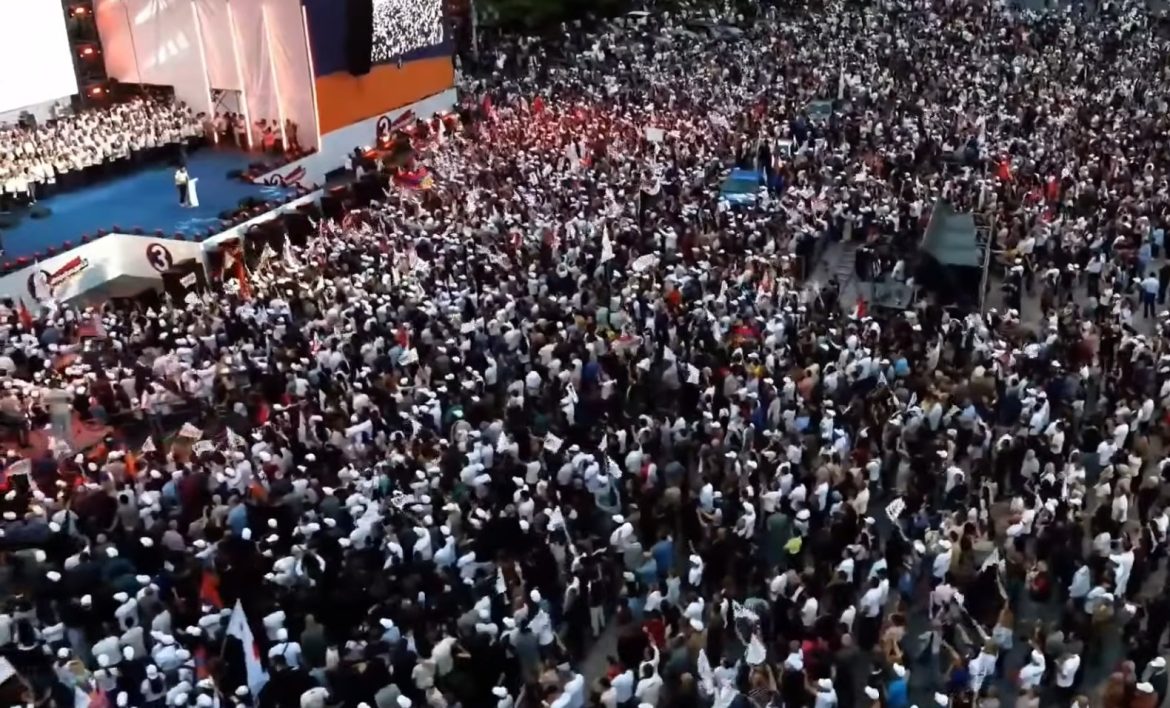
Strong Armenia delivered a similar message during a major rally in Republic Square, where tens of thousands gathered after a march through Yerevan. Narek Karapetyan, the bloc’s lead candidate and nephew of businessman Samvel Karapetyan, framed the election as a choice between continued weakness and national renewal. He warned that another Pashinyan term could open the door to dangerous concessions, including the possible resettlement of Azerbaijanis in Armenia. “Anyone who wants to live together with Azerbaijanis can vote for Civil Contract,” he told the crowd. “Anyone who wants to keep the last Armenian land — 10% of our homeland — Armenian, should vote for Strong Armenia.”
The size and energy of the opposition rallies have demonstrated that public dissatisfaction with Pashinyan’s rule has reached a critical point. Strong Armenia, the Armenia Alliance, Prosperous Armenia, and other opposition forces are now campaigning in an environment where the ruling party faces unprecedented criticism from multiple directions: national security, Artsakh, relations with Russia, dependence on Turkey and Azerbaijan, economic vulnerability, church-state confrontation, and the use of law enforcement against political opponents.
The final days before the election have therefore exposed the central contradiction of Pashinyan’s campaign. He presents himself as the guarantor of democracy and peace, while his government presides over mass arrests of opposition supporters, raids on campaign offices, selective prosecutions, unpunished violence against government critics, pressure on public-sector employees, and deepening foreign dependence. He speaks of sovereignty while seeking political legitimacy through gestures from Ankara and reassurance from Moscow. He promises economic stability while Armenian exporters face the consequences of a collapsing foreign-policy balance.
June 7 will not merely decide the distribution of seats in Armenia’s next parliament. It will determine whether the Armenian people accept another term of territorial retreat, political persecution, and foreign dependency — or whether they use the ballot box to begin restoring national dignity, state sovereignty, and accountability after years of defeat and humiliation.
For Armenia’s opposition, the message has become clear: the country cannot survive another cycle of excuses, concessions, and repression. The final decision now rests with the Armenian voter.