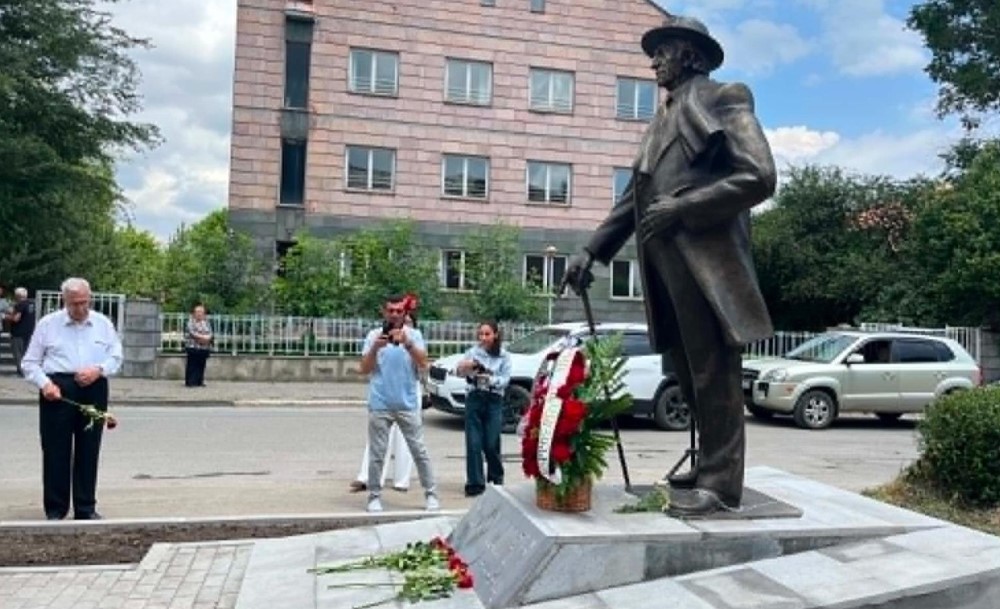
A statue honoring prominent Armenian revolutionary, statesman and intellectual Karo Sasuni was unveiled at the intersection of Proshyan and Garegin Nzhdeh streets in Gyumri.
Sasuni was a public and political figure, lawyer and historian who played an important role in Armenia’s national liberation movement. He was elected to the parliament of the First Republic of Armenia in 1919 and appointed governor of the Alexandropol province in 1920.
During the critical years of 1914 and 1915, Sasuni participated in efforts to protect the Armenian population. He also took part in the battle at the Dashtadem Fortress near Talin, which contributed to the conditions that made the Armenian victory at Sardarabad possible.
As governor of Shirak, Sasuni became known for his uncompromising campaign against corruption. Inga Avagyan, director of the Kumayri Historical and Cultural Museum-Reserve, said Sasuni quickly confronted bribery by holding both those who offered bribes and those who accepted them accountable.
The 2.4-meter bronze statue was created by sculptor Misak Melkonyan. According to the sculptor, its details carry symbolic meaning: Sasuni’s pipe represents thought and reflection, the necklace symbolizes freedom, and his extended index finger reflects his authority as a state official.
The monument was made possible through the support of benefactors Ashot Nersisyan, president of the Zoravar Sepuh public organization, and Ivan Altahjian.
Speaking at the ceremony, Hamazkayin Central Executive member Artashes Shahbazyan described the unveiling as an event of national significance. He noted that Sasuni devoted more than two decades to the Armenian liberation struggle, participated in state-building and military efforts, and later dedicated his work in the Diaspora to the preservation and advancement of the Armenian people.
Tigran Jimbashyan, one of Sasuni’s former students, also attended the ceremony. He recalled Sasuni as a respected teacher of Armenian literature and the history of the Armenian liberation movement, as well as a leader who enjoyed respect among Kurdish communities and authored a work on Armenian-Kurdish relations.