By Levon Baronian
Christ is Risen, Blessed is the Resurrection of Christ
This ancient Armenian greeting, proclaimed on Easter morning, is not simply a ritual exchange. It is a declaration about the nature of existence itself. It affirms that death is not final, that what is buried is not lost, and that light returns.
In this sense, Armenia can be understood as the national manifestation of the central theme of resurrection, just as Christ is its human expression.
This is not a theological substitution, but a structural truth. Christianity presents, in the person of Christ, the pattern of persecution, death, burial, and resurrection. Armenia, across centuries, has embodied that same pattern at the level of a nation. What is revealed in Christ as a path for humanity has been lived by Armenia as a historical reality.
Christ was persecuted for the truth He revealed. He was rejected, condemned, and executed not for weakness, but for the clarity of what He represented. That same structure appears in the Armenian experience. Armenia has not simply suffered misfortune. It has been targeted repeatedly for what it is and what it represents. A people shaped by identity, faith, and continuity has faced not only conquest, but sustained attempts at erasure.
Armenia does not merely believe in resurrection. It enacts it.
This is why Armenian history cannot be read as a simple sequence of rise and decline. Again and again, Armenia has entered conditions that, by all ordinary standards, should have marked its end. Kingdoms have fallen, sovereignty has been lost, the population has been scattered, and the nation has stood at the edge of disappearance. The catastrophe of the Armenian Genocide represents the most extreme form of this pattern, an attempt not only to defeat a people, but to erase them entirely.
Yet Armenia remains.
Not as an accident of survival, but as the continuation of a deeper pattern. A nation repeatedly persecuted, repeatedly brought to the point of death, repeatedly buried, and repeatedly returning.
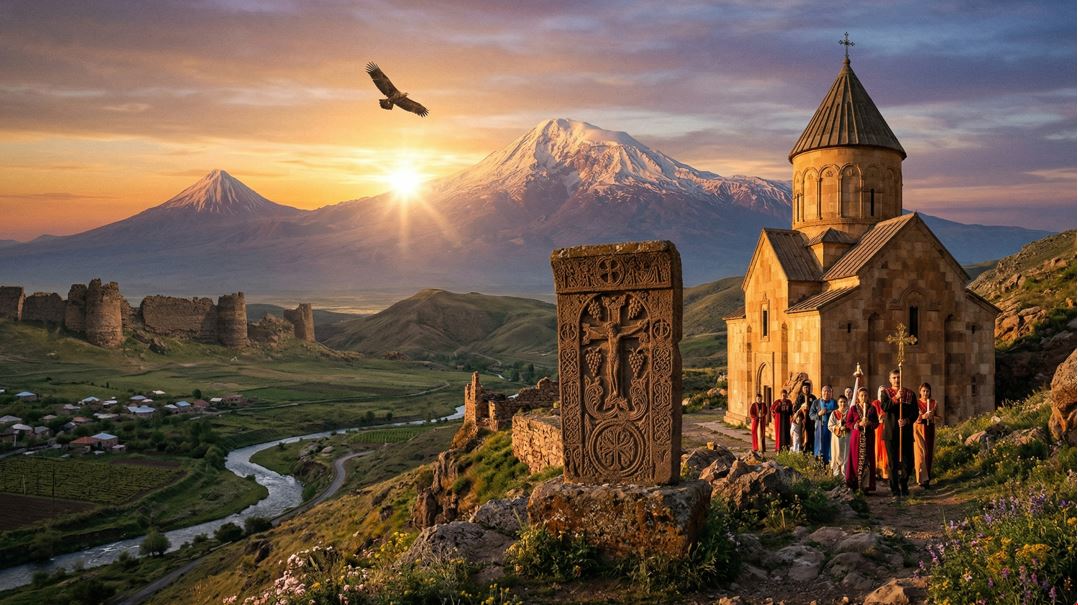
To understand why, one must begin not with politics, but with Armenian consciousness itself. The word arev means sun, but the root “Ar” appears across fundamental terms: aryun (blood), ara-rel (to create), arvest (art), ardar (just), artziv (eagle). These are not isolated coincidences. They form a coherent field of meaning centered on life, creation, elevation, and order. The implication is clear. Armenian thought has long been structured around the primacy of light as both a physical and metaphysical principle.
The symbols reinforce this unity. The artziv, the eagle, is the king of the skies, rising above and seeing from the heights. The aryuts, the lion, is the king of the earth, strength and sovereignty grounded below. Between sky and earth, vision and force, the same root persists. The same principle manifests at every level.
In such a framework, to be a people of “Ar” is to be a people of light. Before Christianity, this was expressed outwardly, through recognition of the sun and cosmic order. With Christianity, it was brought inward and universalized. The proclamation that Christ is the light of the world did not introduce a foreign idea to Armenians. It revealed the highest form of something they already understood.
This is why Armenia was the first nation to adopt Christianity. It was not coincidence. It was recognition.
The structure of Easter itself preserves this continuity. At the First Council of Nicaea, the Church established that Easter would follow the first Sunday after the first full moon following the spring equinox, maintaining its connection to Passover and aligning it with the return of light. The feast moves because the truth it signifies is not confined to a single moment. It is a recurring pattern.
Armenia’s history reflects that same pattern with clarity and force. What Christianity declares as a path for humanity, Armenia has demonstrated as a path for nations. It stands as a national manifestation of resurrection, a civilizational witness that what is rooted in light is not extinguished by death.
The present moment must be understood within this same structure. Under Nikol Pashinyan, Armenia is undergoing a phase that corresponds to persecution and internal erosion. What is unfolding is not merely political miscalculation or strategic weakness, but the advancement of an ideology fundamentally at odds with the historical character of the Armenian nation. That ideology rests on the premise that Armenia must accept its condition, reconcile itself to defeat, and normalize a posture of submission to hostile powers. It frames capitulation as realism and surrender as prudence.
Such a worldview represents a break from the civilizational logic that has sustained Armenia across centuries. Armenia has never endured by accepting finality. It has never survived by internalizing defeat as destiny. Its continuity has depended precisely on the refusal to accept death as the end of its story. In this sense, the current trajectory does not simply weaken Armenia externally; it challenges the very principle by which Armenia has existed.
Christianity rejects death as final. It insists that what appears finished is not finished. The ideology now being advanced within Armenia does the opposite. It asks the nation to accept finality, to relinquish the expectation of return, and to redefine survival in terms of accommodation rather than renewal. It is, in essence, a call to accept a permanent diminishment.
This is why the present moment must be understood as a phase of death in the full sense of the pattern. Not only external pressure, but internal redefinition. Not only threat, but the risk of forgetting what has historically made Armenia capable of returning.
Yet the pattern itself provides the answer. Armenia has entered such phases before. Each time, they have appeared conclusive. Each time, they have not been. The deeper structure has reasserted itself.
Persecution is followed by death.
Death is followed by burial.
And burial is followed by resurrection.
Armenia is not exempt from this sequence. It moves through it.
This brings the argument back to its beginning.
“Christ is Risen, Blessed is the Resurrection of Christ.”
For Armenians, this is not only a proclamation of faith. It is a recognition of their own historical role. As Christ reveals the path of resurrection to humanity, Armenia reflects that same path to nations.
Armenia is persecuted.
Armenia is brought to death.
Armenia is buried.
And Armenia rises again.
Not once, but again and again.
That is why Easter, for Armenians, is not only remembered.
It is lived.