By Levon Baronian
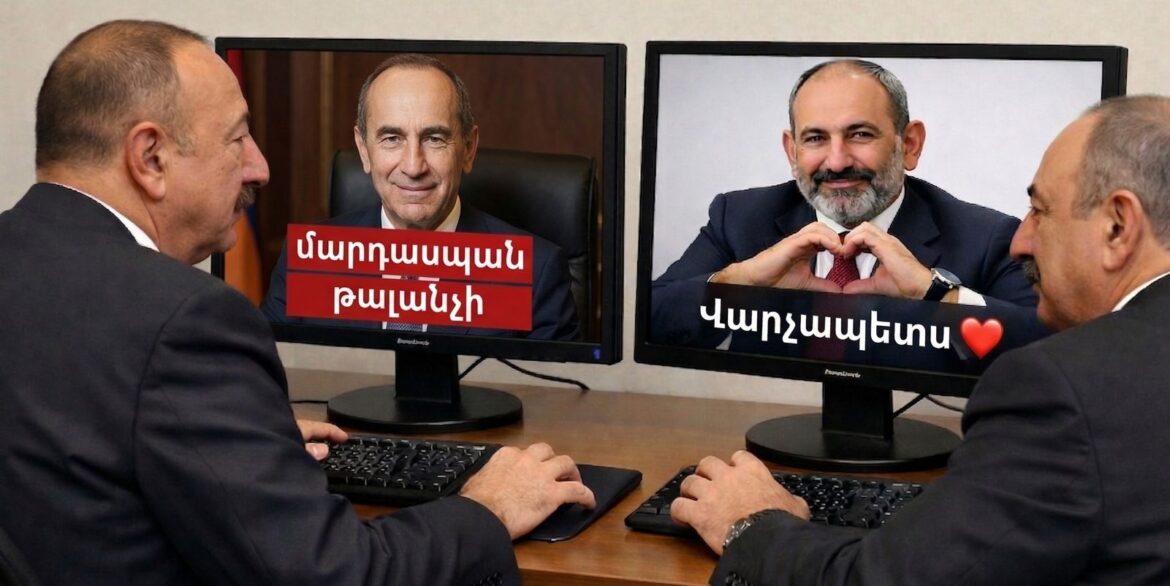
In recent years, Armenian social media, especially Facebook and Instagram, has been flooded with accounts claiming to represent “ordinary Armenians” while aggressively pushing political narratives. One pattern stands out more than anything else: the constant, repetitive, and often fact-free hostility directed at former President Robert Kocharyan.
At first glance, this can look like normal political disagreement. But when you take a closer look, the pattern starts to raise serious questions.
There is already documented precedent showing that hostile actors operate inside Armenian-language information spaces. Social media platforms themselves have exposed coordinated networks originating from Azerbaijan that used fake accounts, multilingual content, and deceptive identities to influence public perception. In its April 2021 report, Meta detailed the removal of such a network, noting that it operated across Facebook and Instagram, used fake personas, and posted in Armenian alongside other languages: https://about.fb.com/wp-content/uploads/2021/05/April-2021-CIB-Report.pdf
These efforts were not limited to attacking Armenia from the outside. They were designed to shape narratives within Armenian discourse itself.
There is also a historical layer that is often overlooked. During the Soviet period, large Azerbaijani populations lived inside Armenia. By 1979, more than 160,000 Azerbaijanis resided in the Armenian SSR, making up over 5 percent of the population. This is documented here: https://en.wikipedia.org/wiki/Azerbaijanis_in_Armenia
That reality means tens of thousands of people had direct familiarity with Armenian society, and in many cases, the Armenian language.
At the same time, there is clear evidence that Armenian language instruction exists in Azerbaijan today, including among state-linked professionals. Reports indicate that government employees, journalists, and others have studied Armenian, especially after the 2020 war: https://jam-news.net/why-is-azerbaijani-language-taught-in-nagorno-karabakh-and-armenian-in-azerbaijan/
The goal is not cultural exchange. It is understanding and engaging Armenian discourse.
Put these pieces together and one thing becomes clear. The capability to operate convincingly in Armenian-language environments is there.
Now look again at what is happening online.
Accounts that aggressively attack Kocharyan tend to behave in very similar ways. They recycle the same talking points, avoid real discussion, and show up in waves under political posts, often repeating identical phrases. Many present themselves as Armenian, yet their language, tone, or cultural references sometimes feel off when you look more closely.
This does not feel like normal political debate. It feels like messaging.
And the content of that messaging is just as revealing.
Take the constant claim that Kocharyan “robbed the country” or “stole billions.” These statements are presented as unquestioned fact, yet after years of investigations following 2018, there is still no final court ruling that substantiates such sweeping accusations. The claim survives not because it has been proven, but because it is endlessly repeated.
Another accusation that appears frequently online is that Kocharyan was behind the Armenian Parliament shooting. It is often stated bluntly, as if it were settled truth. In reality, no credible evidence or judicial finding has ever proven such a claim. If anything, the events of October 27 destabilized the country at a time when Kocharyan, as president, had the most to lose. Key figures were eliminated, the political system was shaken, and the burden of maintaining stability fell directly on him. The fact that the state held together afterward is often attributed to his ability to manage that crisis.
The same pattern appears in discussions of the March 1 protests. Online narratives tend to reduce a complicated and tense political situation into a simple slogan blaming Kocharyan alone. What is often left out is the role of opposition leaders at the time, including Nikol Pashinyan, who was actively mobilizing crowds and escalating tensions. Ignoring that context makes the story cleaner, but not more accurate.
Then there is the claim that Kocharyan “sold out” Armenia or “gave everything away.” This, too, clashes with the record of his presidency, a period marked by economic growth, infrastructure development, and a relatively stable security environment compared to what followed. Yet that context is usually absent from online discussions.
Just as important as what is being said is how it is being said. These accusations rarely come with sources, data, or even basic argumentation. Instead, they appear as repeated slogans, often copied word-for-word across multiple accounts. That kind of repetition does not suggest independent thinking. It suggests coordination.
And coordination is all that is needed.
Disinformation does not have to be sophisticated. It just has to be loud and consistent enough to create the impression that “everyone is saying the same thing.”
This brings us back to the central question. No one is claiming that every critical voice is fake. Armenians have different views, as they should. The real question is whether a meaningful portion of this online activity is being amplified or shaped by actors who are not genuine participants in Armenian political life.
Given what is already known about Azerbaijani-linked influence operations, Armenian language capabilities within Azerbaijan, and the historical familiarity many Azerbaijanis have had with Armenian society, it is not a stretch to see how this could be happening.
In fact, it would be surprising if it were not.
The logic is straightforward. Figures like Kocharyan are associated with a stronger, more assertive Armenian state posture. Undermining them weakens that position. At the same time, flooding the information space with hostility, division, and simplified narratives makes it harder for society to think clearly about its choices.
You do not need to control the conversation. You just need to distort it.
That is exactly what this begins to look like.
The danger here is not only political. It is informational. When people can no longer tell whether they are arguing with fellow citizens or with manufactured voices, the foundation of public discourse itself starts to erode.
And in that environment, Armenians may find themselves debating not just each other, but narratives that were never truly theirs to begin with.