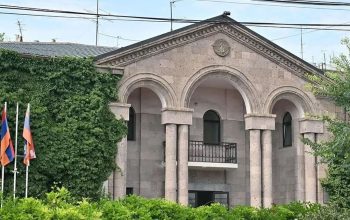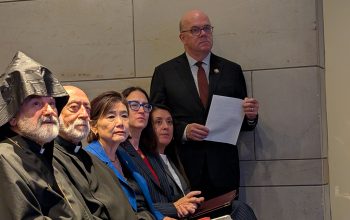
Azerbaijan has opened another front in its campaign to recast the Armenian heritage of Artsakh, this time bringing dozens of foreign diplomats to Gandzasar and Dadivank while presenting the medieval Armenian monasteries as part of the heritage of ancient Caucasian Albania.
During the September 11-12 Azerbaijani-organized tour of Artsakh, presidential aide Hikmet Hajiyev presented Gandzasar to visiting diplomats as “Caucasian Albanian” rather than Armenian. At the former Gandzasar branch of the Matenadaran, he also displayed Armenian manuscript reproductions and pointed to their blank pages in an attempt to ridicule Armenian historical claims.
The Matenadaran quickly dismantled that presentation. Director Ara Khzmalyan explained that the volumes left at Gandzasar were museum reproductions, not original manuscripts. Only selected illustrated pages had been reproduced because the books were created for exhibition. The Armenian originals remain preserved in Yerevan.
The historical question itself is hardly ambiguous. Gandzasar’s Armenian inscriptions, manuscripts, architecture and documented medieval history long predate the present political dispute. What unfolded in September was therefore not simply an academic disagreement between two competing interpretations, but a dispute over how Armenian cultural heritage in depopulated Artsakh is being presented to the outside world.
Yet the Armenian government initially offered no comparable political response.
As criticism spread in Armenia, neither the Foreign Ministry nor other major government institutions had publicly challenged Hajiyev’s presentation by September 13.
Instead, the most direct rebuttal came from the Matenadaran.
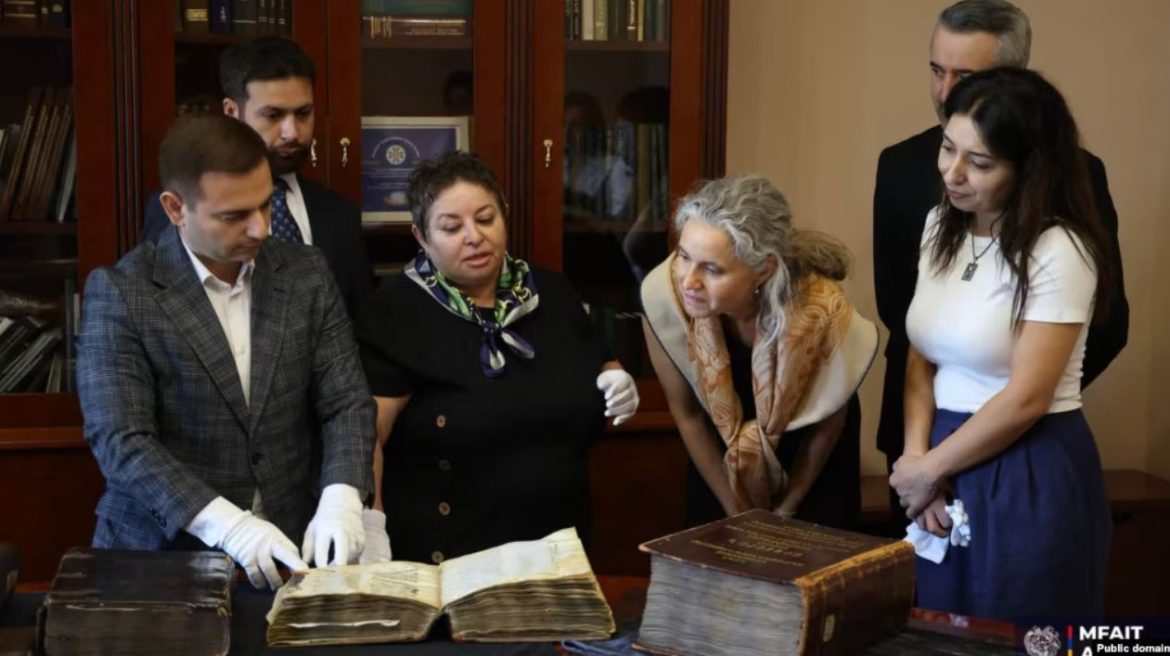
When EU Special Representative Magdalena Grono, who had participated in the Azerbaijani-organized visit, came to the Matenadaran in Yerevan on September 14, she was shown the original Armenian manuscripts and the reproductions that had been displayed at Gandzasar. The Matenadaran emphasized that the originals had never been exhibited at Gandzasar and remain safely preserved in its collection.
Grono subsequently stated that she did not dispute the historical Armenian presence and “rich footprint” in Artsakh and said Armenian cultural heritage should be preserved. Her clarification followed criticism of her earlier characterization of the controversy as involving “deeply diverging views and narratives” regarding the origin of cultural sites.
The Armenian government, however, continued to treat the episode primarily through the prism of its negotiations with Azerbaijan.
Foreign Minister Ararat Mirzoyan was asked on September 15 why his ministry had not issued a statement. He replied that the necessary steps had been taken and pointed to the Matenadaran as the more specialized institution. Mirzoyan said the government was satisfied with the Matenadaran’s response and with Grono’s subsequent visit there.
The following day, Security Council Secretary Alen Simonyan disclosed that he had spoken privately with Hajiyev after the Gandzasar episode. Simonyan said the two officials remain in frequent contact, speaking roughly every two days, and that he had expressed concern that such incidents should not interfere with the Armenia-Azerbaijan process.
His explanation of why he had avoided a sharper public response was revealing.
Simonyan said he could make a forceful statement that would make Armenians “feel good for 15 minutes,” but that doing so could damage negotiations. Asked whether he had directly told Hajiyev that Gandzasar is Armenian, Simonyan rejected framing the discussion in terms of determining which side was right, saying that Armenia and Azerbaijan have different perspectives and that his task was to prevent those perspectives from colliding.
Prime Minister Nikol Pashinyan finally addressed the controversy publicly on September 16, after being challenged in parliament to state directly that Gandzasar is Armenian.
Pashinyan called Hajiyev’s conduct “unacceptable and incomprehensible,” but he did not use the occasion to mount a broader political challenge to Azerbaijan’s attempt to redefine the monastery. Instead, he referred lawmakers to the Matenadaran director’s explanation, said the Armenian origin of Gandzasar had already been established through the appropriate specialist and described further discussion of the issue as essentially pointless.
He then returned to the same theme emphasized by other members of his government: peace must be handled carefully.
Pashinyan argued that peace could easily be destroyed and that rebuilding it could take decades. The government’s approach throughout the controversy therefore remained consistent. The historical rebuttal was left largely to scholars and cultural institutions, while Armenia’s political leadership avoided turning Azerbaijan’s claims over Gandzasar into a direct interstate confrontation.
That distinction matters.
The dispute is taking place after the September 2023 Azerbaijani offensive that resulted in the displacement of Artsakh’s Armenian population. The churches, monasteries, cemeteries, inscriptions and other monuments they maintained for generations now stand without that Armenian community around them.
Under those circumstances, the battle over terminology is not abstract.
When Armenian inscriptions are described as falsifications, Armenian monasteries are relabeled as Caucasian Albanian, and foreign diplomats are brought to the sites while Azerbaijani officials present that interpretation, the international understanding of Artsakh’s history is itself being contested.
The Matenadaran answered the historical claims with evidence.
The Armenian government chose a different priority: limiting the political confrontation and protecting its negotiations with Baku.
The events at Gandzasar have made that choice unusually visible.