By William Paparian
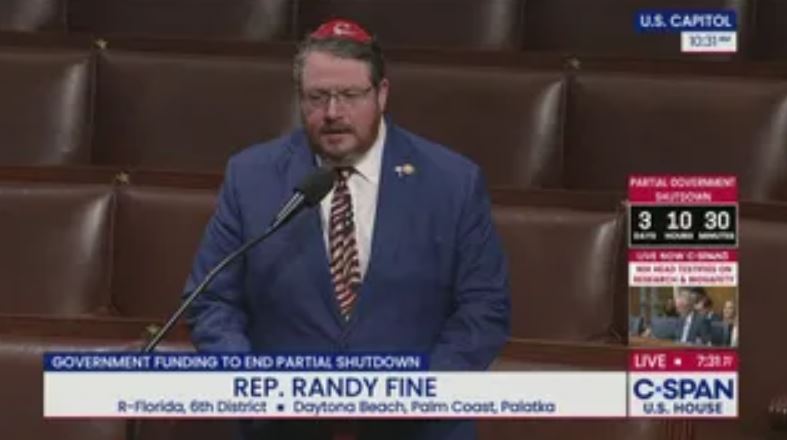
Last week, U.S. Rep. Randy Fine (R-FL) appeared on The Jenny Beth Show and delivered a remark that should shock every American who believes in equality and public service. While attacking his Armenian-American primary challenger, Dan Bilzerian, Fine declared: “We don’t want Armenians to be able to serve in Congress. But I’m not gonna lose too much sleep about it.”
The comment did not come in a vacuum. Fine, a vocal supporter of Israel and a cosponsor of H.R. 6534—the bill to repeal Section 907 of the 1992 FREEDOM Support Act and greenlight unrestricted U.S. arms and aid to Azerbaijan—framed his attack as concern over antisemitism and dual citizenship. Yet by generalizing from one candidate to an entire ethnic community, he crossed into outright ethnic exclusion.
For Armenian Americans, the words landed like a gut punch. They echo a century of discrimination we were told America had outgrown—yet they also stand in stark contrast to the extraordinary loyalty our community has shown this nation in its hour of need.
Consider Fresno, California, where my family and thousands of other Armenian Americans trace our roots. In 1922, my late mother Serpouhi arrived in Fresno at age 7 with her parents and older brother and sister, survivors seeking refuge after the Armenian Genocide. The whole family worked in the canneries.
They faced the same barriers so many others did: racially restrictive covenants in property deeds that explicitly barred “Armenian, Asiatic or native of the Turkish Empire” from owning or occupying homes in neighborhoods like Fig Garden. Businesses posted signs reading “No Armenians Allowed” or the cruder “No Dogs or Armenians.” In the streets and schools, we were called “Fresno Indians” or “Dirty Black Armenians”—slurs that reduced us to perpetual foreigners despite our contributions to California agriculture.
This was not ancient history. Those covenants lingered into the 1950s. Yet just 22 years after my mother’s arrival, she was a Red Cross volunteer during World War II. While visiting a stateside military hospital to cheer up wounded servicemen, she met my late father, who had been wounded in action serving with the 22nd Marine Regiment in the Marshall Islands. Their meeting was only possible because of the war effort that brought so many Armenian Americans into uniform.
And they were far from alone. After Pearl Harbor, Armenian Americans answered the call in remarkable numbers. Out of a U.S. Armenian-American population of roughly 200,000 in the early 1940s, approximately 18,500 served in the armed forces.
Fresno’s own Victor “Transport” Maghakian reenlisted just weeks after the attack and became one of the most decorated Marines of the war, earning the Navy Cross for heroism on Makin Island and fighting through seven major Pacific campaigns despite multiple wounds. Heroes like Ernest H. Dervishian earned the Medal of Honor in Italy, and Harry Kizirian became one of the most decorated Marines on Okinawa.
These men and women did not serve to “prove” their Americanness to bigots. They served because it was their country too. Their sacrifice helped erode the very barriers that had confined their parents and grandparents. By the postwar decades, the covenants were struck down, the signs came down, and Fresno’s Armenian community moved from the margins into the mainstream of American life.
That is why Rep. Fine’s remark strikes such a raw nerve today. It revives the language of exclusion—telling an entire ethnic group they are unwelcome in the institutions their fathers bled to defend. It does so in service of a foreign-policy disagreement: Fine’s push to arm Azerbaijan after its 2023 military operation in Nagorno-Karabakh, which drove out more than 100,000 ethnic Armenians amid credible reports of ethnic cleansing. Armenian Americans see the pattern: old slurs dressed up in new geopolitical clothing.
America has never been perfect. We have confronted worse bigotry—against Japanese Americans interned during the very war our fathers fought, against Black Americans denied the vote, against every wave of immigrants told they didn’t belong. What defines us is the choice to reject that past, not repeat it.
Congressman Fine owes the Armenian-American community—and every American who values merit over ancestry—an immediate and unqualified apology. More than that, he should reflect on the history he invoked, however unwittingly.
The sons and daughters of Fresno’s canneries and raisin fields did not ask for permission to serve. They simply did—on the battlefields of the Pacific and Europe, and later in boardrooms, classrooms, and yes, public office.
We will continue to do so. No single congressman’s rant will change that. The covenant of American citizenship is written in shared sacrifice, not in the prejudices of the past. Armenian Americans have upheld our end of that covenant for generations. It is time our elected leaders upheld theirs.
Former Pasadena Mayor William Paparian is a Los Angeles County Deputy District Attorney and a Captain (CA) Judge Advocate with the California State Guard. The views expressed are his own and not those of the Los Angeles District Attorney’s Office or the California Military Department.