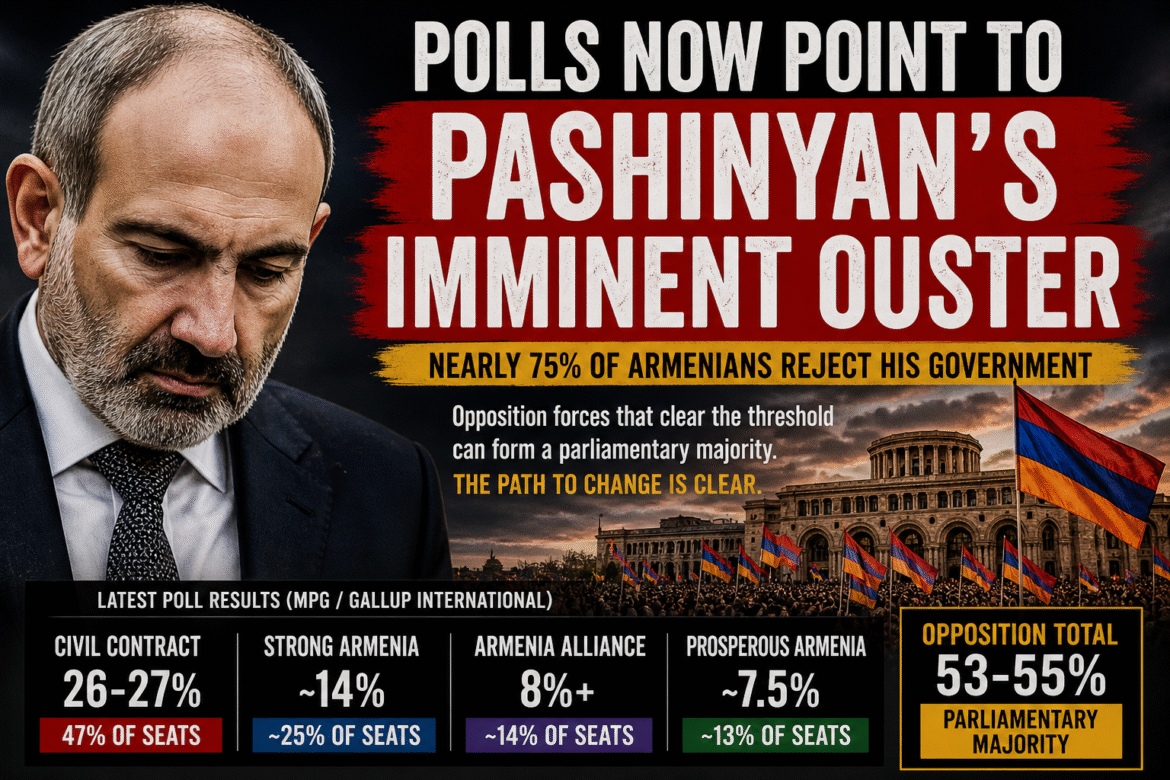
For the first time since 2018, credible polling data now points to a realistic and achievable outcome: the ouster of Prime Minister Nikol Pashinyan from power through the ballot box.
The latest survey by Gallup International Association’s Armenian partner (MPG) does more than show a weakened government. It confirms that the political foundation sustaining Pashinyan has eroded to the point where his removal is now within reach.
The most telling figure is this. Pashinyan’s Civil Contract commands only 26 to 27 percent support. In plain terms, nearly three out of every four Armenian voters do not support the current government. For a sitting administration, this is not simply a decline. It is a collapse of governing legitimacy.
Supporters of the ruling party may point to its position at the top of a fragmented field. That framing ignores the central political reality. Armenia does not form governments based on who finishes first. It forms governments based on who commands a majority in parliament. By that standard, the numbers now point decisively away from Civil Contract.
The same poll places the Strong Armenia alliance at approximately 14 percent, the Armenia Alliance at just over 8 percent, and Prosperous Armenia at roughly 7.5 percent. Individually, these forces trail the ruling party. Together, they surpass it. Under Armenia’s electoral system, that is what determines power.
When the votes of parties that fail to meet the threshold are excluded, as required in seat allocation, Civil Contract’s share translates to roughly 47 percent of parliament. This is well short of a governing majority. The combined opposition reaches approximately 53 to 55 percent, enough to form a government.
This is not speculation. It is the direct mathematical implication of the current polling.
What makes this moment unprecedented is not only the weakness of the ruling party, but the broader shift in the electorate. In previous polling cycles following the 2021 elections, when Civil Contract secured a commanding majority, no credible data suggested that Pashinyan could be removed through elections. Even as his support declined, the opposition remained too fragmented to convert dissatisfaction into power.
That condition no longer exists.
The pool of undecided and disengaged voters has shrunk significantly in recent months. This shift has not benefited the ruling party. Instead, it has strengthened multiple opposition forces at the same time, creating for the first time a coalition-capable majority in the electorate.
The political meaning of this shift is clear. A government supported by barely a quarter of voters cannot sustain itself in a system where a unified opposition holds a parliamentary majority. The only remaining question is whether that majority will act with the unity required to govern.
If the opposition forces currently above threshold coordinate following the election, as political logic and public expectation increasingly demand, the numbers now support a decisive outcome. The removal of Pashinyan from power is within reach.
The narrative of inevitability that once surrounded the current government has been broken. In its place, a new reality has emerged, defined by momentum, consolidation, and a clear path to change.
For the first time in years, the data does not point to continuity. It points to ouster.