By Levon Baronian
Armenia’s upcoming parliamentary elections are often discussed as if the opposition must first unite into a single bloc before it can seriously challenge the current government. That assumption sounds logical on paper, but it does not reflect how political power is actually formed in Armenia.
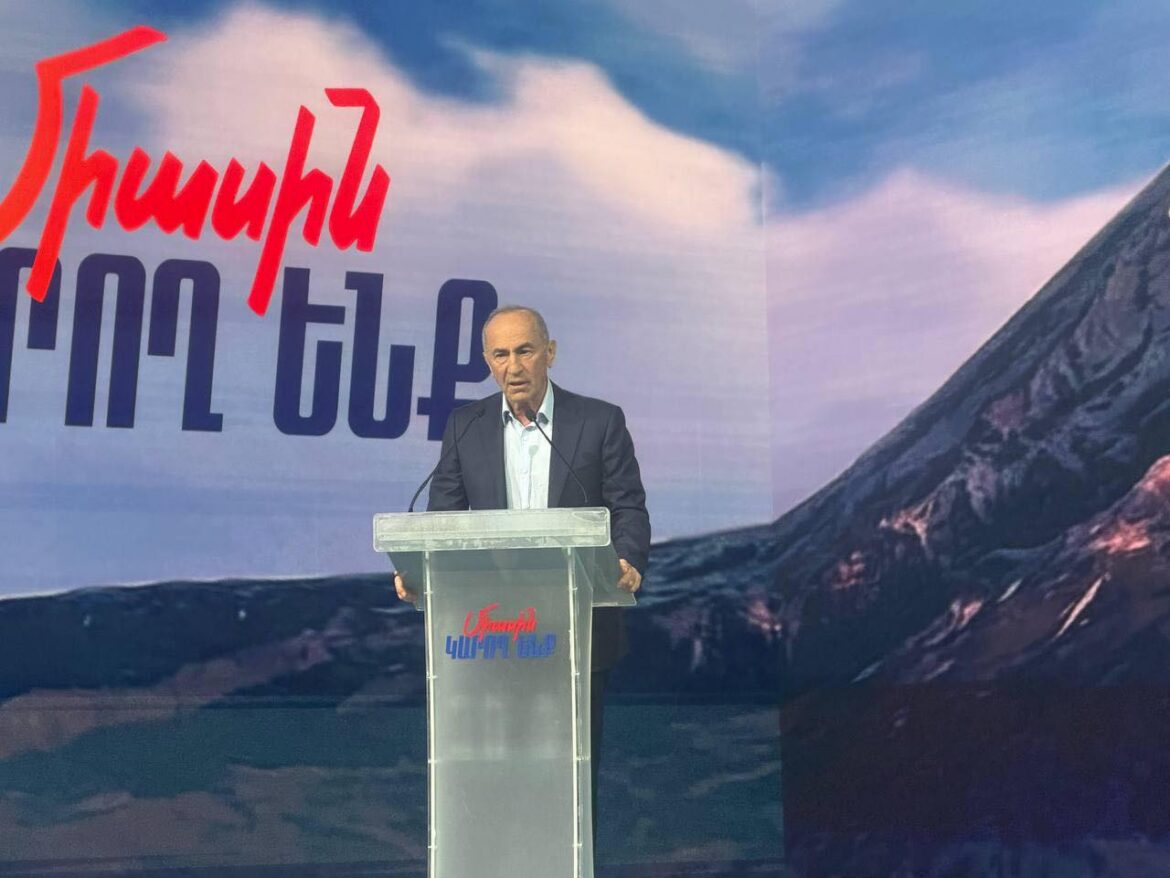
The reality is more straightforward. Armenia already has a viable candidate for prime minister and a political force capable of supporting him: Robert Kocharyan, backed by the Armenian Revolutionary Federation within the Hayastan Alliance.
Kocharyan is not a theoretical option. He leads the most organized and electorally proven opposition force in the country. He has already demonstrated that he can mobilize voters across Armenia, maintain a disciplined base, and operate a functioning political structure. In a fragmented environment, those factors matter more than slogans or temporary momentum.
His position is strengthened by the role of the Armenian Revolutionary Federation. The ARF is not just another party in the field. It is an institution with deep roots, a defined worldview, and a global presence that no other Armenian political force can match. It brings structure, continuity, and experienced cadres who understand how to translate political support into governance.
That combination is what separates a viable governing alternative from a collection of opposition voices.
Much of the public discourse still relies on a simplified narrative that groups all pre-2018 leadership into a single category. This ignores the obvious reality that Kocharyan and Serzh Sargsyan are not part of a unified political camp. They are rivals with different constituencies and different records. Treating them as one indistinguishable “old system” avoids a serious discussion about actual leadership options.
It also distracts from the real question, which is not who fits into a past label, but who has the capacity to govern now.
There is also a persistent claim that the opposition must fully merge before the election in order to win. That claim misunderstands the nature of Armenian politics. Multiple opposition forces can and likely will run separately. What matters is what happens after the vote. A governing majority is formed through alignment, not branding. Parties that compete independently can still come together around a common direction once the results are clear.
In that process, Kocharyan’s role is not to eliminate other opposition actors. It is to serve as the central point around which a governing coalition can form. With his existing base and the institutional support of the ARF, he is the only figure currently positioned to do that.
At the same time, the ruling Civil Contract continues to rely on the perception that its position is secure. That perception does not match the broader political mood. A large share of the electorate remains undecided or disengaged, and public frustration continues to grow. This is not the environment of a confident government. It is the environment of a system that is shifting.
Recent developments have only reinforced that shift. Public behavior, tone, and repeated missteps have widened the gap between the leadership and the public. These are not isolated incidents. They reflect a deeper problem that voters increasingly recognize.
In this context, elections are not decided by who appears strongest in a narrow snapshot. They are decided by who is prepared to take responsibility for governing.
That brings the discussion back to a simple conclusion.
Among all current figures, Kocharyan, supported by the ARF and allied forces, offers the clearest combination of experience, structure, and readiness to govern. Others may play a role in shaping the opposition landscape, but none currently present the same level of organizational and political capacity.
The choice facing Armenia is not between stability and uncertainty. It is between a government that has lost the confidence of many and an opposition that already has a viable center.
That center exists.
It is Kocharyan, supported by the institutional strength of the ARF.