Two separate incidents in recent days involving National Assembly Speaker Alen Simonian and Prime Minister Nikol Pashinyan have once again exposed the growing anger boiling inside Armenia. One unfolded outside parliament during a protest by relatives of missing soldiers. The other took place inside Saint Anna Church on Palm Sunday. Together, they paint a picture of a government increasingly surrounded not by public trust, but by public resentment.
The first incident occurred on March 26 on a street adjacent to the parliament building. It happened during a protest by relatives of soldiers missing from the 2020 Artsakh war, who have been demanding the publication of the findings of a parliamentary committee report on the war that was reportedly completed in 2025 but has still not been made public. According to committee chairman Andranik Kocharian, the report’s release was blocked by Simonian.
During the protest, a verbal altercation broke out between Simonian and activists Mikael Markarian and Arsen Vardanian, a member of the little-known Pan-Armenian Front party. Video from a live broadcast on Markarian’s Facebook page showed a heated exchange after Simonian refused to speak with the activist. Both sides used offensive language and accused the other of initiating the confrontation.
Markarian and Vardanian were initially detained by police for allegedly failing to comply with a lawful police demand, though they were later released after being fined administratively. Armenia’s Investigative Committee later announced that Markarian had also been charged in a criminal case with hooliganism involving the use of information or communication technologies. He was detained again on Friday. The charge carries a possible penalty ranging from a fine to up to five years in prison.
Speaking afterward, Simonian claimed the confrontation had been a provocation organized by a “political unit.” He suggested that as elections approach, such incidents will only increase. He said he knew who was behind it and where it was being directed from, though he declined to name anyone. At the same time, he attempted to separate the protesting parents and relatives of fallen or missing soldiers from what he described as political activists trying to manipulate their pain for political purposes.
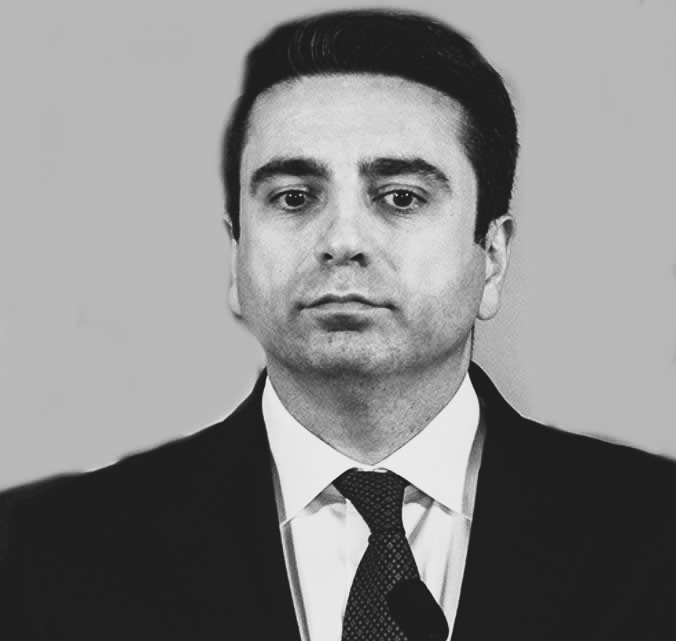
But Simonian’s effort to cast himself as the victim comes against the backdrop of his own long record of disgraceful public conduct. In 2023, he ordered his bodyguards to overpower a man who heckled him in central Yerevan and then spat in the man’s face after being called a traitor. In 2024, he again directed his guards to intervene against a displaced Artsakh Armenian woman at Yerablur military cemetery, reportedly insulting her as a “garbage cat.” In November 2025, two opposition activists and podcasters were arrested after Simonian accused them of insulting him during a podcast. They too were charged with hooliganism, though they said they were merely responding to Simonian’s own offensive language.
This latest episode, therefore, cannot be viewed in isolation. It fits a clear pattern: a high-ranking official who behaves with arrogance and provocation, then seeks shelter behind law enforcement when the public reacts.
Just three days later, on March 29, another disturbing scene unfolded, this time inside Saint Anna Church during Palm Sunday services attended by Pashinyan and members of his entourage.
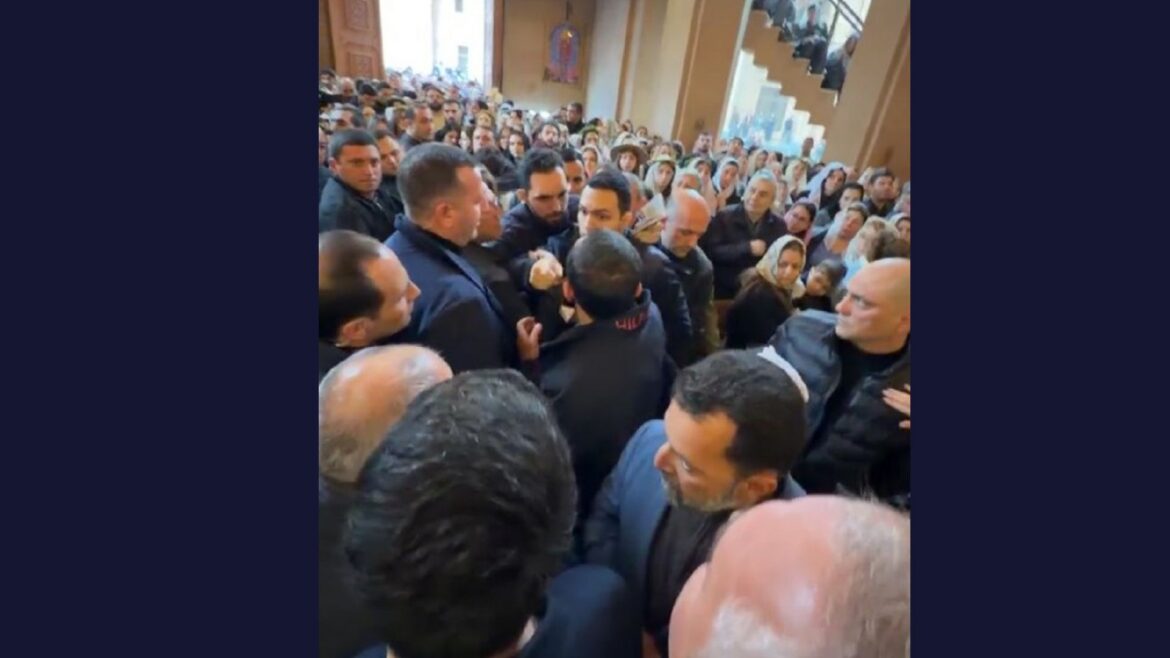
According to available reports, the tension began while Pashinyan was still inside the church. A young man in the crowd tried to move closer, shouting that he wanted to stand in the middle, as security personnel quickly moved to stop and pull him back. Moments later, the situation escalated further when the same individual allegedly attempted to strike the prime minister, prompting bodyguards to respond. Voices from the crowd could be heard calling for restraint, while Pashinyan himself repeatedly said, “Calm down.”
A second tense moment followed as Pashinyan and his team prepared to leave the church before the service had concluded. Security officers began clearing a path through the crowd, which only added to the irritation of those present. The same young man objected to being pushed and told Pashinyan, “Don’t look at me like that,” before again appearing to lunge toward him. Pashinyan reportedly signaled to his bodyguards not to react and again urged restraint.
The officials ultimately left without further escalation. But the deeper significance of the incident was unmistakable. This was not merely another security disturbance. It took place inside a church, on Palm Sunday, one of the most sacred days in the Armenian Apostolic Church calendar. That alone would have made it shocking. But in today’s Armenia, it also reflected something larger: the intensifying anger among many Armenians, especially believers, toward a prime minister who has repeatedly shown hostility toward the Armenian Church and the Catholicos.
Authorities later confirmed that two individuals were detained in connection with the church incident. Armenia’s Ministry of Internal Affairs said they were taken from the church courtyard on suspicion of hooliganism and interfering with the lawful official and political activities of a public official. The detentions reportedly took place about two hours after the incident.
These two confrontations, though different in setting and circumstance, are tied together by the same underlying reality. Armenia today is a country governed by officials who have lost moral authority in the eyes of large segments of the public. In such an atmosphere, confrontations are no longer rare. They are becoming routine.
What is most telling is not simply that these incidents happened, but where they happened and whom they involved. One occurred beside parliament, where families of missing soldiers were demanding truth. The other occurred in church, during a sacred service, where many Armenians seek solace from the very national collapse this government has overseen. In both cases, the presence of the authorities did not bring calm or respect. It brought tension, anger, and disorder.
This is the political climate Pashinyan’s rule has produced. A government that came to power promising dignity, justice, and national renewal has instead delivered defeat, division, repression, and humiliation. Today, even the most public and sacred spaces in Armenian life are becoming stages for the raw confrontation between an increasingly discredited regime and a wounded, bitter, and distrustful people.