Prime Minister Nikol Pashinyan’s disputed post-election mandate is already producing the consequences many warned about: Russian economic pressure, uncertainty over Armenia’s energy security, and a widening geopolitical struggle over the proposed U.S.-administered corridor through southern Armenia.
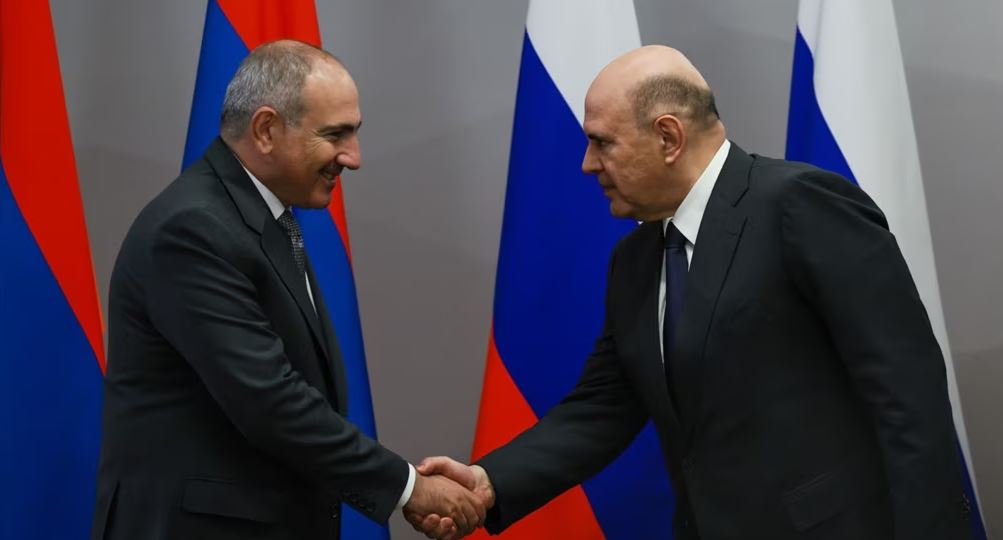
On Wednesday, Pashinyan telephoned Russian Prime Minister Mikhail Mishustin, just two days after downplaying the impact of Moscow’s trade restrictions on Armenia’s economy. Both governments described the conversation in vague diplomatic language, saying the two discussed trade, economic, scientific, technological, cultural, and humanitarian cooperation. The Russian side also noted that the call took place at Armenia’s initiative.
The official wording could not hide the real context. Russia has recently moved to block multimillion-dollar imports of Armenian agricultural products and beverages, citing sanitary grounds. The restrictions followed two European summits hosted by Yerevan in early May and came amid Moscow’s growing demands that Armenia choose between its declared European course and continued membership in the Russian-led Eurasian Economic Union.
Pashinyan had assured voters before the June 7 elections that Russia would quickly lift the restrictions if he remained in power. He also claimed he and Russian President Vladimir Putin would meet again in the second half of June. But after the vote, Pashinyan said no such meeting had ever been planned. Putin has not congratulated him on his claimed election victory, which Armenia’s opposition does not recognize.
The economic pressure is not theoretical. Armenian farmers and agribusinesses are already being hit by blocked exports, with growing cases of commercial farmers destroying produce they cannot sell abroad. Armenian agricultural exports to Russia have grown rapidly over the past 10 to 15 years and reportedly totaled more than $700 million last year, while Armenia’s overall exports to Russia reached nearly $3 billion, compared to $667 million in exports to EU member states.
At the same time, Armenia is facing a new threat over natural gas. Following Russian warnings that Moscow could sharply raise the price of gas supplied to Armenia, the Public Services Regulatory Commission moved Wednesday to block Gazprom Armenia from raising retail prices for domestic consumers until the end of 2026. Armenian households will continue paying up to 148 drams per cubic meter in the coming months.
The issue stems from a warning sent in late May by Russian Energy Minister Sergei Tsivilev, who said Armenia’s efforts to join the European Union do not correspond to the nature of the partnership between the two countries. Moscow has threatened to suspend or scrap a 2013 agreement exempting Russian natural gas, oil products, and diamonds purchased by Armenia from Russian export duties. That agreement has kept Armenia’s wholesale gas price far below international market levels.
Russian officials have made clear that they view Pashinyan’s foreign policy as hostile. State Duma Speaker Vyacheslav Volodin complained that Russia supplies gas to Armenia at what he called a quarter of the European price, citing $177.50 per thousand cubic meters for Armenia compared with $633 in Europe. Russia accounts for at least 80 percent of Armenia’s imported natural gas, which is used not only by households but also by power plants and key sectors such as agribusiness.
Rather than acknowledging the vulnerability created by this dependence, Pashinyan dismissed Russian threats during the campaign. He claimed Armenia would soon be flooded with “billions and trillions” of dollars through transport links and commercial ties with Turkey and Azerbaijan, and said the country could therefore afford higher gas prices.
That claim now collides with another major flashpoint: the so-called TRIPP project, the “Trump Route for International Peace and Prosperity,” a U.S.-administered transit route for Azerbaijan through Armenia along the Iranian border. Deputy Foreign Minister Mnatsakan Safarian said Wednesday that Russian involvement in the project is not on Yerevan’s agenda. According to him, the project is currently being discussed in an Armenia-U.S. format, not with Moscow.
Safarian was responding to Russian Deputy Foreign Minister Mikhail Galuzin, who reiterated Moscow’s desire to have a role in the route. Galuzin argued that Yerevan will have to take Russia’s opinion into account because Russian border guards remain deployed in the area and because Armenia remains a member of the Eurasian Economic Union.
The proposed corridor also remains a source of concern for Iran, which has repeatedly opposed arrangements that could alter the regional balance along its northern border. Galuzin said the prospects for implementing TRIPP remain uncertain partly because of Tehran’s opposition.
Taken together, these developments show the dangerous contradiction at the heart of Pashinyan’s policy. His government speaks of “sovereignty” while Armenia becomes more vulnerable to economic pressure, more dependent on outside rescue packages, and more exposed to great-power rivalry. It promises prosperity through Turkey and Azerbaijan while Armenian farmers lose the Russian market. It talks of European integration while Armenia’s gas supply, export economy, and southern border remain tied to hard realities that slogans cannot erase.
The Armenian public was told that Pashinyan’s reelection would bring stability. Instead, the immediate aftermath has brought Russian sanctions, threats to energy pricing, uncertainty over critical infrastructure, and a widening confrontation over Armenia’s strategic territory.
This is not a policy of balance. It is a policy of gambling with the Armenian state.