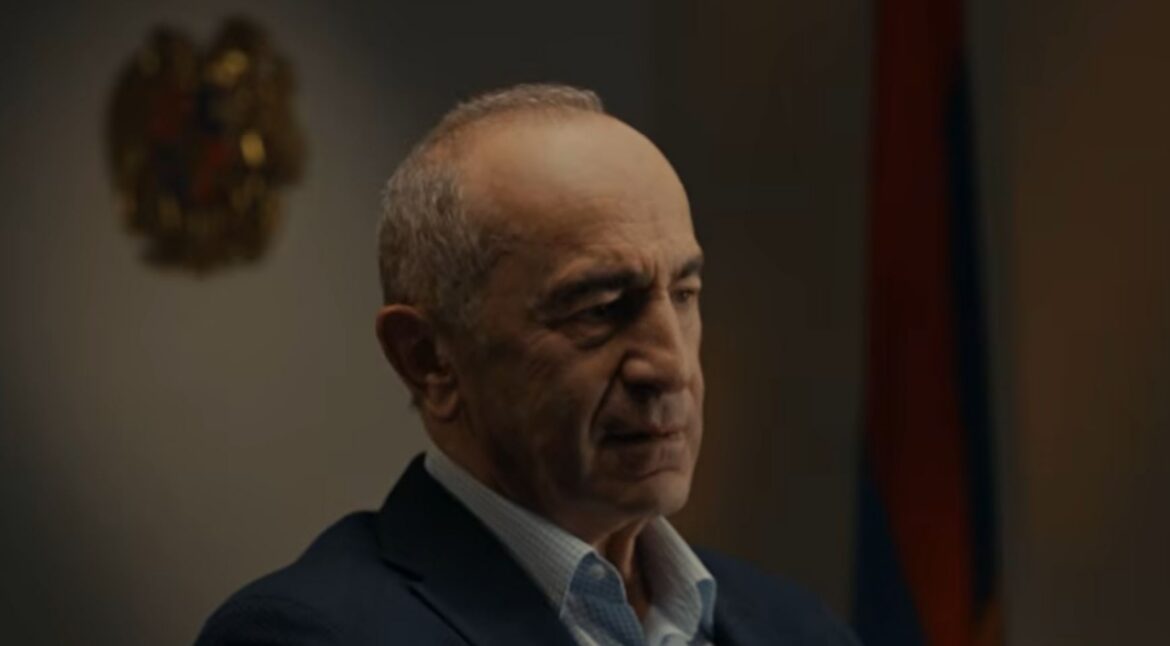
A new documentary film about Armenia’s second president, Robert Kocharyan, titled “Inchpes vor Kam” (As I Am) has debuted on YouTube, offering a detailed and deeply personal portrait of a man whose public image has for years been shaped not only by his record, but also by relentless political attacks, accusations, and deliberate distortions.
The film presents Kocharyan not as the caricature often promoted by his opponents, but as a statesman formed by Artsakh, war, family, discipline, and a profound sense of responsibility toward the Armenian people. Through interviews with family members, colleagues, attorneys, political allies, and Kocharyan himself, the documentary places his life and career within the broader story of modern Armenian statehood.
The film begins with Kocharyan’s understanding of homeland. He describes the homeland not as an abstract slogan, but as an emotional collection of memories: childhood, family, school, neighborhood, and the environment in which a person grows. From there, the documentary draws a distinction between the “small homeland” of one’s ancestral home and the “great homeland” of statehood and national responsibility. For Kocharyan, Artsakh and Armenia were never separate ideas, but parts of one national whole.
That theme runs throughout the film. Kocharyan’s childhood in Stepanakert, his traditional Armenian family, and the moral example of his parents are presented as central to his character. His father, Sedrak Kocharyan, is described as a scientist and public servant devoted to Artsakh. His mother is remembered as strict, principled, and deeply formative in the upbringing of her children. The documentary emphasizes that Kocharyan’s sense of duty did not come from political ambition, but from a family culture of honesty, restraint, work, and responsibility.
A major section of the film returns to the Artsakh war, when the people of Stepanakert lived under bombardment and families spent long periods in basements. Kocharyan’s own family, according to the documentary, did not live apart from the suffering of the people. They shared the same conditions, the same fear, and the same determination. The film presents this experience as crucial to understanding Kocharyan’s leadership: he did not arrive at power from comfort, theory, or street rhetoric, but from the existential struggle of a people fighting for survival.
The documentary then follows Kocharyan’s transition from Artsakh to Armenia, portraying his move to Yerevan not as a search for power, but as the assumption of a heavier national responsibility. Kocharyan is shown explaining that by going to Armenia, he understood that his responsibility before the Armenian people was being doubled. The film also rejects the artificial division between “Karabakh Armenians” and “Armenian Armenians,” presenting that division as a destructive political invention that has caused great harm to Armenian unity.
One of the strongest elements of “Inchpes vor Kam” is its effort to dismantle the long-running campaign of accusations against Kocharyan. The film directly addresses the claims that have followed him for years, including accusations of hidden ownership, corruption, and control over major assets. Kocharyan explains that many of these claims were repeated so often that even people who had worked with him began to wonder whether they might be true. He specifically refers to allegations tying him to the Zangezur Copper Molybdenum Combine, saying he never had any connection to it. The documentary presents this as an example of how political slander becomes public “truth” when repeated endlessly.
The film also explains why Kocharyan and his team did not always respond to every accusation. Their original view, as presented in the documentary, was that some claims were so absurd that no reasonable person would believe them. In retrospect, the film argues, that restraint was a mistake. The failure to answer every lie allowed opponents to construct a false image through repetition. This is one of the documentary’s central arguments: that the public was not merely given criticism of Kocharyan, but was fed an organized narrative designed to make his return to politics impossible.
That point becomes especially important in the section dealing with the events after 2018. The documentary presents Kocharyan’s return to active politics as something forced by events, not driven by personal ambition. Kocharyan states that he had no intention of returning to politics, but that the situation in Armenia and the growing danger to Artsakh made silence impossible. The film frames his arrest and prosecution after the 2018 change of power as politically motivated, part of an effort by the new authorities to blame the past, cleanse themselves of responsibility, and neutralize a serious national political figure.
The documentary also sharply criticizes the conduct of Armenia’s judicial system during Kocharyan’s case. His attorneys and associates describe a climate of pressure, fear, and political interference. The film refers to judges who repeatedly extended his detention despite knowing the weakness of the case, and to the broader atmosphere in which courts were pressured by the executive branch. It also recalls the shocking political environment in which courts were publicly targeted and judges who made decisions unfavorable to the authorities came under attack.
In one striking portion, the film discusses Kocharyan’s imprisonment, including the conditions of his solitary confinement. He describes a small cell of roughly seven square meters, where he organized his time around reading, exercise, and meetings with attorneys. His lawyers recall that unlike many detainees held in isolation, Kocharyan did not appear dependent on emotional support or constant conversation. Instead, he maintained discipline, order, and self-control, even under conditions meant to break a person psychologically.
The film also seeks to debunk the image of Kocharyan as an authoritarian, inaccessible, or arbitrary leader. Several interviewees describe him as punctual, disciplined, restrained, and highly respectful in private discussions. They say that he did not impose decisions by shouting or humiliating others, but instead asked detailed questions, listened carefully, and often allowed professionals to make final decisions even when he personally had doubts. The documentary contrasts this with the current political culture of loudness, disorder, emotional manipulation, and dishonesty.
Another important part of the documentary focuses on Kocharyan’s presidency and the reconstruction of Armenia after the economic devastation of the 1990s. The film recalls an Armenia with only a few illuminated streets in Yerevan, almost no functioning service economy, severe industrial decline, and an urgent need to rebuild. Kocharyan describes a practical strategy: identify sectors where modest investment could quickly create large numbers of jobs. Jewelry, diamond processing, carpet production, industry, chemistry, construction, infrastructure, and services are all presented as areas where his administration sought rapid recovery and growth.
The documentary also highlights foreign investment and Diaspora engagement during Kocharyan’s presidency. It discusses the privatization and development of the Yerevan Brandy Company, the entry of Eduardo Eurnekian into Armenia’s airport sector, and the major role of Kirk Kerkorian’s Lincy Foundation in rebuilding infrastructure, roads, cultural institutions, and parts of the disaster zone. Kocharyan emphasizes that Lincy Foundation funds did not enter Armenia’s state budget, but were administered directly through foundation mechanisms, in part to prevent accusations of misuse. This detail directly challenges the familiar claims that such funds were stolen or mismanaged.
The film also presents Kocharyan’s foreign policy as one based on balance, seriousness, and predictability. He describes Armenia’s strategic relationship with Russia, constructive ties with the United States and Europe, important cooperation with Iran, and the practical use of Diaspora influence in foreign policy. The documentary’s argument is that Kocharyan’s Armenia did not reduce itself to one geopolitical direction, but pursued national interests with discipline, confidence, and awareness of regional realities.
That contrast becomes especially sharp when the film turns to the 44-day war and the loss of Artsakh. Kocharyan and others in the documentary argue that the war was not one Armenia was doomed to lose. They describe missed opportunities, ignored warnings, refusal to listen, and a leadership incapable of calculation. Kocharyan’s wartime visit to Artsakh is portrayed as painful and frustrating, as he watched what had been built over decades collapse while his proposals and experience were ignored.
The loss of Artsakh is the emotional center of the film. Kocharyan speaks of the graves of relatives and fallen soldiers left behind, and of the agony of seeing a land central to Armenian identity abandoned. Yet those close to him say that even after the loss, he did not collapse into despair. Instead, he continued to insist that there are always solutions, always possibilities, and always a need for discipline and organized struggle.
The documentary’s final message is broader than the defense of one man. It argues that Armenia’s crisis is not only military or diplomatic, but moral and civilizational. The film warns against the erosion of national identity, the weakening of the Armenian Church, the distortion of Armenian history, the poisoning of public life by lies, and the replacement of statecraft with chaos. It presents Kocharyan as the opposite of that chaos: restrained, disciplined, nationally rooted, and formed by real responsibility rather than slogans.
“Inchpes vor Kam” is therefore more than a biographical documentary. It is a political and historical response to years of propaganda. It challenges the accusations that have been used to demonize Kocharyan, revisits the record of his leadership, and places his public life within the story of Artsakh, Armenian statehood, and the unfinished struggle for national survival. For viewers willing to look beyond slogans and inherited narratives, the film offers a serious reconsideration of Robert Kocharyan’s legacy and the lies that have too often obscured it.