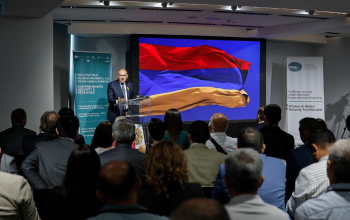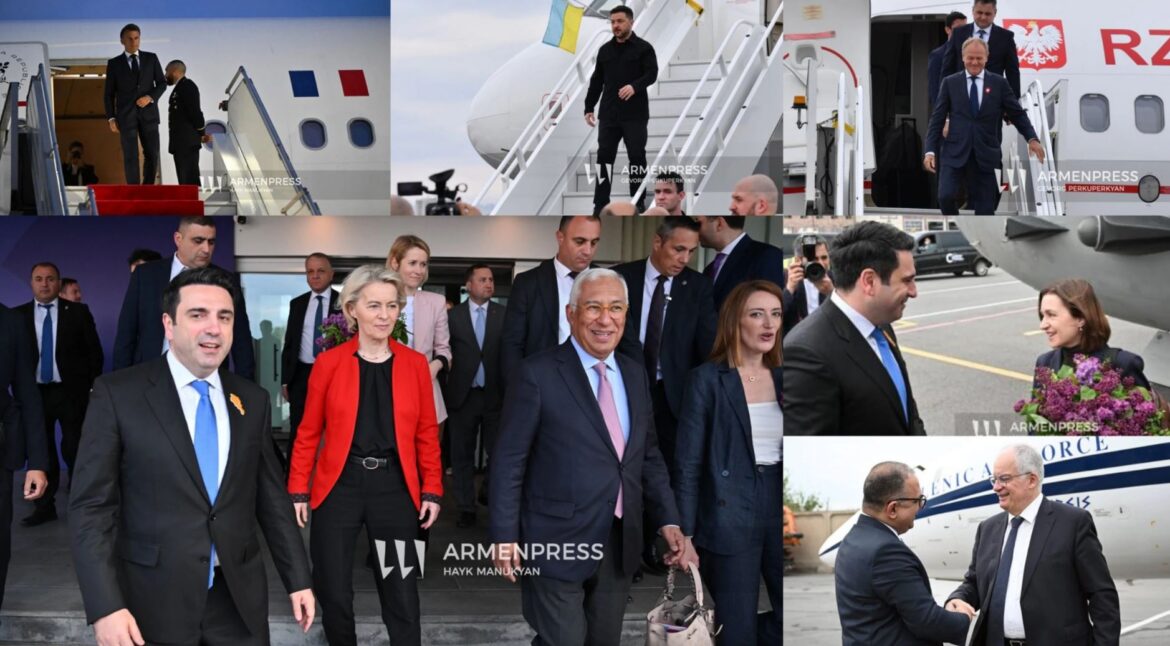
As European leaders descend on Yerevan for the European Political Community summit and the first-ever EU-Armenia summit, they will undoubtedly speak the familiar language of “democratic resilience,” “European values,” “peace,” and “reform.” The summit will be co-chaired by European Council President António Costa and Prime Minister Nikol Pashinyan, while Costa and European Commission President Ursula von der Leyen are also scheduled to represent the EU at the bilateral EU-Armenia summit.
But behind the staged handshakes and diplomatic slogans lies a more disgraceful reality: Europe is not coming to Yerevan to defend Armenian democracy. It is coming to whitewash the Pashinyan regime because Pashinyan is doing the work Europe wants done in the South Caucasus.
The same European officials who lecture the world about the rule of law are preparing to stand beside a prime minister whose government is arresting opposition figures before a decisive election, intimidating critical media, targeting the Church, seizing private property, and normalizing Azerbaijan’s post-war demands against Armenia.
This is not democracy. It is geopolitical laundering.
In recent weeks, Armenian law-enforcement bodies have continued arresting members of Samvel Karapetian’s Strong Armenia bloc, which is expected to be one of Civil Contract’s main challengers in the June 7 parliamentary elections. The Anti-Corruption Committee detained additional members after raiding a Strong Armenia office in Yerevan’s Avan district, accusing them of election-related violations without providing meaningful public detail. Similar charges against dozens of opposition members and supporters have been rejected by the movement as politically motivated.
At the same time, no comparable action has been taken against Pashinyan’s own political camp, despite opposition accusations that Civil Contract has engaged in the same kind of pre-election promises and material inducements for which opposition figures are being targeted. Even the charity run by Pashinyan’s wife, Anna Hakobian, has been challenged in court by Western-funded election-monitoring NGOs over alleged violations of the ban on political benevolence. Yet the machinery of prosecution appears to move in only one direction.
This is the kind of “level playing field” Europe is pretending not to see.
The hypocrisy becomes even more obvious when one looks at Armenia’s media environment. Reporters Without Borders has significantly downgraded Armenia in its World Press Freedom Index, dropping the country from 34th to 50th place. RSF noted that only a handful of media outlets demonstrate independence, that journalists face pressure, insults, and violence, and that such violence often goes unpunished. Local watchdogs recorded multiple cases of threats, insults, or obstruction against journalists in the first quarter of the year, nearly all attributed to the government.
Pashinyan himself gave the game away when he told journalists that if he stops being prime minister, they would lose their jobs within hours, and warned that if they continue exercising free speech as they do now, they could become jobless or even disabled. That statement alone should have disqualified him from being treated as a democratic reformer by any serious European leader.
Instead, Europe rewards him with summits, photo opportunities, and the language of partnership.
The Pashinyan regime’s abuse of power is not limited to elections and media. His government has moved aggressively against the Electric Networks of Armenia, owned by opposition-linked businessman Samvel Karapetian. According to documents obtained by RFE/RL’s Armenian Service, the government offered to take over the utility for a valuation of only 23.3 billion drams, roughly $62 million, while conditioning payment on the return of nearly the same amount in dividends. That would leave Karapetian and his family with a net gain of only about $380,000 for a company employing thousands and tied to major infrastructure.
This came after Karapetian criticized Pashinyan’s attack on the Armenian Apostolic Church, was arrested, and later moved to form a political movement. The timing is impossible to ignore. The government forcibly took over ENA’s management, the regulator revoked Tashir’s operating license, and Armenia ignored an order from the Stockholm arbitration body to refrain from seizing ENA, changing its management, or revoking the license pending a verdict.
If this were happening under a government disfavored by Brussels, the same European officials now smiling in Yerevan would call it state capture, political persecution, and expropriation. But because Pashinyan speaks the language of “Europe,” they look away.
The same pattern is visible in Pashinyan’s assault on Armenian national institutions. Earlier this year, he acknowledged that he forced the resignation of the director of the Armenian Genocide Museum-Institute because of what she presented to U.S. Vice President JD Vance during his visit to Tsitsernakaberd. Her supposed offense was connecting the Armenian Genocide with Artsakh and anti-Armenian violence in Azerbaijan, a connection long presented to foreign dignitaries by the museum’s own scholars.
This was not administrative discipline. It was political censorship of Armenian historical memory.
And yet, when European leaders arrive in Yerevan, they will not ask why a prime minister is deciding what scholars may say at the Armenian Genocide Museum. They will not ask why the Church is being targeted. They will not ask why opposition figures are being arrested weeks before an election. They will not ask why journalists are being threatened. They will not ask why a major private company is being crushed after its owner entered politics.
They will speak instead about “resilience.”
That word has become a convenient mask. In Europe’s vocabulary, “resilience” no longer means the defense of democratic institutions. It means keeping Armenia aligned with Europe’s geopolitical priorities, regardless of what Pashinyan does internally.
The most dangerous part of this European hypocrisy is that it directly affects Armenia’s national security. While Pashinyan presents himself abroad as the architect of peace, Azerbaijan continues to escalate its demands. Ilham Aliyev has repeatedly demanded the so-called “return of West Azerbaijanis,” claiming that as many as 300,000 Azerbaijanis should be allowed to settle in Armenia. Pashinyan insists the matter is not being discussed, but he also refuses to place the right of return of Artsakh Armenians on the agenda, claiming that both issues could inflame the political situation.
In other words, the rights of the ethnically cleansed Armenians of Artsakh are being neutralized in order to avoid upsetting Baku, while Azerbaijan’s claims against Armenia remain alive.
Europe knows this. Europe knows Azerbaijan’s strategy. Europe knows that Pashinyan has already made unilateral concessions while receiving no durable guarantees in return. But Europe has chosen to treat Pashinyan as useful because he weakens Russian influence, opens the door to regional “connectivity,” and helps advance a Western-designed architecture in the South Caucasus.
That is why European officials will forgive almost anything.
They will forgive the arrests. They will forgive the threats against journalists. They will forgive the pressure on the Church. They will forgive the abuse of state power. They will forgive the dismantling of Armenian national positions. They will forgive the humiliation of Artsakh’s cause. They will forgive the authoritarianism because the authoritarian is useful to them.
This is the great fraud of the moment: Pashinyan is being marketed as Armenia’s democratic future while ruling like a man who fears the Armenian voter.
If Europe truly believed in democracy, it would not give political cover to a government that is turning the June election into a managed contest. If Europe truly believed in free speech, it would not ignore Pashinyan’s threats against journalists. If Europe truly believed in the rule of law, it would not pretend that the seizure of ENA is a normal regulatory matter. If Europe truly believed in human rights, it would not applaud a government that buries the rights of Artsakh Armenians while Azerbaijan speaks openly about settling hundreds of thousands of Azerbaijanis in Armenia.
The truth is simpler and uglier. Europe is not defending Armenian democracy. Europe is protecting Pashinyan because Pashinyan is protecting Europe’s agenda.
Armenians should see this summit for what it is. It is not a celebration of Armenia’s democratic progress. It is a staged endorsement of a regime that has become useful to foreign capitals precisely because it is willing to do what no nationally rooted Armenian government would do.
European leaders may leave Yerevan congratulating themselves for supporting Armenia. But if their support means shielding Pashinyan from accountability, ignoring political persecution, and rewarding concessions to Azerbaijan, then they are not supporting Armenia.
They are supporting the man dismantling it.