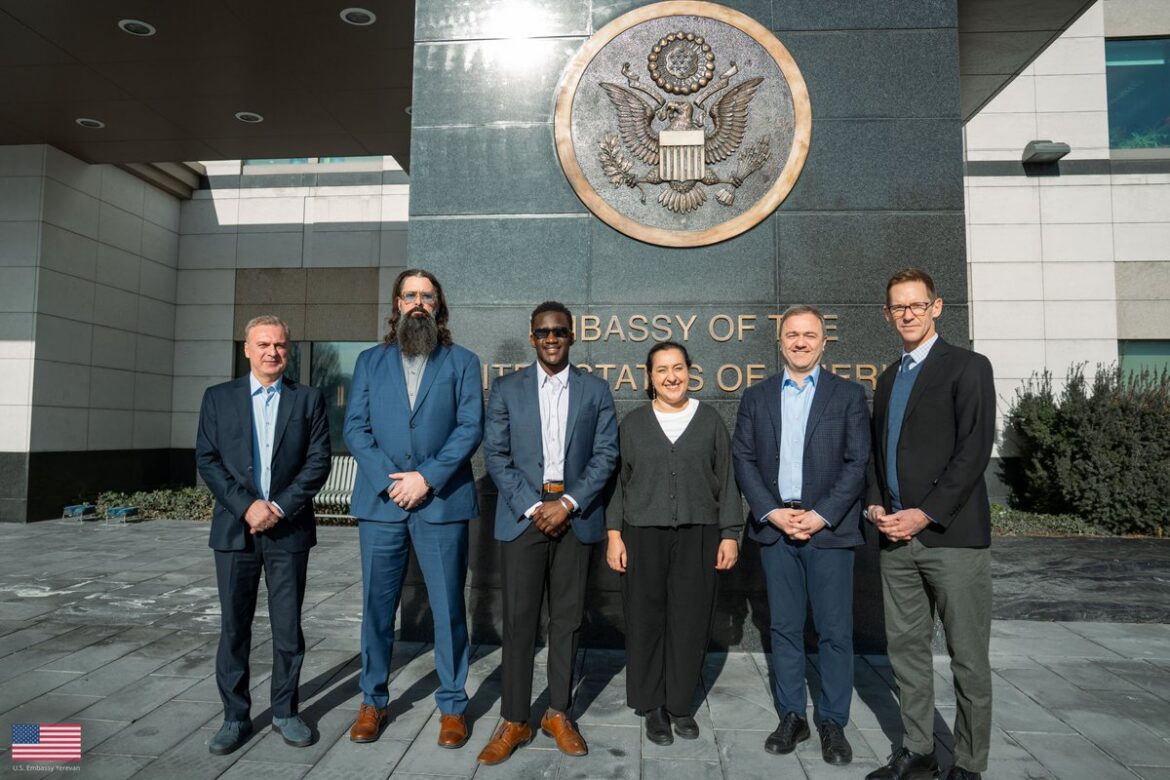
A team from the American engineering and consulting giant AECOM has visited Armenia to begin site investigation work for TRIPP, according to the U.S. Embassy in Armenia.
In a brief statement, the Embassy said the work will include a feasibility study and the development of proposals for railways and other infrastructure, presented as measures to promote “long-term economic growth,” improve “connectivity,” and advance “regional integration.” No further details on the scope, route options, budget framework, or oversight mechanisms were disclosed.
The announcement comes as Armenian Prime Minister Nikol Pashinyan has publicly set a timeline for the project. In November 2025, Pashinyan said project approval should be reached in the first half of 2026, with construction expected to begin in the second half of 2026. He also said the railway would follow the Soviet-era route, describing alternative alignments as unrealistic. According to Pashinyan, the gas pipeline and power lines would run significantly north of the railway, while the road component would likely be integrated into Armenia’s North–South highway network.
While the Embassy’s framing presents AECOM’s role as purely technical, the company’s international footprint has repeatedly been tied to major controversies that raise broader questions about the political economy of “development” contracting—especially where projects intersect with security policy, foreign influence, and heavily outsourced implementation chains.
AECOM was a major contractor in post-2003 Iraq, an environment widely criticized for turning “reconstruction” into a lucrative contracting ecosystem. Reporting on U.S. audits described allegations of unsupported or excessive costs tied to supplying the Iraqi army under U.S. oversight, illustrating how public funds in occupied or unstable contexts can be routed through foreign contractors with weak accountability on the ground. AECOM disputed the claims and described them as errors that were corrected, but the episode remains part of the record surrounding the reconstruction economy.
In the development-finance sphere, the World Bank in 2017 debarred AECOM Asia (18 months) and AECOM New Zealand (six months) over integrity violations that included failures to disclose conflicts of interest and misrepresentation in the context of Bank-financed projects. The debarments underscore how global infrastructure markets can become a competitive arena not only for expertise, but for influence and access—particularly where international financing systems and domestic procurement intersect.
AECOM has also faced major disputes tied to billing and contract compliance in the United States. Reuters reported that Tishman Construction, an AECOM unit, agreed to pay $20.2 million to resolve an investigation into an alleged overbilling scheme involving overtime charges on major New York City projects.
Beyond individual settlements and audits, AECOM is also linked to a wider contracting lineage that critics associate with coercive labor systems in militarized supply chains. An investigation by the International Consortium of Investigative Journalists (ICIJ) described migrant labor abuses connected to service and support work on U.S. military bases in the Gulf, and noted that Amentum—a major Pentagon contractor operating in that ecosystem—grew out of AECOM. That reporting detailed how subcontracting structures can place the harshest pressure on the most disposable layer of the labor chain, even while prime contractors and consulting platforms present themselves as neutral providers of “services.”
Armenia has not disclosed the full contracting architecture around TRIPP—what AECOM’s deliverables will be, what assumptions will underpin the feasibility models, whether subcontractors will be used, what transparency standards will apply, and what legal safeguards will govern labor, procurement, and liability.
For a project expected to move from approval to construction within 2026, those unanswered questions are not secondary details. They will determine whether “connectivity” becomes a development tool under Armenian control—or another externally managed corridor logic where the consultant’s report carries more weight than public accountability.