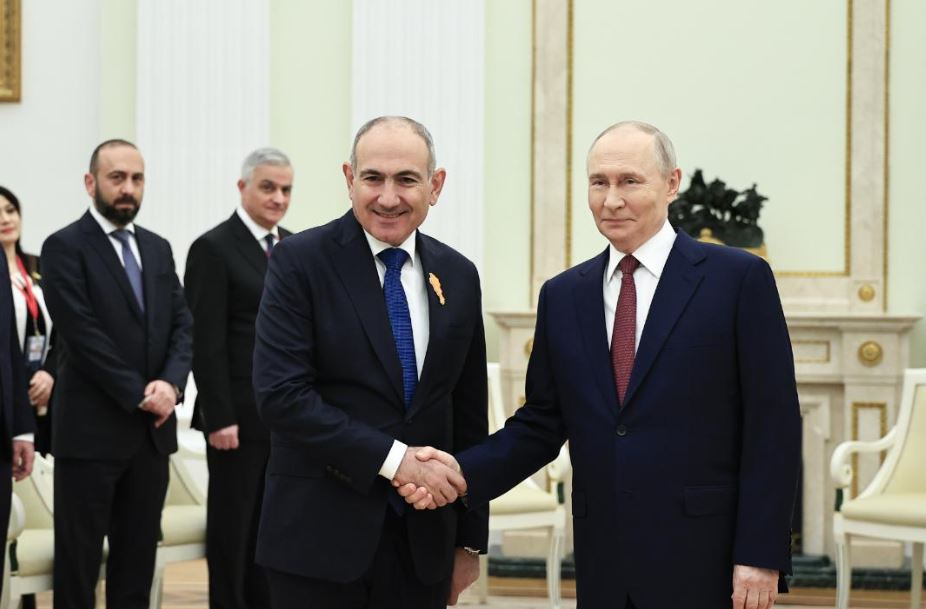
Prime Minister Nikol Pashinyan insisted Wednesday that Armenia will avoid sudden moves in its relations with Russia, even as Moscow signaled growing frustration over Yerevan’s Western course and questioned Armenia’s future role in the Eurasian Economic Union.
Speaking during a campaign stop in Lori, Pashinyan said his relationship with Russian President Vladimir Putin remains “truly friendly,” claiming the two leaders have had more than 200 phone conversations since 2018. He added that Armenia’s attitude toward Russia remains “very warm,” while again accusing political opponents of acting as Russian “agents.”
The remarks came amid a fresh escalation in tensions between Yerevan and Moscow. Those tensions were visible during Pashinyan’s April 1 meeting with Putin and deepened after Armenia hosted European gatherings in early May attended by Ukrainian President Volodymyr Zelenskyy. Putin later said Armenia must decide whether it intends to remain in the Russian-led EEU or pursue membership in the European Union.
Russian Deputy Prime Minister Alexei Overchuk has said Armenia’s status in the EEU will be discussed at the bloc’s May 29 summit in Kazakhstan, which Pashinyan is not expected to attend. Armenian Foreign Minister Ararat Mirzoyan responded that Armenia cannot be removed from the EEU against its will and said leaving the bloc is not currently on Yerevan’s agenda.
Moscow has also warned that Armenia cannot expect to pursue EU integration while keeping the same economic privileges it receives through Russian-led arrangements, including tariff-free market access and discounted gas. Russia remains Armenia’s largest trade partner, accounting for more than one-third of the country’s foreign trade last year, while the EU’s share was far smaller.
The diplomatic friction has unfolded alongside a turbulent campaign season for Pashinyan, marked by confrontations with voters. Russian Foreign Ministry spokeswoman Maria Zakharova pointed to those incidents Wednesday, saying criticism of Pashinyan’s conduct should not be blamed on Moscow. She cited recent footage involving an Artsakh refugee woman and the grandfather of a fallen soldier, arguing that the backlash stems from Pashinyan’s own behavior rather than Russian interference.