By Andranik Aboyan
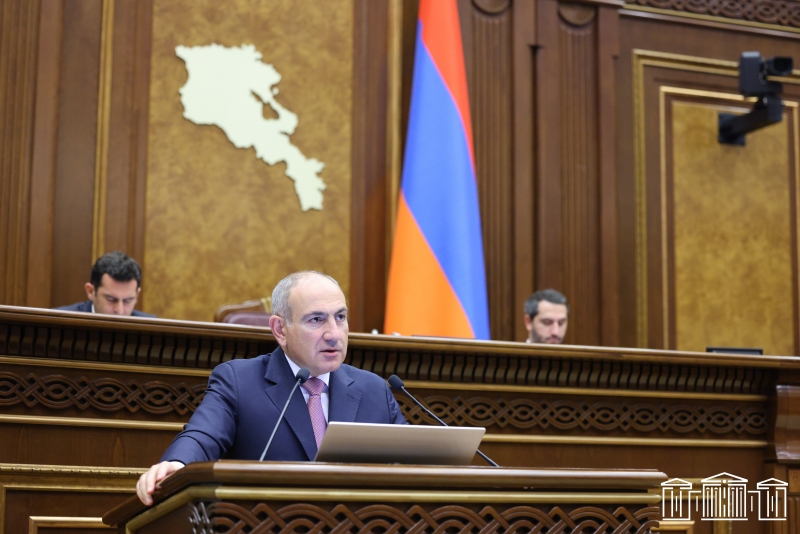
Under pressure from the opposition and from public opinion, Prime Minister Nikol Pashinyan’s office finally released the 2019 Artsakh negotiation documents that had remained hidden while the country went through war, defeat and territorial loss. The next day, Pashinyan appeared in the National Assembly and faced questions about those same texts: what was actually proposed, and why did he reject it one year before the 2020 disaster.
The basic record is not complicated. In 2019, the US, Russian and French co-chairs of the OSCE Minsk Group put forward an updated version of the so-called Madrid Principles. The document affirmed a sequence that had already become familiar: withdrawal from the surrounding Azerbaijani districts occupied since the early 1990s, and a binding mechanism for determining Artsakh’s final status.
The text spoke of a “free expression of the will of Artsakh’s population,” with legal force for all parties. It clarified that the wording of the question or questions “will not be limited in any way.” In practice, this meant that the Armenians of Artsakh could vote for full separation from Azerbaijan or unification with Armenia. The formulation did not guarantee the outcome, but it guaranteed that the choice would be theirs and that the result would bind all sides.
This is what the document says in plain language. When Pashinyan came to parliament, he offered something different. He described the 2019 text as a mere “summary of the previous period of negotiations,” not a framework for peace. He claimed that when he asked the mediators whether Artsakh could remain outside Azerbaijan under that “package,” they answered that this would only be possible “if Azerbaijan agrees.” He then stated that “it has never been written in any negotiation package that the referendum you mentioned should take place in Nagorno-Karabakh.”
So we have, on one side, an explicit reference to the free and binding expression of the will of Artsakh’s population, with no restriction on the content of the ballot. On the other side, we have a prime minister assuring the country that nothing of the sort was ever written. The contradiction does not require special training to notice. It only requires the ability to read.
Opposition deputies from the Hayastan and Pativ Unem blocs did exactly that. They pointed to the text and to Pashinyan’s own prior words and argued that the government had refused a settlement that preserved a real instrument of self-determination. They linked that refusal to the path that led to the 2020 war.
The response from the ruling Civil Contract party followed a familiar pattern. Parliament vice speaker Ruben Rubinyan announced that he “refutes” the idea that there was any “new proposal” in 2019 and also “refutes” the idea that the government rejected anything. The aim here is obvious enough. When the written record contradicts today’s talking points, the record must give way.
The problem for Civil Contract is that Pashinyan himself has already described what happened. In August, he openly stated that he rejected the 2019 plan. He did not present this as an error. He presented it as a patriotic achievement, claiming that he refused to “make concessions” because such concessions would have meant the “loss of Armenia’s independence and statehood.” The same leader now presides over a party line that denies there was any proposal to refuse.
The picture becomes clearer when we factor in what was already known from 2019. A secretly recorded audio from a meeting in Yerevan captured Pashinyan explaining that he opposed the mediators’ plan because it did not immediately formalize Artsakh’s separation from Azerbaijan. In that recording, he even says he is ready to “play the fool or look a bit insane” to avoid such a settlement. In other words, he speaks quite candidly about the strategy: obstruct the existing framework, accept the appearance of irresponsibility, block any compromise that falls short of instant victory.
Azerbaijan’s Foreign Minister Jeyhun Bayramov recently added another element when he recalled that Pashinyan told Ilham Aliyev, at the time, that “the people will kill me if I sign such a thing.” Pashinyan has declined to comment. Rubinyan, once again, rushed to deny it. The choreography repeats itself with impressive discipline.
If we step back from the daily noise and look at the structure of this behavior, another kind of question arises. What kind of political culture treats written documents, recordings and prior statements as disposable material, to be rearranged according to the needs of the moment? Here it helps to bring in a thinker whose name rarely appears in Armenian debates, but whose analysis fits the situation with uncomfortable precision.
Theodor Adorno, a German philosopher of the so-called Frankfurt School, studied how modern states and media systems shape consciousness. He did not focus only on censorship or direct repression. He examined how language itself becomes an instrument of management. In his view, once political and economic power reach a certain level of centralization, the lie stops looking like a personal moral failure and starts functioning as a routine administrative tool.
A key element in Adorno’s work is the treatment of the public as an object of manipulation rather than as a subject capable of judgment. Political speech no longer aims to inform citizens, but to wear down their sense of reality. People hear one thing on Monday, the opposite on Friday, and the command to believe both. Over time, they may stop asking basic questions. They may even stop trusting their own eyes.
Consider the way Civil Contract now handles the 2019 file. The government releases the document under pressure. The text clearly affirms a binding mechanism for the people of Artsakh to decide their status. The prime minister appears in parliament and denies that such a mechanism was ever written. His deputy declares that no proposal was rejected, although the prime minister has already said the opposite. Leaked audio and foreign testimony fill in the rest of the timeline.
In a minimally healthy political environment, such contradictions would trigger a reckoning. Either the earlier admissions were wrong, or the present denials are false. Evidence would be weighed, explanations offered, responsibility assigned. Under the logic that Adorno describes, something else happens. Evidence turns into background noise. The important thing is the current narrative. Yesterday’s narrative can be forgotten because the same apparatus that broadcast it will now broadcast its replacement.
This technique has a psychological side that people today usually call gaslighting. The term refers to the deliberate attempt to make someone question their grasp of reality by contradicting obvious facts in a confident, repetitive way. In the Armenian case, the target is not a single person, but the population. Citizens are asked to accept that a written document does not say what it says, that an admitted refusal never took place, that recorded words and signed texts occupy a lower level of reality than the latest talking point.
The effect is not only confusion. It is also paralysis. If nothing holds, if every fact can be inverted by official speech, then rational discussion loses meaning. Opposition arguments can always be dismissed as “misinterpretation” or “distortion,” even when they simply quote the text. In such an atmosphere, many people retreat into private life. Others accept whatever story seems least frightening. The rulers, who created this situation, then present it as popular consent.
Adorno saw this pattern in the propaganda systems of his time, which used radio, press and later television to build a world of ready-made narratives. Today, the tools include party-aligned media, social networks, and a permanent stream of statements from state officials. The content changes. The method does not.
What do we learn, then, from the 2019 documents and from the spectacle in parliament that followed their release?
We learn that Armenia did have, on the table, a flawed but real mechanism for Artsakh Armenians to determine their status through a binding vote. The government refused that mechanism and chose a different path, with consequences that everyone can see. We also learn something about the current style of rule. When pushed to account for past choices, the leadership does not simply defend them. It attempts to erase them and instructs the public to forget what it has just been shown.
Adorno would describe this as a case where domination extends into the sphere of memory itself. The power to decide what happened, and what did not happen, becomes another lever of control. For a small, endangered state, this habit carries an obvious danger. A country that cannot look honestly at its recent past, that cannot admit the content of its own diplomatic record, cannot plan a realistic future.
Armenia lives in a harsh environment. It faces hostile neighbors, unresolved security threats, and a shrinking margin for error. Under such conditions, the minimum requirement from any government is sobriety. That means accurate information, clear acknowledgment of past decisions, and respect for the public’s capacity to think. The handling of the 2019 documents shows the opposite tendency. The ruling party continues to treat narrative management as a substitute for accountability.
No foreign mediator can correct that. No Western capital or regional power will do this work on our behalf. The task falls, inevitably, on Armenian society. The first step is modest but essential: read the document, remember what has been said about it, and refuse to let today’s “clarifications” overwrite yesterday’s admissions. In other words, defend the simple right to say that two plus two makes four, even when the government of the day insists that the correct answer now differs.