Areg Gharabegian
In recent years, the Armenian population in Armenia and the Diaspora has basically been polarized into three major groups: supporters of the existing regime in Armenia, opponents of the existing regime, and people who outnumber the other two groups combined but do not care about their nation and are not ready to do anything for its well-being. I am not an expert in the social behavior of people or their political views; however, by spending most of my time in Armenia for the last 10 years, I see things and hear what people say. In this write-up, I have listed things that I have personally witnessed and heard lately to give you a general idea about the nation’s state of mind.
After reading this article, one may say I am an opposition member and that is why I say what I say. Others would think that I do not like to have fun and enjoy luxury things, while still others could have different takes. My goal has been to list different acts and events to portray the status of the nation the way I see it. After reading this, you can come to your own conclusions.
The government has opened a legal case against Catholicos Karekin II because, despite a court order, he refused to reinstate a vardabed whom he had dismissed from the church after that vardabed sided with the government against the church. It was announced that the first court hearing was on a Friday afternoon in Etchmiadzin. It was anticipated that a large crowd would gather in front of the courthouse to support the Catholicos, but there were only about 2,000 people present. I had parked on a side street behind the courthouse to avoid traffic. As I was walking away, a resident standing on his doorstep asked me what was going on. I asked him if he had heard the news, but he hadn’t, so I told him about the case and asked if he would be joining the crowd. He shrugged his shoulders, and it was clear that he had no intention of supporting the Catholicos.
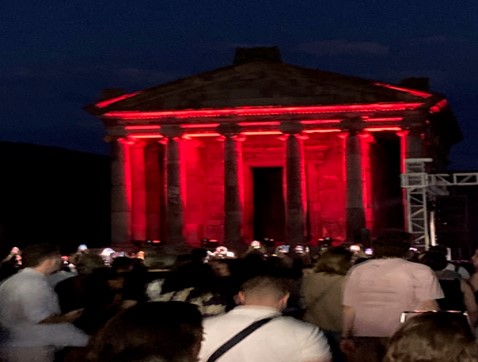
Musical event in Garni
The next evening, there was a musical event with a light show at the Garni Temple, where there were at least twice as many people as were in front of the courthouse. Participants were mainly young people who had paid 10,000 to 20,000 drams ($28 to $55), depending on when they had bought their tickets, and traveled for more than an hour from Yerevan to participate. Everyone seemed happy and appeared to be enjoying the event under the open sky while drinking overpriced coffee or alcoholic drinks sold on the premises.
You can come to your own conclusions about these two events and determine how people think about having a good time versus supporting the church. I am not a regular churchgoer or a believer, but I respect the Armenian Apostolic Church, as it acted as the de facto government for the Armenian nation when we did not have a government for 1,000 years.
In the last 12 months, I have flown in and out of Yerevan 16 times. Each time, the flight was full, and Armenians were going abroad for vacation and tourism or returning from one. It is also interesting that on flights over the Atlantic, the large majority of passengers in business class or premium class are typically Armenians. One can see Armenians in Dubai malls with bags from designer stores and at top restaurants or hotels such as the Atlantis Royal. I was in Athens and never saw any Armenians at the historic sites or museums, but I noticed Armenians at restaurants in the Athens Riviera with food covering the entire table as they toasted continuously.
I was seated at the pool bar in Sharm el-Sheikh and wound up helping a young Armenian guy order a drink. Then we started talking, and I asked him if he was there for vacation. He said that he was there for two weeks for his honeymoon. Keep in mind that it was a five-star, adults-only hotel on the beach. There were also other Armenians in this hotel. I need to mention that there are four flights every morning from Yerevan to Sharm el-Sheikh. One can conclude that a large number of the population has money and enjoys the good life. One should not expect such people to be active in opposition to the present regime, as they do not wish to rock the boat.
A few weeks ago, I met a high school classmate who was visiting Armenia for the second time, eight years after his first visit. He had flown Turkish Airlines from Los Angeles to Yerevan, and he was praising the good service and nice planes of that airline. I was at Zvartnots Airport the other day for a short visit to Europe. When I walked into the departure hall, the Turkish Airlines counter was the first one, and the line for its customers was so long that it stretched close to the main entrance. It seems Armenians have no issue flying with Turkish Airlines, even considering both the old and recent history with Turkey. Isn’t their president the one who brags these days that Turkey freed Artsakh from Armenians?
One recent afternoon, I met a friend from Armavir marz who clearly was upset. I asked him why he was upset, and he mentioned that he had been in their village and had an argument with a bunch of villagers who were saying that opening the border with Turkey would be good for them, as they could sell their tomatoes and cucumbers to the Turks and become rich. He mentioned that he tried to explain to them that Turkey is the world’s largest tomato producer and would not need our tomatoes, but according to him, this did not register in their thick heads. One needs to ask these villagers why, all these years, they have not been selling their tomatoes to Iran, where the border is open and which is much closer to the Armavir marz than Turkey is. In which category should we put these naive villagers?
I needed a new set of tires for my car, so I went to a store that is the representative of a major tire brand in Armenia and was recommended by a friend. As I was waiting for the tires to be installed, I started talking with the owner. Once he found out that I was from Los Angeles, he mentioned that his family is also in Glendale and that he goes to visit them regularly because he has a green card. He was also a staunch supporter of the government and was telling me that now everything is much better in Armenia. So I asked him: if he supports the government and thinks everything is fine, then why is his family in the U.S.? His response was that his daughter is going to medical school at UCLA and his son has to start college in the U.S. next year. It was obvious from the tone of his voice that he was wondering how I dared to question his life choices. Isn’t this a contradiction? He supports the regime and thinks that they are doing a great job, but apparently it is not good enough for his family.
Wine festival on Saryan Street
On August 8, 1990, the ARF announced the return of its organizational structure to Armenia at a packed Opera House, with thousands standing outside. Fast forward 36 years to 1 p.m. on Saturday, August 8, 2026, when it was announced that there would be a gathering at Yerablour for the anniversary of that day and to pay respects to those who fell during the Artsakh wars. Only 64 people were present. Do we need to be concerned and upset? Maybe not. After all, ARF members are part of the same people who now prefer to have fun, drink, and eat in fancy places. Besides fancy restaurants, bars, and clubs in Yerevan, there are now lots of fancy places in other parts of Armenia where people go to have a good time. As we were returning from Garni Temple the other evening, I saw several new outdoor restaurants near the temple that were full and playing live music. Then we had to go through Jrvezh on the way to Yerevan, where there was heavy traffic because there were parties or weddings at several fancy halls. Apparently, that is what people want these days.
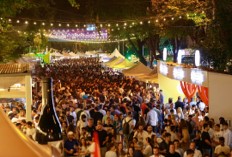
Summer evenings are nice and warm in Yerevan; therefore, one can find lots of outdoor gatherings and events. One week there is a wine festival, another week there is a beer festival, and then there are free concerts in Republic Square. At all such events, there are thousands of people, and it is hard to move around. This year, there are concerts on the rooftop of the Opera House where tickets are typically 20,000 drams ($55). If you want to attend, then you need to purchase your ticket as soon as the event is announced; otherwise, it will sell out.
We went to Gyumri for two days. After having a late lunch, I drove toward the center of the city to go to the hotel. Some roads were closed by the police, and there was traffic congestion on other roads around the city’s main square. I found out that there was a free concert scheduled for that evening, as it was “International Youth Day.” A stage was set at the end of Abovyan Street, which is a pedestrian-only street. When the concert started that evening, the entire street was full of people.
I remembered the gathering that was organized during the Srbazan movement in the open area in front of the Gyumri Cultural Center. At the time, the organizers thought that a good number of citizens had participated, but the crowd for the free concert was much larger. It is possible that the next leader of Armenia could be a popular singer who will ask thousands of supporters to vote for him or her. No doubt a large number would vote, as most voters in Armenia do not care about the person’s stance on different issues or the platform of the candidate, but instead vote for a person whom they like. Do not think that this thought is ridiculous, as before the last elections, I was talking with someone and she mentioned that she would not be voting for Kocharyan (Armenia Alliance) because she does not like his daughter-in-law Sirusho, a famous singer in Armenia.
Recently, I was talking with a Diaspora Armenian who was telling me that Armenia has flourished in the last few years, and as proof he mentioned that roads have been asphalted, there are new fancy buildings in Yerevan, people are driving nice cars, and central Yerevan is like a European city. In a sense, he is right, but then one needs to look deeper to see issues with this so-called flourishing. In 28 years since independence, Armenia accumulated $7 billion in foreign loans, and then in the last eight years, the foreign loans ballooned by another $7 billion. Of course, if you pump that much money in such a short time into a small country like Armenia, there will be signs of flourishing, but then the question is how and who will pay back all these loans. Armenia’s economy is not strong enough to be able to generate enough cash to pay back $14 billion. This is an issue that people do not look at carefully, and they become happy with immediate results without thinking about future consequences.
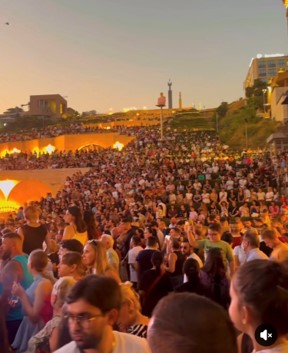
Concert in Cascade
Cascade is one of Yerevan’s major landmarks and my favorite place to go to have lunch or dinner. Now, on summer evenings, the city plans events there, such as free concerts where they set up a stage at the base of the Cascade or dance events where people dance traditional Armenian dances. It is hard to find even a standing spot on the steps of the Cascade, especially when there are free concerts.
Someone looking from the sidelines would get the impression that everything is fine in Armenia; however, if one goes to the villages far from Yerevan, then one can see the poverty, dirt roads, and mediocre housing. It is good to have fun once in a while, but not to have all the fun in central Yerevan while neglecting the villages.
I have listed some thoughts and events that at first may look random, but I think there is a pattern in how most Armenian people think or act. Based on these items, one may be able to conclude whether something is “wrong” with the Armenian population or everything is “fine.” You be the judge of that.