By Levon Baronian
Four days before meeting Turkish President Recep Tayyip Erdoğan in Antalya, Nikol Pashinyan reaffirmed that international recognition of the Armenian Genocide was off his government’s foreign policy agenda. The official account of the November 11 meeting discussed trade, transport links, and normalization. It said nothing about genocide recognition.
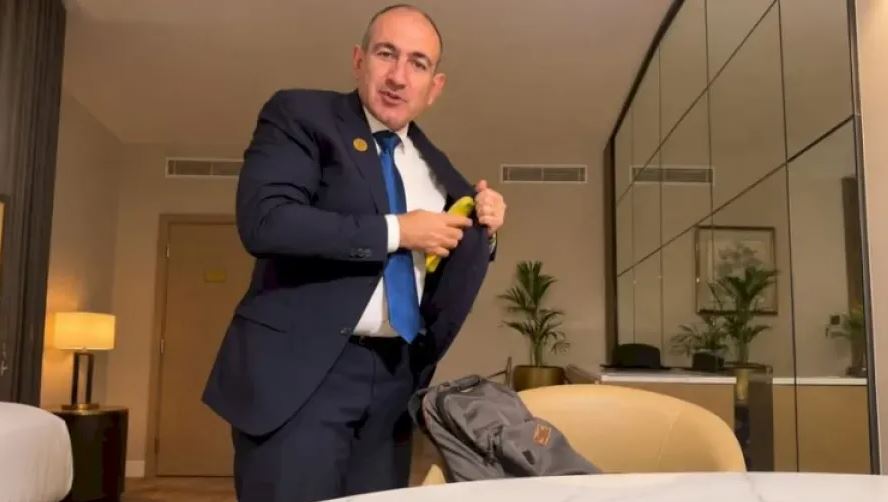
The banana Pashinyan picked up at his hotel in Antalya, on the other hand, received an entire video series. He slipped it into his jacket pocket in Turkey, pulled it out in Dublin, and, back in Yerevan, opened a safe on camera to show the public where he was keeping it.
For millions of Armenians watching this unfold, the reaction is not amusement. It is disgust and fury at watching the prime minister of Armenia reduce the office of the state to cheap buffoonery while surrendering core national principles. Yet to dismiss this as mere incompetence or eccentricity is to miss the calculation behind it. Pashinyan’s banana stunt is not just an embarrassment. It is a deliberate psychological operation: an attempt to bypass rational outrage, lower the nation’s defenses, and plant a message of submission directly into the Armenian subconscious.
The Work of a Familiar Symbol
Anyone who understands political messaging knows that propaganda does not always rely on speeches or policy papers. Often, it relies on familiar symbols that carry emotional weight before the mind has time to push back.
For Armenians who grew up when bananas were a rare, exotic luxury, the fruit still carries an unmistakable memory: the excitement of somebody bringing one home. Think of a middle-aged Armenian woman who remembers that feeling as a child, and later remembers the quiet pleasure of buying one for her own children. A banana could make an ordinary day feel a little special.
Pashinyan’s videos hijack that warmth and force it into an entirely new political story. The treat comes from Turkey. He brings it home. The safe completes the picture by treating it as something precious, something worth guarding.
The banana is what is on screen. The political argument is left for the viewer’s subconscious to absorb: Turkey is where good things come from, and Pashinyan is the leader bringing them home to you.
If the prime minister stood before parliament and declared that unilateral concessions to Ankara would bring prosperity, he would be met with immediate, uncompromising resistance. He would be confronted over what Turkey has given in return, why the border remains closed, and why Armenia is abandoning historical justice for empty promises. In a thirty-second social media clip, none of those questions are asked. The regime uses the spectacle of a prime minister locking a piece of fruit in a safe to drown out the outrage over what he is actually giving away.
Conditioning Through Spectacle
Effective propaganda does not work through a single stunt. It works through repetition, familiarity, and wearing down the public’s will.
Through an endless stream of casual videos (morning bike rides, heart gestures with Turkish journalists, cups of tea, and pocketed bananas), Pashinyan tries to remake the image of Armenian leadership. Instead of a head of state accountable for historic, irreversible losses, he projects the image of a harmless, folksy clown. The goal is to disarm public anger by turning statecraft into a running gag.
At the same time, constant absurdity breeds exhaustion. By flooding the public square with humiliating theater day after day, the authorities try to dull the nation’s capacity for sustained resistance over existential losses. While people are forced to stomach the spectacle of a fruit in Antalya, a historic surrender, the removal of the Armenian Genocide from Armenia’s state agenda, is pushed through as if it were routine.
Beyond Correction
This is not a misstep, and it is not an isolated communications failure. It is part of a sustained project to rewire how Armenians think about their history, their rights, and what is negotiable.
In Stepanakert in 2019, Pashinyan stood before the nation and declared, “Artsakh is Armenia, period.” By 2023, he had explicitly included Artsakh within the 86,600 square kilometers of Azerbaijan that his government was prepared to recognize. Rather than own the betrayal, he tried to rewrite political memory. He pointed selectively to past statements to present capitulation as continuity, while erasing the fact that the Minsk Group framework had always reserved Artsakh’s final status for a legally binding expression of will. By repeating a new version of events with total confidence, he worked to train the public to doubt what it knew to be true and accept defeat as destiny.
In Antalya, the same method was applied to an even deeper pillar of Armenian identity. For generations, Armenians in the homeland and across the Diaspora fought to secure international recognition of the Genocide and to hold Turkey accountable for its crimes. Today, Erdoğan can sit across from a prime minister of Armenia who has publicly taken international recognition off the table before the meeting even begins.
Ankara pockets a historic political concession without offering a single gesture of accountability in return. Armenians are handed a humiliating stunt with a banana, packaged to make surrender look lighthearted.
We are long past the point of expecting answers, explanations, or course corrections from Nikol Pashinyan. A leader who turns the state into a circus while dismantling the nation’s foundational rights cannot be reasoned with or reformed. He showed Armenians what he locked inside his safe. The only responsible answer left for the Armenian nation is to remove him before there is nothing left on the table to protect.