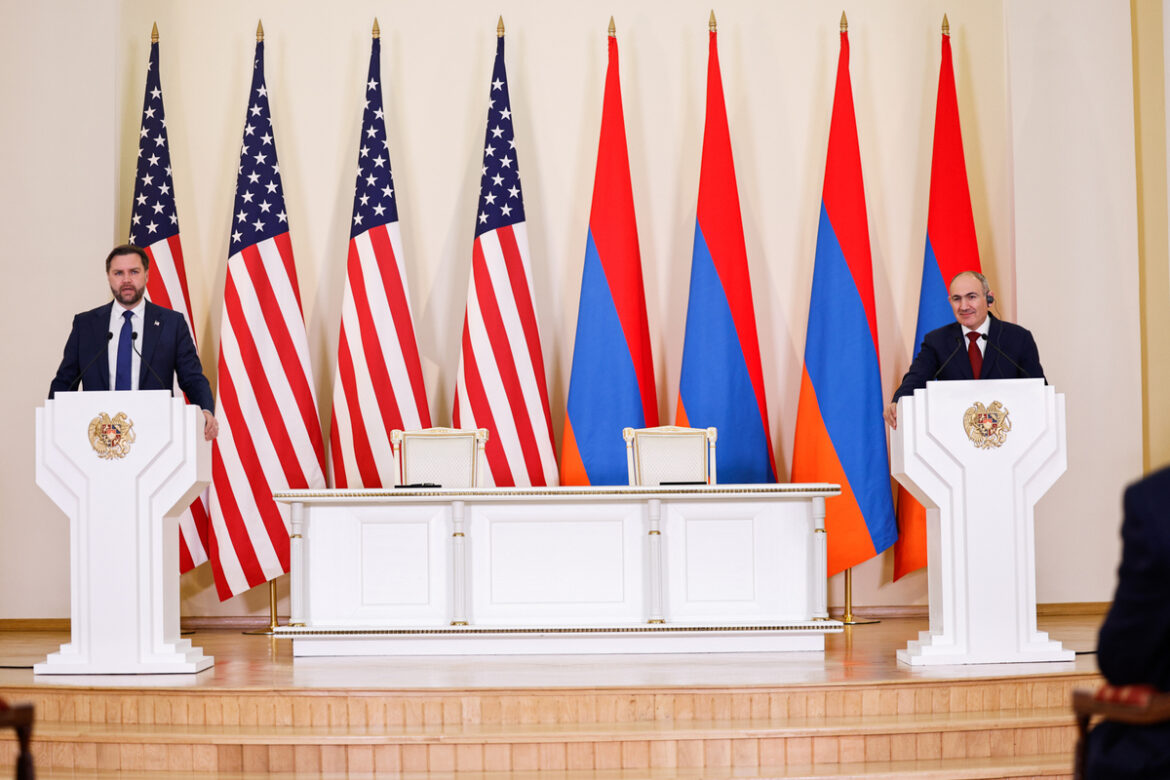
U.S. Vice President J.D. Vance offered unusually warm public backing for Armenian Prime Minister Nikol Pashinyan during a historic visit to Yerevan on Monday, linking the success of Washington’s newly unveiled regional transit project to political stability in Armenia ahead of the June 7, 2026 parliamentary elections.
At the center of Vance’s talks with Pashinyan was the Trump Route for International Peace and Prosperity (TRIPP)—a U.S.-backed plan for a transport and infrastructure corridor through Armenia’s Syunik region that would reconnect Azerbaijan to its Nakhichevan exclave. Standing alongside Pashinyan at a joint news conference, Vance said the route could transform trade and energy flows across the South Caucasus and deepen Armenia’s regional connectivity.
Washington and Yerevan released initial details of the TRIPP framework in January, describing a long-term management structure for the project and signaling U.S. intent to take an active operational role. Armenian officials have also said a U.S. engineering and consulting team has arrived to begin early site work tied to the corridor.
Pressed about financing and timelines, Vance avoided specifics, arguing that investor interest exists and that the main question is keeping the peace process on track. He then added that, while he would not “talk about” the election directly, Pashinyan had his endorsement—framing the Armenian leader as the partner Washington needs to move TRIPP from paper to reality.
Pashinyan, in turn, highlighted what he called Armenia’s deepening strategic partnership with the United States, praising the new U.S. engagement.
The corridor plan remains politically sensitive in Armenia. Opposition figures have warned that any arrangement resembling an extraterritorial “Zangezur corridor” could weaken Armenian sovereignty in Syunik, particularly if transit rules limit Armenian border controls. Similar rhetoric has surfaced from Baku in describing what it wants from a future settlement.
Regional pushback is also part of the equation. Iran has repeatedly signaled discomfort with a U.S.-linked project near its border with Armenia, viewing it as a potential avenue for expanded American security presence in a zone Tehran considers vital.
Vance also touted a newly announced $11 million U.S. sale of reconnaissance/surveillance drones to Armenia, saying it would strengthen deterrence against external threats, while declining to be drawn into questions about potential U.S. military action against Iran.
During Vance’s meetings, activists rallied in Yerevan urging the U.S. vice president to press Azerbaijan on Armenian detainees held in Baku. The issue did not feature in the public portion of Vance’s joint appearance with Pashinyan.
Vance was scheduled to travel onward to Azerbaijan, where the United States has simultaneously been pursuing expanded security and economic arrangements—underscoring Washington’s broader push to reshape influence and connectivity in the South Caucasus.