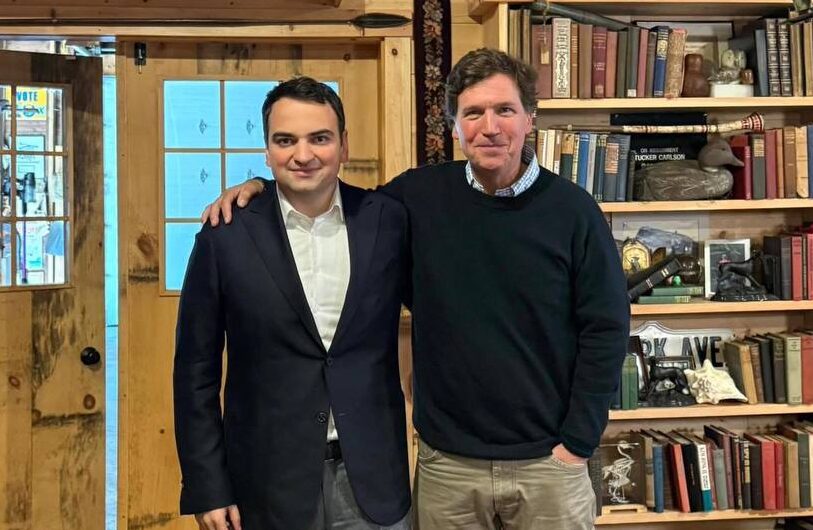
In a 90-minute appearance on Tucker Carlson’s show titled “The Global War Against Christianity Has Intensified Even More,” Narek Karapetyan—nephew of jailed businessman Samvel Karapetyan and chair of the “Our Way” coordinating council—and attorney Robert Amsterdam argued that Armenia’s government has escalated pressure on the Armenian Apostolic Church and on those who defend it, including Samvel Karapetyan, who has been in pre-trial detention for nearly five months.
Narek Karapetyan framed the dispute in civilizational and historical terms. Recalling the Armenian Genocide, he said Armenians “refused to convert” and paid with their lives, and he claimed that, since the 2020 Artsakh war, the current leadership has pursued normalization with Azerbaijan under conditions that “ask Armenians to forget their history,” soften discussion of the Genocide, and interfere with church leadership and teaching. “Six months ago the prime minister began attacks against the church and its leader,” he said, alleging an effort to restructure and control a 1,700-year-old institution.
He described widespread shock at what he called an unprecedented campaign, adding that many who disagree stay silent out of fear of pressure. In his view, Armenia’s democratic forms remain while practice drifts toward one-man rule amid declining approval ratings for the government.
On the arrests, Narek Karapetyan said three archbishops and his uncle were detained in the same climate. He insisted Samvel Karapetyan’s brief public remarks—“if politicians do not succeed, we will participate in our own way”—did not call for overthrow and that investigators struggled to find a criminal article to fit the statement. He recounted investigators “searching for hours” before filing charges of calling for seizure of power. According to him, those detained could be freed “even tomorrow” if they renounced public support for the church, but Samvel refuses to do so on principle.
Narek also said the government aims to seize parts of Samvel Karapetyan’s Armenian holdings, pointing to steps toward nationalizing the Tashir Group–owned Electricity Networks of Armenia. He characterized his uncle’s stance as one of conscience: “He could walk free and return to business but he will not trade his faith.”
Attorney Robert Amsterdam broadened the critique to Washington, arguing the U.S. State Department treats religion as a policy instrument and “decides which Christians to support.” He criticized American praise for Prime Minister Nikol Pashinyan, accusing the latter of trying to split the church, attending liturgy with a defrocked priest, and using coarse language about clergy. “A person who calls clergymen prostitutes is using language I have never heard from any leader about church figures,” Amsterdam said, adding that the U.S. government is allowing this to continue.
Amsterdam further argued that a peace push has come at a heavy cost for Armenians—citing the destruction of Artsakh’s heritage, the mass displacement of its population, and Armenian captives still held in Baku—and questioned how Armenia could be led by a prime minister who “seems to renounce his own history,” removes Mount Ararat from stamps, avoids the Genocide issue, and seeks to unseat the Catholicos. He called such moves incompatible with an apostolic church whose head must be elected and sanctified by bishops rather than installed by politicians.
For months the prime minister and his allies have publicly demanded the removal of the Catholicos and other senior clergy, alleging violations of vows and even foreign ties. Critics note that concrete evidence has not been presented; Pashinyan has said his information comes “from the people.”
From the interview, the portrait that emerges is of a high-stakes confrontation between state power and ecclesiastical independence—with Samvel Karapetyan cast by his defenders as a prominent figure paying the price for standing with the church.