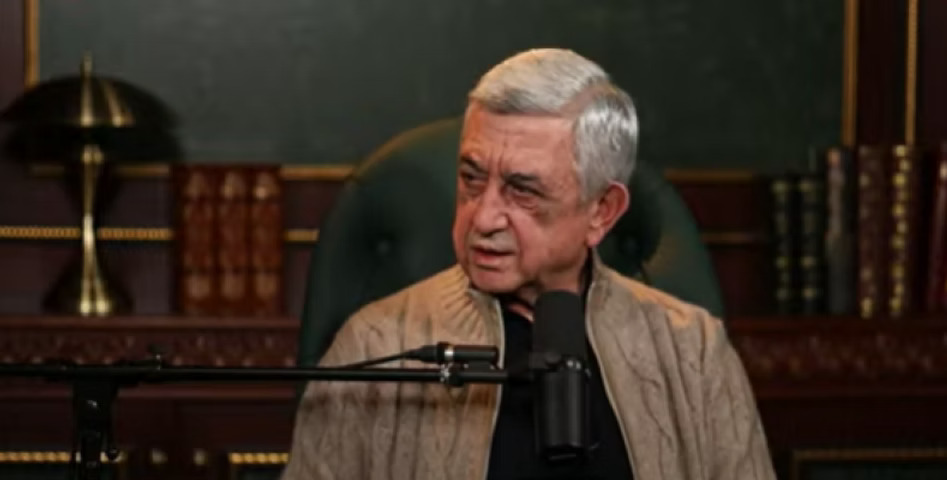
Prime Minister Nikol Pashinyan responded to former President Serzh Sargsyan’s seven-hour overnight interview with a string of ten Facebook posts published this morning. The “Imnemnim” podcast began at 10 p.m. and ran until about 5 a.m. Pashinyan’s first post appeared at 6:21 a.m., roughly one hour after the broadcast ended, indicating he had watched the interview during the night.
Although Sargsyan addressed many topics and offered new details about the 2018 revolution and his resignation, Pashinyan’s sharpest reactions focused on Sargsyan’s claims about the causes of the 44-day war and the 2019 negotiation process.
Why the 44-Day War Happened and Whether It Could Have Been Avoided
Sargsyan argued the war was avoidable and cited three Armenian-side factors:
- Refusal of negotiations. He said the prime minister effectively avoided the negotiation process and rejected it outright.
- Actions that gave Baku cover to start a war. He pointed to the July 2020 Tavush battles. After repelling an Azerbaijani attack, Pashinyan awarded dozens of servicemen in Sardarapat and declared that they had nullified Baku’s claims that its army could resolve the Karabakh issue in 24 hours. At the time Pashinyan said the July victories shattered a decade-long Azerbaijani narrative and proved the Karabakh issue had no military solution and required constructive approaches from Baku. Sargsyan countered, “We saw what the events in Tavush led to, and that is one of the reasons, I mean for Azerbaijan.”
- Weakening of the Armenian army. From mid-2018 and into 2019, Sargsyan said, problems in the Armed Forces were already visible. According to him, Azerbaijani and Turkish intelligence understood the situation well and saw a significant drop in combat effectiveness. “These were the three reasons why the war began,” Sargsyan said.
Pashinyan’s Counter to Sargsyan
Rejecting Sargsyan’s three premises, Pashinyan wrote on Facebook that only one thing could have prevented the 44-day war: accepting that Karabakh should be part of Azerbaijan. In his formulation, “the legitimacy imagined by Armenia” for settling the conflict had to be aligned with “international legitimacy,” and in practice this could not be done without first accepting Karabakh within Azerbaijan. “There was simply no other option,” he wrote. “If we think that we could have done it in 18–19, then yes, it is my mistake that I did not do it.”
On Mastery of the Negotiations and the Dushanbe Meeting
Sargsyan said Pashinyan initially did not master the negotiation process, noting that reading documents alone does not make it clear where they lead. He further suggested that after Pashinyan’s autumn 2018 meeting with Ilham Aliyev in Dushanbe, the government shifted away from the three cornerstone principles of the Karabakh settlement—territorial integrity, self-determination of peoples, and non-use or threat of force—and elevated a vague “principle of justice.”
“For me it was a very big signal that danger was approaching,” Sargsyan said, because the established principles were internationally recognized, while justice is inherently relative. “For us it could be fair, for the other side it could be unfair, and vice versa.” He speculated the shift was made at Azerbaijan’s request and may have involved a trade-off: agreeing to that language in exchange for calm on the border. “Yes, we will agree to this, you do not fire on the border either,” he said, describing the possible understanding.
The 2019 Document Dispute
Sargsyan also addressed the 2019 negotiation track. He said a peace document was on the table that year but that Pashinyan concealed it for a long time, keeping it secret even from the Artsakh authorities. “The fact that the co-chairs gave the Armenian rulers a new document was hidden from the public,” he said. Sargsyan claimed he informed Artsakh’s leadership that such a document existed and urged them to ask to see it; they were surprised, saying it was impossible there was a document they did not know about.
Pashinyan’s public statements on the matter have shifted. In December 2019 he told parliament, “there is no document under discussion on the table.” In February of this year he acknowledged that “there has always been paper on the negotiating table,” asserting there was never a day without some document.
Opposition forces have repeatedly called for publication of the June 2019 proposals and all other official texts related to the settlement. Pashinyan has maintained that the materials are incomplete and not fully presented to him, saying, “We take some out of the refrigerator, some from among the conditions, some are completely private, people come and give them to us.”
Today Pashinyan said the key records of the negotiation history, including those from 2019, have been sorted and are being scanned and will be published by year’s end, alongside several public documents. “I will also put a letter you wrote in it, so that you don’t think twice. To wake up, tell Levon Ter-Petrosyan and Robert Kocharyan,” he wrote on Facebook.
Sargsyan’s View of the 2019 Proposal
Sargsyan said he saw the co-chairs’ 2019 proposal about eight months ago. He called it fully discussable for the Armenian side and suitable as a basis for negotiations, since it preserved the three well-known principles, including the right to self-determination. The one difference, he said, was that the provision on the free expression of the will of the people of Karabakh appeared in the preamble rather than as a separate point.
Concluding his assessment, Sargsyan said of Pashinyan, “As for why he put himself in the place of a madman, those are his words, not mine. I think that he was not ready to resolve the issue through compromises, and without compromises it was impossible to resolve the issue. To put it in layman’s terms, he put himself in the place of a no-tizi, and no-tizi is destructive.”