By Andranik Aboyan
On the surface, the Trump Route for International Peace and Prosperity (TRIPP) is being sold as a miracle of diplomacy. Armenia and Azerbaijan, after years of war and blockade, agree to reopen a route through Syunik; the United States appears as guarantor; European commentators talk about a “Middle Corridor” linking Europe to Central Asia. The image is of trains and fiber-optic cables gliding through an era of peace.
The actual architecture looks different. Under the Armenia–Azerbaijan peace agreement brokered in Washington in August 2025, a roughly 30–40 kilometer strip of Armenian territory in Syunik becomes the site of a strategic transit corridor connecting mainland Azerbaijan to Nakhichevan and Turkey, with development rights granted to the United States for 99 years. American-backed consortia are expected to lay rail, oil and gas pipelines, high-voltage lines and fiber cables along that strip, subleasing and operating the corridor under a long-term concession model.
Formally, this land remains Armenian. Legally, the route is supposed to operate under Armenian law. But in practice, anyone who has watched how infrastructure concessions work knows where the real leverage lies: with those who control the financing, the technical standards, the insurance, and the contracts. When the US State Department quietly tells journalists that the strategic aim is to reduce the influence of Russia, Iran and China in the South Caucasus, they are not talking about charity; they are talking about control over a chokepoint.
To understand why this chokepoint suddenly matters so much, you have to zoom out from Syunik and look at capital in its contemporary setting.
From Factories to Corridors: How Profit Hunts for Space
The advanced capitalist economies have spent the last decades living in a strange contradiction: there is more money than ever, and fewer obvious places to put it. Manufacturing has slowed or moved; domestic infrastructure is ageing; demographic growth is tepid. Corporate balance sheets and investment funds are swollen with cash, yet rates of return in the old “core” sectors are under permanent pressure.
When profit margins are squeezed in the productive centers, capital does not politely accept lower returns. It shifts terrain. In the nineteenth century that meant railways, canals, colonial concessions; in the late twentieth century it meant globalizing production chains and pushing into finance. In the twenty-first century, you see the same reflex expressed through three main fronts: digital infrastructure, green and energy transitions, and the logistics of long-distance trade.
TRIPP sits in that third category. It is not just a solution to an Armenian–Azerbaijani quarrel but one node in a broader attempt to redraw the map of Eurasian circulation. The US has been patiently building diplomatic formats like C5+1 with the Central Asian republics for a decade; what began as a security and counterterrorism dialogue has shifted toward energy, infrastructure and access to rare-earths and strategic minerals. American officials now talk openly about the C5+1 platform as a way to integrate Central Asia into Western-led trade and investment routes that bypass Russia and reduce dependence on China’s Belt and Road.
Think tank pieces in Washington are already floating a complementary “Caucasus C3+1” structure that would anchor Armenia, Azerbaijan and Georgia in a similar framework with the US, explicitly linked to the so-called Middle Corridor—the overland route from China through Kazakhstan, the Caspian, the South Caucasus and Turkey to Europe. TRIPP is designed to plug Armenia directly into that corridor, not as an equal partner but as the host territory for a missing segment of track.
C5+1 and the Architecture of Exclusion
Formats like C5+1 are telling because of what they leave out. Five Central Asian states sit on one side of the table; the “+1” is an external power—in this case the United States—positioning itself as coordinator and gatekeeper. There is no Russia in the room; China appears only as the absent rival whose projects are being quietly undercut. Analysts close to the process will say this quite openly: the point is to create patterns of integration that bring Central Asia, and now the South Caucasus, into tighter economic and security dependence on the US and its allies, without having to say so in those words.
You can see the same logic in emerging talk of a Black Sea–centered “B5+1” pattern, pairing littoral states with Washington around security and development, layered on top of NATO and EU structures. Even where the format is still not institutionalized, the grammar is clear: group of smaller states, one extra-regional patron, a focus on “connectivity,” “energy security” and “resilience”—all euphemisms for reorganizing space to suit the needs of capital and power in the core.
TRIPP functions as a physical hinge between these initiatives. On one side, it ties into Central Asia via Azerbaijan and Kazakhstan. On the other, it offers a future hook into Black Sea internet cables and energy projects that would further lace Armenia into the web of Western-aligned infrastructure. Armenian officials are already discussing aligning a planned Black Sea internet cable with the TRIPP route, effectively letting a US-licensed corridor shape the country’s digital as well as physical backbone.
The policy jargon for all this is “connectivity.” The more honest description is that we are watching an architecture of exclusion being built: corridors and club formats that deliberately route around Russia and Iran, and partially around China, in order to secure the flows of commodities and information that the contemporary accumulation model requires.
Kazakhstan’s Wheat and the Semi-Periphery
The Kazakh episode that Armenian media have latched onto—a first shipment of about 1,000 tons of wheat reaching Armenia via Azerbaijan, sparking controversy over its quality—looks trivial at first glance. In fact it is a useful miniature of the entire situation.
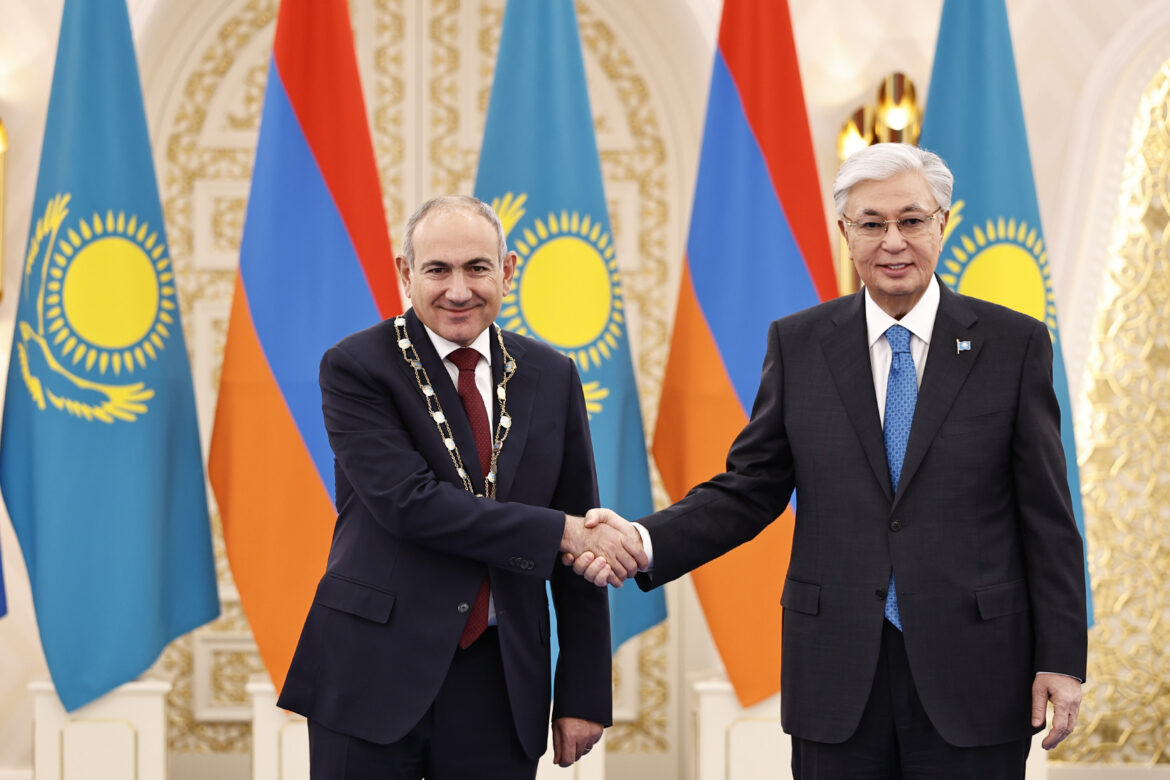
Kazakhstan is formally an ally of Russia through the Eurasian Economic Union and other structures. Yet its leadership has been quietly trying to diversify away from excessive dependence on Russian routes and Chinese projects. TRIPP offers a new westward option: grain, oil, electricity and metals loaded in Central Asia, shipped across the Caspian, passed through Azerbaijan and Nakhichevan, and delivered to markets via Turkey, potentially under Western-insured contracts.
For Kazakhstan’s ruling circles, participation in TRIPP and alignment with C5+1 are ways to improve their bargaining position between the giants. For Armenia’s government, the wheat shipment is used as a public relations demonstration: look, the route works; look, peace brings bread. For the operators of the corridor, it is proof of concept that they can move commodities through a geopolitical minefield and be paid for doing it.
Nobody in that chain is primarily concerned with Armenian food security or Kazakh peasants. The point is to show that this line on the map can carry value and that participants further up the chain—financiers in New York and London, infrastructure firms in Ankara and Baku—can treat it as a reliable asset.
A Short Detour Through History, Then Back to Now
There is a temptation to declare, “This is colonialism,” and leave it at that. The parallels are real enough to be worth mentioning once, if only to discipline our memory.
In the late nineteenth century, London capital was pouring into railways and canals across Asia, Africa and Latin America. Those projects were not acts of mercy; they were ways to deploy surplus capital from an overcrowded core into routes that would guarantee access to raw materials and markets. Concessions ran for decades. Local governments were handed the maintenance costs and political blowback; the metropole collected interest and profits. Profitability problems at home were displaced into space: turned into a question of controlling ever more distant lines of communication.
TRIPP does not replicate that world exactly, but it belongs to the same family of responses. It is what you get when a system organized around profit hits repeated limits and goes looking for new space—this time not in the form of direct colonies but as long-term leases, special economic zones, investment treaties and “+1” formats that fix peripheral states into particular roles in global value chains.
The difference is that today’s capital is also layered with finance, data and green transition rhetoric. The same corridor that moves grain and oil is also imagined as a route for green hydrogen, a cable path for cloud data, a vector for AI services. The same diplomatic communiqués that talk about TRIPP also talk about rare earths in Central Asia and supply chains for batteries and semiconductors. The geography of profit has become more abstract, but the underlying need is the same: to find, or force open, channels where returns can be higher than the stagnating average in the old centers.
Armenia Between Corridor and Country
All of this would be an interesting case study in geopolitical economy if it were not being built through Armenia’s most vulnerable province. For Yerevan, TRIPP is presented as a way out of isolation: unblock borders with Turkey and Azerbaijan, gain access to Central Asian markets, attract investment. The cost is rarely spelled out clearly.
A 99-year development right for an external power over the country’s southern artery inevitably shifts who Armenia must answer to. When the core of your transit system is designed, financed and insured from abroad, your foreign policy becomes, in practice, constrained by the needs of that infrastructure. The question is no longer only “what is good for Armenia?” but “what keeps the corridor stable and profitable?”
This is where the language of “peace” becomes slippery. Peace is obviously preferable to war and blockade. But a peace built around the logic of contemporary capital—around turning Armenia into a corridor whose main justification is that it facilitates someone else’s energy and mineral exports—carries its own kind of dependency. The Baku–Ankara axis gets its land bridge; Washington gets its foothold on Iran’s border and its concrete expression of C5+1-type strategy; Kazakhstan gets a new outlet; a thin layer of Armenian elites gets contracts and proximity to foreign power. The rest of Armenian society is invited to be grateful that trains and fiber run across Syunik.
If there is any lesson to take from the history of similar projects, it is that such arrangements do not automatically collapse; they can last for generations. But they also do not stay still. Every crisis in the world economy, every shift in the rivalry between great powers, is transmitted along these corridors. To accept TRIPP as the organizing principle of Armenia’s future is to accept that those shocks will be wired straight into the country’s territory, economy and politics.
The point, then, is not to romanticize some imagined alternative where Armenia stands completely outside global capital and power. It is simply to name TRIPP for what it is: not a neutral “route for peace,” but a specific way that capital in its contemporary, overextended form tries to offload its own contradictions into space. Once that is clear, the question for Armenians becomes less, “Which side’s narrative do we repeat?” and more, “Do we want to be built into this particular machine, on these terms, for the next century?”