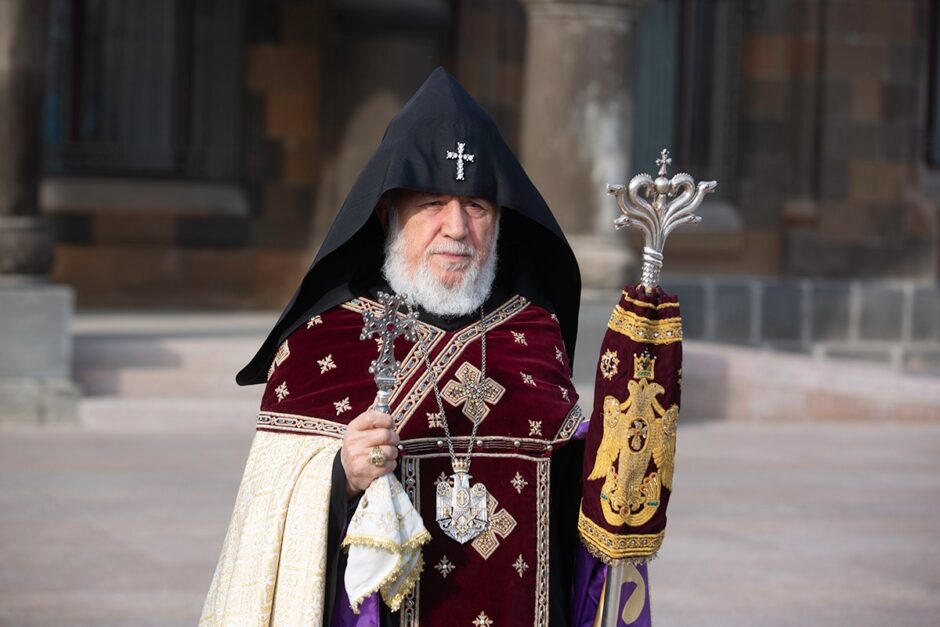
The trial of Catholicos of All Armenians Karekin II and six senior bishops resumed Friday in Vagharshapat, as Prime Minister Nikol Pashinyan’s campaign against the leadership of the Armenian Apostolic Church continues to move from public attacks and demands for the Catholicos’s removal into the courts and state institutions.
Judge Serzh Rushanyan of the Armavir Regional Court of First Instance presided over the September 18 hearing after weeks of jurisdictional disputes delayed the proceedings. The case had initially been assigned to Judge Hakob Manukyan, who recused himself shortly after the first hearing began on August 7, citing a prior professional connection with one of the defense attorneys. Rushanyan later transferred the case to Yerevan, but the Court of Cassation ultimately ruled that it should return to the Armavir court.
Karekin II and the six bishops did not personally attend Friday’s hearing and were represented by their attorneys.
The defense asked the court to terminate the criminal prosecution and dismiss the case, arguing that the charges concern an internal canonical decision of the Armenian Apostolic Church over which secular courts have no authority.
“The state has no right to decide who should be a bishop,” defense attorney Ara Zohrabyan told the court.
Zohrabyan argued that the defrocking of a bishop is an exclusively spiritual and canonical act and therefore cannot constitute the crime alleged by prosecutors. The defense also asked Rushanyan to refer the matter to Armenia’s Constitutional Court if he believes procedural law prevents him from dismissing the case directly.
Rushanyan said he will rule on the motions at the next hearing, scheduled for October 30.
The prosecution stems from the Church’s disciplinary actions against Bishop Gevorg Saroyan, who had aligned himself with Pashinyan’s effort to challenge the authority of the Catholicos.
On January 10, Karekin II removed Saroyan as Primate of the Diocese of Masyatsotn, citing abuse of office, failure to fulfill his duties and coercion and pressure against clergy. Saroyan challenged the decision in civil court, and an interim order was issued while his lawsuit was pending.
On January 27, following consideration by the Supreme Spiritual Council, Karekin II defrocked Saroyan and returned him to lay status under the name Arman Saroyan. The Church said Saroyan had violated his vow of obedience by challenging the Catholicos’s canonical authority, filing suit against the Mother See and engaging in conduct that violated ecclesiastical order and unity.
State investigators subsequently opened a criminal case alleging obstruction of enforcement of the civil court order. Karekin II and six members of the Supreme Spiritual Council were later charged in connection with the decision.
The case has placed directly before a secular Armenian court the question of whether the state can intervene in the Armenian Apostolic Church’s determination of who may serve as a bishop and how clergy may be disciplined.
The Armenian Constitution provides for the separation of religious organizations from the state while separately recognizing the Armenian Apostolic Church’s exclusive historical mission in the spiritual life, national culture and preservation of Armenian identity.
The Supreme Spiritual Council again condemned the authorities’ actions following a three-day meeting at the Mother See of Holy Etchmiadzin that concluded September 17.
The Council declared unacceptable what it described as the government’s continuing interference in the internal life of the Church, as well as pressure, persecution and restrictions imposed through state mechanisms. It said such actions violate constitutional protections for Church autonomy and freedom of religion and conscience.
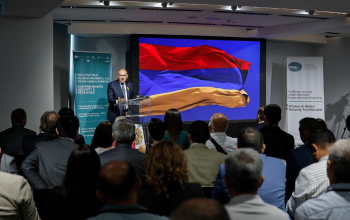
The prosecution against Karekin II comes against the backdrop of a confrontation that began directly after the Catholicos used an international forum in Bern, Switzerland, to raise the plight of Artsakh and issues increasingly marginalized by the Pashinyan government.
On May 27, 2025, Karekin II addressed an international conference organized with the World Council of Churches on the preservation of Armenian religious, cultural and historical heritage in Artsakh. He spoke of the ethnic cleansing and forced displacement of Artsakh’s Armenian population, Azerbaijan’s occupation of Armenian territories, the destruction and appropriation of Armenian Christian heritage and the continued detention of Armenians in Baku.
Just two days later, on May 29, Pashinyan launched a public attack on the Armenian Church during a government meeting, sharply criticizing its leadership and the condition of church properties. The confrontation escalated almost immediately.
Within days, Pashinyan turned his attacks personally toward Karekin II, alleging that the Catholicos had violated his vow of celibacy and demanding that he leave office. On June 10, Pashinyan went further, proposing the creation of a “coordinating council” to organize the removal of Karekin II and the election of a new Catholicos.
The Armenian Church responded on June 2 by describing the attacks as a politically motivated anti-Church campaign intended to weaken the Church, silence its voice and diminish its role in Armenian public life. The Supreme Spiritual Council stressed that internal Church matters are governed by ecclesiastical canons and lie outside the jurisdiction of political authorities.
The confrontation subsequently expanded well beyond rhetoric. Senior clergy have faced arrests and criminal prosecutions, including Archbishops Bagrat Galstanyan and Mikael Ajapahyan, both of whom denied the charges brought against them. In June 2025, law-enforcement officers entered the grounds of the Mother See during an attempt to detain Ajapahyan, an action strongly condemned by Church authorities.
Pashinyan has denied that he is conducting an anti-Church campaign, saying instead that he is challenging clergymen whom he accuses of violating Church canon law. At the same time, he has repeatedly demanded Karekin II’s departure and publicly organized efforts aimed at replacing him.
By 2026, the effort had become formal government policy. The Pashinyan administration’s 2026–2031 program explicitly calls for the removal of Karekin II, the installation of a locum tenens, changes to the Church’s governing framework and the election of a new Catholicos.
The criminal case now before the Armavir court represents the latest front in that confrontation. At its center is a question extending far beyond the fate of one defrocked bishop: whether Armenia’s political and judicial authorities can override the Armenian Apostolic Church’s canonical decisions and determine who may exercise episcopal authority within the Church.
The court is expected to address the defense motions when proceedings resume on October 30.