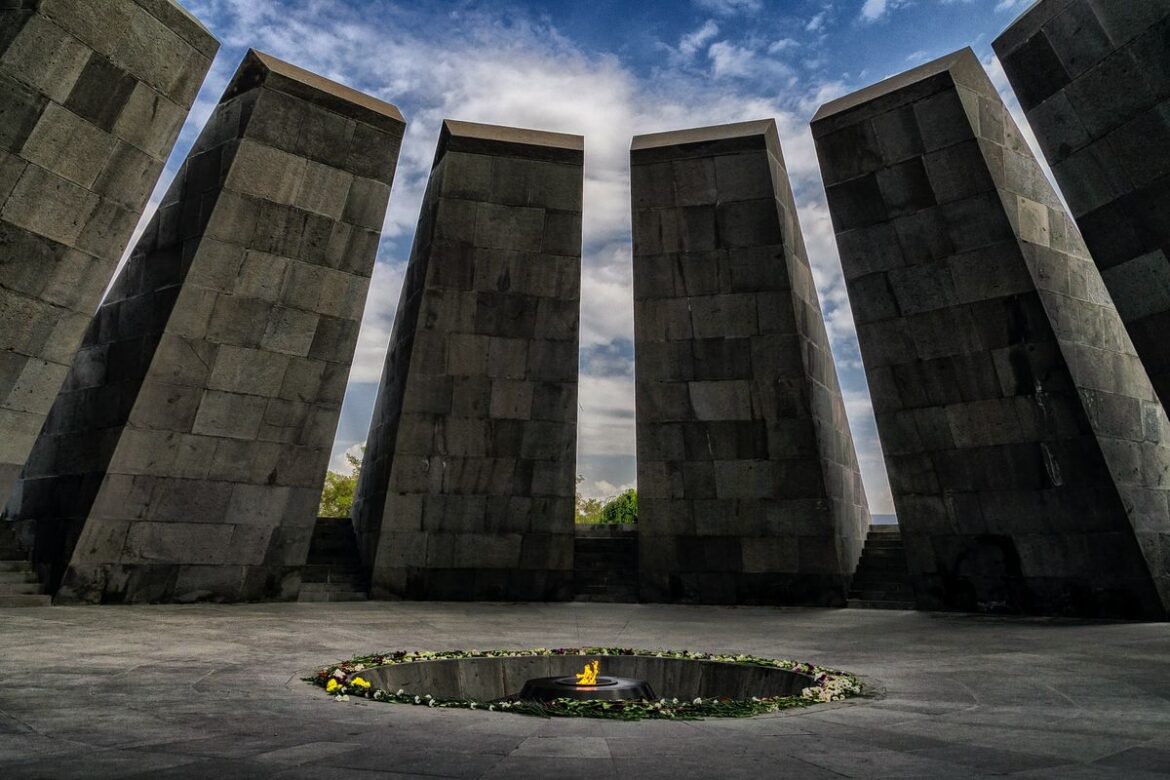
On February 10, 2026, Vice President JD Vance stood at the Tsitsernakaberd Armenian Genocide Memorial in Yerevan—the first sitting U.S. vice president ever to do so—alongside his wife Usha Vance. They laid a wreath, signed the guest book, and paid solemn respects to the 1.5 million Armenians systematically murdered and deported by the Ottoman Empire in 1915, an atrocity universally recognized by historians as genocide. Moments later, Vance’s official X account posted a photo and caption truthfully describing the visit: they were there “to honor the victims of the 1915 Armenian genocide.”
Within hours, that post vanished. Deleted. Replaced with a sanitized version featuring videos and photos of the ceremony but stripped of any mention of “genocide”—reduced to a bland note about laying flowers at the eternal flame and signing the guest book. The White House dismissed it as a “staff error” by someone not on the delegation, but this excuse crumbles under scrutiny. Official vice-presidential accounts do not post unvetted content during high-stakes diplomatic trips. This was no accident; it was a deliberate retraction, a calculated act of historical erasure to appease Turkey, a NATO ally that aggressively denies the genocide and punishes those who acknowledge it. Far from a minor glitch, this deletion stands as a dishonorable betrayal—of victims, of truth, of American moral leadership, and of the very principles Vance once claimed to champion.
The act is dishonorable first and foremost because it inflicts fresh pain on survivors’ descendants and the Armenian people. Imagine visiting Auschwitz or a Holocaust memorial, posting a tribute to the victims of the Shoah, then scrubbing the word “Holocaust” hours later to avoid offending Germany. The outrage would be immediate and justified. Yet here, at a site built to eternalize unimaginable suffering—starvation marches, mass executions, death camps—the administration chose deletion over dignity. Armenian-American communities reacted with fury and heartbreak, describing the move as sending “shockwaves” and a “dangerous signal” of retreat from genocide recognition. By erasing the term after standing on sacred ground, Vance’s team did not merely omit a word; they participated in the long Turkish campaign of denial that seeks to rob victims of even the language to name their horror. This is not diplomacy; it is complicity in forgetting.
Worse still, the deletion exposes raw political cowardice. The Trump administration has consistently refused to use “genocide,” prioritizing Turkey’s sensitivities over historical fact—even as the U.S. Congress recognized the events in 2019 and President Biden affirmed the term in 2021. Vance’s initial post momentarily broke that pattern, offering a flicker of honesty. Its swift removal reveals fear: fear of Turkish backlash, fear of complicating upcoming talks in Azerbaijan (a close Turkish ally), fear of jeopardizing NATO relations amid broader geopolitical maneuvering. Reports explicitly link the timing to Turkey’s role in mediating with Iran and other regional dynamics. In short, truth was sacrificed on the altar of expediency. For a leader who built his brand on bluntness and disdain for elite cowardice, this retreat is particularly damning. It proves that when real pressure arrives—not from domestic critics, but from a foreign power—the tough talk evaporates.
This incident also inflicts deep damage on America’s credibility as a defender of human rights. The United States has long positioned itself as the moral counterweight to authoritarian revisionism—condemning Holocaust denial, Russian atrocities in Ukraine, Uyghur camps in China. Yet here, on a genocide memorial, the vice president bowed to a denialist state that criminalizes the very truth he briefly acknowledged. The hypocrisy is glaring and corrosive. It tells the world that American principles are flexible when allies are involved, that genocide recognition is negotiable if it risks friction with Ankara. Armenian diaspora groups and international observers rightly labeled it an “embarrassing climbdown” that normalizes historical whitewashing. In an age of rising authoritarianism and “fake news,” such actions from the highest levels of U.S. government erode trust in democratic institutions and embolden those who rewrite history for power.
Finally, consider the precedent. If a vice president can visit a genocide memorial, speak the truth momentarily, then delete it under pressure, what message does that send to future leaders—or to victims of ongoing atrocities? It signals that moral courage is optional, that inconvenient facts can be memory-holed with a simple “staff error” excuse. Vance’s reversal was not leadership; it was surrender. It dishonored the dead by treating their memory as a diplomatic bargaining chip, dishonored the living by gaslighting them about what they witnessed, and dishonored the office by turning solemn tribute into cynical theater.
The deletion was no mere slip. It was a choice—a dishonorable one—to prioritize geopolitical convenience over unvarnished truth. History will remember not the wreath laid, but the words erased. True honor demands standing firm, even when inconvenient. Vance failed that test, and America is diminished for it.
Former Pasadena Mayor William Paparian is a Los Angeles County Deputy District Attorney and a Captain (CA) Judge Advocate with the California State Guard. The views expressed are his own and not those of the Los Angeles District Attorney’s Office or the California Military Department.