The Center for Armenian Research and Analysis (CARA) gathers and analyzes critical information on activities occurring in occupied Artsakh by state and non-state actors, and produces a weekly brief, with actionable data, to public and private stakeholders. Keeping Artsakh alive and in the public consciousness is part and parcel of CARA’s mission of providing clear and unfettered research and analysis pertaining to indigenous Armenian rights and cultural survival.
TOP ARTSAKH HEADLINES, OCTOBER 26 – NOVEMBER 1, 2026
Yerevan Sends Azeri Who Illegally Crossed the Border Home While Baku Continues to Hold Armenian Leaders Hostage
On October 26, Armenian authorities freed Yashar Qasimov, an Azerbaijani civilian from the bordering Tovuz district, and returned him to Baku. He crossed into Armenia’s Tavush Province on October 19, by the official account after “getting lost.” The National Security Service (NSS) reported his detention three days later and announced the handover, which Prime Minister Nikol Pashinyan confirmed. Pashinyan claimed that “no frontline or border in the world is entirely uncrossable,” thoroughly ignoring the fact that Armenian sovereign territories are still occupied by Azeri incursion forces and that Armenia’s borders are irresponsibly porous in the aftermath of Azeri aggression by any standard.
Pashinyan was attempting to answer an opposition uproar over an earlier, violent breach. Nasimi Musayev, an Azerbaijani soldier who, purportedly, “deserted” his unit on September 26, crossed into Syunik Province unnoticed, broke into a house in Shaki village, and shot local resident Ani Avetisyan and assaulted her children before his capture on October 1. Armenian citizens condemned the flagrant lack of the most basic security guarantees that allowed a member of the Azeri military to penetrate deep into Armenian territory. In a patently absurd move of betrayal, Pashinyan attempted to publicly blame Avetisyan, an Armenian mother who was shot twice by the Azeri assailant while she protected her children with her very life.
Two Azerbaijani intruders into Armenian territory in under a month, and the Pashinyan regime’s answer is that borders cannot be “sealed.” The second was sent home within a week. The Armenian hostages held in Baku since 2023 are still not home. (Source: Armenian Mirror-Spectator Article)
Freed Hostage Gevorg Sujyan: “Every Number Is a Name”
In Yerevan, Gevorg Sujyan, an Armenian aid worker and founder of the New Armenia Homeland-Diaspora NGO, described five years as a hostage of the Azeri state. Azerbaijani soldiers seized him on November 11, 2020, while he was delivering humanitarian aid to Artsakh (Nagorno-Karabakh), two days after the ceasefire that ended the 44-day so-called Second Artsakh (Nagorno-Karabakh) War, a choreographed onslaught of atrocities against Armenia, Artsakh, and all Armenians by Azerbaijan, Turkey, Israel, Pakistan, Ukraine, and thousands of Jihadist mercenaries, with the approval and support of global powers.
Sujyan wore a badge and other attire identifying him as a charity representative. The Azeri soldiers who detained him then attempted to behead him with a knife (as was the case for many other Armenians in Artsakh) until their commander sent him to Baku instead.
He was beaten and tortured heavily during the seven-day transfer to Baku, and an Azerbaijani court sentenced him illegally to 15 years. For his first two and a half months, in an 8-square-meter cell, his captors hid his status from his family, told him his relatives were searching for his corpse, and forced him to film a video confirming his capture. He gave up hope of survival and prayed only that his family would recover his body. He was freed on January 14 in an exchange involving four Armenians and two Syrian mercenaries.
Speaking at an event organized by Save Armenia and the Center for Truth and Justice, Sujyan said he cannot sleep while 20 Armenian hostages remain in Baku and 191 people remain officially missing. He urged delegates and the public to remember that “every number is a name” alluding to the number of Armenians still illegally held, abused, and tortured by the Azeri regime.
Sujyan was a civilian aid worker, seized after the ceasefire, threatened with beheading, and given 15 years by a sham court. The same system still holds the others. (Source: Christian Post Article)
ANC International Report Finds Baku’s Case Against Ruben Vardanyan “Fails on Its Own Record”
A report by the Armenian National Committee International (ANC International) finds that the 20-year sentence imposed by a sham Baku Military Court on Ruben Vardanyan, philanthropist and former State Minister of Artsakh, on February 17, 2026, “fails on Azerbaijan’s own judicial records.” The authors examined the 1,969-page indictment, the 1,864-page judgment, and international legal analyses.
The court imposed a 14-year term under Article 214-2 of Azerbaijan’s Criminal Code, an offense the indictment never charged, the guilty verdict never mentions, and statute caps at five years. None of the more than 2,000 forensic medical reports the court cited mention Vardanyan. Not one of the 540 victims or 77 victim relatives the court heard described any act he personally committed. The prosecution preposterously held him responsible for events from 1988 to 1994, when he was a student and young professional in Moscow, long before he arrived in Artsakh in September 2022. It cited “recidivism” as an aggravating factor while acknowledging he had no prior convictions.
An Azeri military “kangaroo” court tried Vardanyan, a civilian, denied him his international lawyer, handed him 422 volumes of case files only in Azerbaijani (a language he does not know), and held nearly 60 hearings closed to independent observers. Baku has held him since September 27, 2023, one of 20 Armenian hostages in its prisons. ANC International Chairman Hagop Der Khatchadourian called for the immediate and unconditional release of all of them. He urged the European Union, the United States, the United Nations, and the Council of Europe to make hostage release integral to relations with Baku and to the Armenia-Azerbaijan peace talks.
By Baku’s own records and paperwork, the proceeding was in fact nothing but more hostage-taking this time with an accompanying case file. (Source: Asbarez Article)
Mirzoyan “Welcomes” Dutch Money for a Purported “Bilateral” Search for those Still Missing
The Netherlands announced new funding to help locate and recover the remains of missing persons in Armenia and Azerbaijan. The pledge came at a joint press conference of Armenian Foreign Minister Ararat Mirzoyan and his Dutch counterpart, who claimed the earmarked sum would address “longstanding humanitarian concerns,” building “mutual trust,” and advancing “lasting regional peace.” The two also reviewed the Armenia-Azerbaijan peace process and Armenia-Turkey “normalization.” The Dutch minister commended what he erroneously termed “peace steps” during the past year, pledged support through the signing of a formal peace agreement, and offered “help beyond money” whatever that may mean. Mirzoyan welcomed the contribution as he and the Pashinyan regime continue to usurp, mismanage, and often steal funds marked for refugees, the many downtrodden in Armenia, and other humanitarian initiatives.
The more than $160 million raised by the Diaspora during the genocidal attacks against Artsakh and Armenia in 2020, for humanitarian support are still unaccounted for and were subsumed into the Armenian regime’s coffers often used to provide Pashinyan lackeys generous “bonuses” for their fine work against the Armenian people and state.
Sadly, the Dutch fund treats the missing of both sides as one ledger. This is particularly disturbing since Baku inflates its count of missing Azerbaijanis while ignoring at least 80 forcibly disappeared Armenians and more than 200 more unaccounted for, including possibly 2000 Armenians thought to populate mass graves dug and filled by Turkish and Azeri special forces units with the help of Jihadist mercenaries. Mirzoyan, sadly, by expectedly, welcomed the equivalence. (Source: Massis Post Article)
Perpetrator Blaming the Victim: Hajiyev Demands Armenia Apologize for “Ethnic Cleansing”
Hikmet Hajiyev, aide to Azeri dictator Ilham Aliyev, in another action that proves that we are living in an inverted :bizarro: universe, audaciously demanded that Armenia apologize to the Azerbaijani people for what Baku is calling past “ethnic cleansing,” “ecocide,” “unprecedented vandalism,” and the “forced displacement of Azerbaijanis” who, he further claimed, spent three decades as refugees and internally displaced persons. Speaking at a media forum in Baku, he claimed that initial agreements on peace have been reached, but that an “official apology and acceptance of responsibility” are essential to “trust-building.” He voiced concern about what he called “revanchism” in Armenian society and told Armenia’s leadership to “exist strictly within its internationally recognized borders” rather than rely on “historical interpretations.”
In parliament, answering opposition MP Tigran Abrahamyan, Armenian Foreign Minister Ararat Mirzoyan said the demand “does not contribute” to peace and that no further precondition can be added. He claimed the government is working to consolidate peace and avoid a return to the “past logic of confrontation,” and that both societies carry “fresh wounds” and must turn to “reconciliation.” The treaty initialed in Washington in August 2025 remains unsigned because Baku demands that Armenia amend its constitution, which Baku claims contains “territorial ambitions.”
In its long-term plans for genocide against Armenians, Baku ethnically cleansed Artsakh of its 150,000 indigenous Armenians in September 2023 then demands that Armenia apologize for “ethnic cleansing.” Mirzoyan only called the demand unhelpful. He did not call it false. (Source: OC Media Article)
Mirzoyan Blames Baku for Warding-Off Third Countries from Mediating Armenian Hostage Release
Armenian Foreign Minister Ararat Mirzoyan told parliament that Armenia’s appeals to foreign governments for access to, or the release of, 20 Armenian hostages in Azerbaijan have failed. He claimed Azerbaijan explicitly warned third countries to stay out, leaving Yerevan without mediation. Armenia is now turning to direct bilateral talks with Baku, and Mirzoyan declined to name the governments approached, citing “diplomatic difficulties.”
The 20 hostages include Artsakh’s former presidents Arkady Ghukasyan, Bako Sahakyan, and Arayik Harutyunyan, and former State Minister Ruben Vardanyan, among others, all of whom Azerbaijan seized after its September 2023 military offensive and the ethnic cleansing of Artsakh that followed. Concern for the hostages has grown since the International Committee of the Red Cross (ICRC) was forced to close its Baku office in September 2025 at Baku’s orders, ending its monitoring of detention conditions and its link between the hostages and their families. Yerevan claims their release “remains a top priority” in its talks with Baku, though no new agreement has been reached.
The Pashinyan regime has now handed the hostages’ fate to the one party holding them. Baku closed the ICRC’s door and warned off every other mediator. (Source: Armenian Report Article)
“On the Ground” in Occupied Artsakh
Baku Deploys 78 More Settler Families into Occupied Akna and Martuni
On October 30, under its illegal “Great Return” Settler Offensive, Baku deployed yet another 272 people in 78 families into occupied Artsakh. 70 families (238 people) went to occupied Akna (Azeri “Aghdam”), and 8 families (34 people) went to the village of Guzeykhirman, in occupied Martuni (Azeri “Khojavand”). Azeri state media report that the settlers purportedly thanked Ilham Aliyev, First Vice President Mehriban Aliyeva, and the Azerbaijani Army.
Baku is settling them on the homeland of 150,000 indigenous Armenians it violently forced out since September 2020, 120,000 of them in the 2023 expulsion. Settlers thanking the army that emptied the land is the “Settlers Offensive” stating its own purpose. (Source: Relocation to Occupied Artsakh)
Baku Draws “Master Plans” for 12 Cities and Shops Occupied Artsakh to Investors
On October 26, Baku announced that the so-called “restoration and reconstruction” of occupied Artsakh (read: destruction and erasure of all trace of indigenous Armenians) is the centerpiece of its national urban planning policy. Rather than rebuild the settlements that stood there, it aims to found “new cities and economic hubs.” Baku is preparing master plans for 12 cities in occupied Artsakh and has completed spatial planning for over 100 villages and settlements. They are part of an Azeri national program covering 68 of 79 cities under a 20-year framework that prioritizes “strategic planning, modern infrastructure, sustainable development, and investor confidence.” These “Master Plans” are, in fact, the infrastructural initiatives and mandates laying at the foundation of Azeri, Turkish, and Israeli military, intelligence, and surveillance projects to further compromise regional security, Armenian Sovereignty, and continue anti indigenous genocidal policies, as well as the further exploitation of natural resources.
Baku has named 2026 the “Year of Urban Planning and Architecture” and is hosting the UN World Urban Forum as an institutional and titular cover for its actual designs, provided, of course, the UN and and other Trojan Horses of global mayhem..
The same day, at the press conference for the AIREX 2026 real estate and investment exhibition in Baku, Parvin Baghirova, fundraising head of the Karabakh Revival Fund, claimed attracting investment to occupied Artsakh will be a central topic. The fund is using the exhibition to raise money for “restoration and reconstruction,” to showcase the region’s “development potential,” to expand public-private partnerships, and to market its “green energy potential” to business representatives, investors, and experts from several countries. The fund’s charter mandates raising “local and international awareness” of developments in the occupied territories as a core activity.
“New cities” in place of the Armenian towns that stood there is erasure drawn up as a master plan. Investors who buy in are financing the “Settlers Offensive,” and funding an occupation is participation in genocide. (Sources: Master Plans in Occupied Artsakh, Investment in Occupied Artsakh)
Baku Pulls Occupied Artsakh’s Farmland into Its “Economic Circulation”
In a continuing litany of unverified and unverifiable claims, official Baku reported agricultural output above AZN 11 billion (USD 6.5 billion) in the first nine months of 2026, with grain production up 8.2%, wheat yields at 36.3 centners, and fruit and berry harvests up 5%. It named “restoring the agricultural potential” of occupied Artsakh as a central aim. There, claims were made that Azeri state efforts purportedly target modern farms, production infrastructure, and “integrating land resources back into economic circulation,” under the 2026-2030 state program for agricultural production and processing, which is boasting “food security, modern irrigation, and digitalization.”
On October 30, Baku announced that it has allocated 230 hectares for industrial greenhouse farms in a single designated zone in occupied Artsakh, and claimed investor interest in nearly every plot, with further expansion planned. Nationwide, land under modern irrigation has supposedly grown to over 155,000 hectares, from 130,000 at the end of 2025. Baku claims laser land-leveling, crop-treatment drones, and better seed have lifted yields under its food-grade wheat program to over 54 centners per hectare, against a national average of 33 to 34.
On October 27, Aghdam Agro Yem LLC received resident status in the Aghdam Industrial Park in occupied Akna for an AZN 11 million (USD 6.47 million) animal-feed plant for livestock farms. Aliyev created the 190-hectare park by decree on May 28, 2021. The Economic Zones Development Agency, under Azerbaijan’s Ministry of Economy, runs it, and it supposedly ranks second in the country by the number of residents. Baku intends it to “revitalize” these occupied territories through agricultural processing, construction materials, and cold storage. It gives residents a 10-year exemption from property, land, income, and profit taxes, a 10-year exemption from VAT and customs duties on imported machinery, equipment, and raw materials, and subsidized social insurance.
“Economic circulation” is Baku’s term for Armenian farmland worked for Azerbaijan after genocide and ethnic cleansing made Artsakh bereft of its indigenous people. A decade tax-free is what Baku pays its minions and businesses to anchor settlers and create para military infrastructure controls on Armenian land. (Sources: Agricultural Production in Occupied Artsakh, Mammadov Statements, Animal Feed Production in Occupied Akna)
Baku Brands Occupied Artsakh a “Green Zone,” from Rooftop Solar to a Power Plant on the Vorotan
On October 28, Baku claimed that occupied Artsakh, which it has declared a “green zone,” accounts for more than 95% of the nearly 1,800 “active consumers” in Azerbaijan. Each may generate up to 150 kilowatts and sell the surplus to the state distributor Azerishiq, and Baku credits occupied Artsakh with most of the 8 megawatts they produce. It claims private solar pays for itself in seven to eight years. The same day it announced that occupied Stepanakert is the first city there to run electric buses, with the rollout spreading to other districts as a “central pillar” of Baku’s purported decarbonization pledges.
Despite being one of the most blatant transgressors of international ecological standards and norms, Azerbaijan continues to provide timely lip-service as it mouths slogans and trite statements about the environment to its international audience.
The program claims to sit beside doubtful Azeri national targets to keep per capita emissions below 600 kilograms a year and to retire Baku’s 500 remaining diesel buses by 2027. Public transit in occupied Nakhichevan is fully electric, Baku says.
On October 31, Baku announced that AzerEnerji is building the 5.3-megawatt Eyvazli Hydropower Plant on the Vorotan River (Azeri “Bargushad”) in occupied Sanasar (Azeri “Gubadli”), billed as the first in “the district’s history.” AzerEnerji is installing generators, switchgear, and two Francis turbines at the end of a 5.3-kilometer diversion pipeline in the ancient Armenian homeland now usurped. The plant will feed Azerbaijan’s grid through a 110-kilovolt substation in Sanasar commissioned in 2021. Baku projects 15.6 million kilowatt-hours a year, saving 3.5 million cubic meters of natural gas and 6,400 tons of carbon dioxide.
The “active consumers” selling solar power are settlers, and the buses carry them through a Stepanakert Baku emptied of its people. A national grid and power plants on occupied rivers are strategic infrastructure that buttresses Turkish-Azeri, as well as Israeli, military and logistics designs for the region. (Sources: Surplus Power, Electric Buses in Occupied Artsakh, Hydropower Plant in Occupied Sanasar)
Baku’s So-Called Environmental “Working Group” Claims to Plant Forests and Weather Stations on Cleared Armenian Land in Occupied Artsakh
On October 30, occupied Akna hosted the Working Group on Environmental Issues of Baku’s Coordination Headquarters for occupied Artsakh. Taking part were state agencies, the “Restoration, Construction, and Management Services,” and Aliyev’s special representations for the occupied districts of Akna, Varanda (Azeri “Fizuli”), Martuni, Jrakan (Azeri “Jabrayil”), Sanasar, Kovsakan (Azeri “Zangilan”), Martakert (Azeri “Aghdara”), Ivanyan (Azeri “Khojaly”), Shushi (Azeri “Shusha”), Berdzor (Azeri “Lachin”), and Karvachar (Azeri “Kalbajar”), and for occupied Stepanakert. The agenda covered environmental “compliance” in infrastructure projects and the “removal of vegetation.”
Working group head and Deputy Minister of Ecology Vugar Karimov announced an “International Forestry Training Center” in occupied Jrakan to grow seedlings “adapted to local climatic conditions.” Baku’s state media put its capacity at 2 million seedlings a year in one report and 5 to 6 million in another. He claimed forest planting on 610 hectares across six occupied districts and 205 hectares of new “green spaces” in Akna, Varanda, Jrakan, and Kovsakan, tied to demining. He also claimed 11 automated hydrological stations on 10 rivers, plus 7 meteorological, 4 radioecological, and 3 agrometeorological stations.
Every river gauge and tree nursery is sited on land whose Armenian owners were murdered or ethnically cleansed, land whose Armenian owners Baku expelled. Planting forests over emptied villages and “removing vegetation” for construction are two halves of one “redesign” of Artsakh with its people written out. (Sources: Working Group Meeting in Occupied Artsakh, International Forestry Training Center in Occupied Jrakan, Forest Planting in Occupied Artsakh, Hydro Stations in Occupied Artsakh)
Foreign Interests and Actions in Occupied Artsakh
Baku Says ICOMOS Certified Its “Restoration” of the Akna Imarat as Forum Delegates Tour Occupied Artsakh
The 7th World Forum on Intercultural Dialogue closed in Baku on October 28, with participants scheduled to visit occupied Artsakh the next day. Aliyev hosted the forum and billed it as advancing “global peace” and “religious and cultural diversity.” It drew UN Special Envoy Miguel Ángel Moratinos and Azeri Culture Minister Adil Karimli, and featured occupied Artsakh and “peace” as a focal theme.
At the forum, Emin Huseynov, Aliyev’s special representative for occupied Akna, Varanda, and Martuni, announced that the International Council on Monuments and Sites (ICOMOS) had awarded a special certificate to the recently reopened Imarat Complex in occupied Akna. Azerbaijani state media said ICOMOS Secretary General Malik presented it, marking the complex’s inclusion on the organization’s special heritage list. Huseynov claimed the award testifies to Baku’s “meticulous restoration.” The complex now serves as a tourist destination presenting the history of the “Karabakh Khanate” and of what Baku erroneously and criminally calls the “30-year period of occupation.” Baku plans to present its “restored” projects to the international community under a “unified concept,” part of a large-scale historical revisionist plan to erase and appropriate Armenian cultural heritage and territory. Huseynov also claimed that Baku has demined much of occupied Varanda, which it calls the “gateway” to the region, and is rebuilding it under “new urban planning principles,” and that selected “ruins” in its historic center will become “open-air memorial complexes.”
If the report is accurate, ICOMOS has lent its name to an exhibit that casts Artsakh’s self-rule as an “occupation.” Baku recasts Varanda’s ruins as memorials to its own story and erases the Armenian heritage of the same land. (Sources: World Forum Visit to Occupied Artsakh, Aghdam Imarat Complex Receives ICOMOS Certificate, Mine Clearance in Occupied Varanda)
Every UN Agency Meets Baku in Occupied Stepanakert as the UN Expands Its Work There
On October 28, UN Resident Coordinator Dmytro Shlapachenko announced that the United Nations is expanding cooperation with Azerbaijan in occupied Artsakh under a new 2026-2030 Cooperation Framework built on “inclusive development” and climate change. All UN agencies recently held a “strategic dialogue” with the Azerbaijani government in occupied Stepanakert. The partnership will reach beyond green energy into urbanization, agriculture, healthcare, and so-called household development. Next year the UN plans two dialogues on the Sustainable Development Goals (SDGs) in occupied Shushi and occupied Nakhichevan.
The UN has convened its whole system with Baku in the capital of Artsakh whose indigenous people and culture Baku and its allies have ethnically cleansed. The UN is putting its name upon the continuing genocide and its settlement infrastructure. The UN is an ally of Genocide in the ethnically cleansed lands of Artsakh and elsewhere around the world. The UN has always sided with agents of destruction (Source: UN in Occupied Artsakh)
Russian, Belarusian, and Central Asian Officials Hold a CIS Council in Occupied Stepanakert
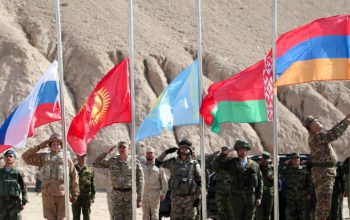
On October 29, the 61st meeting of the Interstate Council on Antimonopoly Policy of the Commonwealth of Independent States (CIS) convened in occupied Stepanakert, hosted by Baku’s State Agency for Antimonopoly and Consumer Market Control. Attendees included Agency Chairman Elnur Baghirov, Belarusian Minister of Antimonopoly Regulation and Trade Aleksandr Yakovchits, CIS Deputy Secretary General Denis Trefilov, and competition officials from Kyrgyzstan, Kazakhstan, and Russia. Delegates discussed digitalization, AI business models, and supply chains, reviewed the work of the Joint Investigation Task Force on antitrust violations, elected Kazakhstan to chair the Council, and set the 62nd meeting in Kyrgyzstan.
Delegates from five states and the CIS secretariat held an important trans-regional meeting in a city bereft of it indigenous Armenian people while it continues to be erased further by genocidal Azeri Baku. Belarus, among them, has stood with Baku through the ethnic cleansing. This is no coincidence and speaks volumes about not only Azerbaijan and the CIS, but what Yerevan and its current regime are pursuing in the region and globally. (Source: CIS Council Meeting in Occupied Stepanakert)
Baku’s NGOs Thank Iran’s President for His Visits to Occupied Stepanakert and Shushi
On October 26, a group of Azerbaijani NGOs published an open letter to Iranian President Masoud Pezeshkian, praising his visits to occupied Stepanakert and Shushi and his “personal dedication” to the Azerbaijani language. They called the so-called “mother tongue” the “spiritual identity” and “historical memory” of millions of Azerbaijanis in Iran. The signatories called on him to realize the “constitutional rights of Iranian Azerbaijanis” through native-language schooling, new secondary and higher institutions, teacher training, textbooks, and legal mechanisms.
Baku’s front groups thank Tehran’s president for touring Armenian cities Baku emptied and continue to destroy, then press him on behalf of Iran’s Azerbaijanis. Every visit by a head of state lends the occupation and the genocide ongoing legitimacy. (Source: Letter to Pezeshkian)
A D.C. University Hosts Baku’s Diaspora Committee to Promote Occupied Artsakh
On October 29, Bay Atlantic University in Washington, D.C., hosted something called “Global Bridges: Discover Azerbaijan,” organized by the Global Education, Culture & Society Alliance (GECSA) with support from Azerbaijan’s State Committee on Work with the Diaspora. Paolo von Schirach, a professor at the university and president of the Global Policy Institute, recounted attending the Global Media Forums in occupied Shushi and praised what he wrongly termed the “reconstruction and rehabilitation” under way. The event framed the Azeri occupation and genocide ongoing as “revitalization” of occupied Artsakh within Azerbaijan’s “multicultural traditions.”
A U.S. campus lent its stage to a Baku state committee’s account of land it emptied of its Armenians. The Shushi media forums von Schirach attended exist to whitewash those crimes. (Source: Event at Bay Atlantic University)
Bayramov Tells the Turkic Summit That 100,000 People Now Live in Occupied Artsakh
At the 13th Summit of the Organization of Turkic States (OTS) in Ankara on October 30, Azeri Foreign Minister Jeyhun Bayramov demanded that Armenia must take the “necessary political and legal steps” to sign a peace agreement. He claimed Azerbaijan has “fully restored its territorial integrity and sovereignty,” ending, what he called, “the conflict” and producing a peace text initialed on principles Baku itself proposed. He claimed that “restoration and construction” in occupied Artsakh now support approximately 100,000 people who purportedly live, work, and study there. The summit adopted the Ankara Declaration.
Bayramov’s 100,000 live on land from which 150,000 indigenous Armenians were ethnically cleansed and forced out. “Restored sovereignty” is his name for ethnic cleansing, and the “necessary legal steps” are the forced constitutional changes Baku demands of Armenia. (Source: Bayramov Statement at OTS Summit)
The Center for Armenian Research and Analysis (CARA) is a trans-national research institute that provides investigative, analytic, and informational resources to public and private entities across the Armenian experiential spectrum.