
On June 11, 2025, NVIDIA and San Francisco–based, Armenian-founded startup Firebird.ai announced a $500 million plan to build a 100-megawatt data center in Yerevan — a project rolled out as a strategic partnership with the government. Firebird.ai is a previously unheard of company which secured what was essentially the largest no competition tender in the history of Armenia. It was founded by Razmig Hovaghimian and Alexader Yesayan. Exactly one week later, on June 18, Samvel Karapetyan — the Tashir Group magnate whose holdings include the Electric Networks of Armenia (ENA) — was arrested under circumstances many observers called dubious, and the state moved swiftly to seize control of the country’s distribution network. These are not isolated incidents: Karapetyan’s Russian ties and his position as the grid’s informal gatekeeper made him a political obstacle to the kind of regulatory guarantees hyperscalers demand. A 100-MW, always-on customer is a grid-scale load that requires firm capacity commitments, bespoke contracts, and political certainty — things investors extract from regulators and state actors, not markets. By sidelining the last domestic counterweight and installing a pliant regulator, the government has converted public infrastructure into a tool to underwrite foreign tech profits
On August 8, 2025 Pashinyan and Trump signed numerous bilateral Memorandums of Understanding(MoUs). Of particular note was the MEMORANDUM OF UNDERSTANDING between the Government of the United States of America and the Government of the Republic of Armenia regarding an AI and Semiconductor Innovation Partnership. It outlined the following
- Exploring opportunities to further develop Armenia’s semiconductor ecosystem.
- Encouraging private sector investment; also through exploring joint projects and public- private partnerships to accelerate practical implementation of this Memorandum of Understanding (hereinafter “MOU”).
- Increasing mutual exchanges of information on best practices for development of secure semiconductor supply chains and artificial intelligence applications;
- Enhancing bilateral and international discussions on best practices for export controls;
- Facilitating joint academic and research partnerships (also through the potential establishment of an Armenia-USA binational science foundation) on semiconductors, and supply chain resiliency to support innovation, workforce development, knowledge and technology transfer.
Raising awareness among US private sector, associations and other relevant stakeholders about semiconductor ecosystem and trusted export control mechanisms existing in Armenia. - Enhancing export controls for secure semiconductor supply chains;
- Strengthening effective export controls for artificial intelligence application and model development;
- Strengthening cooperation between the Participants to define, identify and prevent diversion of artificial intelligence resources;
- Preparing the workforce to effectively use and integrate artificial intelligence applications, including issues of freedom, accuracy, integrity, and purpose.
- Opportunities for promoting investment and infrastructure development in Armenia’s high-tech sector.
To understand why the government moved so aggressively against Samvel Karapetyan, one must revisit the corporate struggle that reshaped Armenia’s telecom sector in 2020. UCOM, once celebrated as the country’s most innovative telecom operator, was co-founded and led by Hayk and Alexander Yesayan, who grew it into a major internet and mobile provider. But as UCOM expanded, its shareholder base diversified: major investors such as the Khachatryan family and Samvel Karapetyan’s Tashir Group acquired significant stakes, with Karapetyan reportedly holding around 16% through his Forum Bank and related vehicles.
The relationship soon turned adversarial. In early 2020, UCOM’s board explored a potential acquisition of VEON Armenia (Beeline), a move that would have transformed UCOM into a near-monopoly telecom operator. The Yesayan brothers opposed the terms of the merger, citing loss of control and the dilution of their already diminished shareholding (about 6%). When the board pressed forward, more than 400 employees — including key technical staff — resigned in protest alongside the founders. This was one of the largest corporate walkouts in Armenian history.
The Yesayans did not leave the sector quietly. Within months they established TEAM LLC (Telecom Armenia) and, in October 2020, acquired VEON Armenia outright — the very asset that had triggered the UCOM conflict. The acquisition was approved by Armenia’s State Commission for the Protection of Economic Competition, effectively anointing TEAM as the country’s second major telecom operator. With VEON’s network in hand, TEAM became not just a mobile player but a national internet backbone provider with ambitions to serve as a transit hub between Europe, the South Caucasus, and the Middle East — precisely the role UCOM had once pursued with financing from Karapetyan’s Tashir.
This history reframes Firebird.ai’s rise. Alexander Yesayan is not merely a startup founder who happened to attract NVIDIA funding; he is a telecom baron whose company now controls a major share of Armenia’s data transit infrastructure. The Firebird data-center deal is not just a tech project — it is the vertical integration of compute, connectivity, and political backing, executed by an actor who already displaced Karapetyan once before in the telecom sector. Seen through this lens, Karapetyan’s June 2025 arrest looks less like an isolated crackdown and more like the final clearing of a rival whose grid ownership could slow or complicate the hyperscale build-out.
Investors care about certainty. A 100 MW, 24/7 facility cannot break ground without ironclad guarantees of power delivery, interconnection, and tariff stability for decades. That means the government must either negotiate with the grid owner (Karapetyan’s ENA) or neutralize him. By nationalizing ENA and appointing a loyal caretaker, the Pashinyan administration did exactly what a risk-averse investor would want: it removed the possibility of a hostile shareholder blocking power contracts or driving up costs, and it delivered a unified negotiating counterparty — the state itself.
Yet this maneuver creates a paradox. Western investors claim to prize the “rule of law” and warn about reputational risk when governments seize assets. But in this case, the asset seizure directly benefits them: it secures the grid, the tariffs, and the political certainty they require. It is difficult to imagine a more investor-friendly outcome than eliminating a politically inconvenient stakeholder and converting the grid into a government-managed project delivery vehicle.
The winners, then, are not just NVIDIA and its backers but the Yesayans, whose telecom empire now stands to profit from carrying, processing, and monetizing the very data flows their former rival could have complicated. The losers are Armenian ratepayers, who will finance the grid upgrades and bear the higher tariffs that make the investment bankable — and perhaps Karapetyan himself, who has been turned from stakeholder to scapegoat in less than a week.
Ari Peskoe the Director of the Electricity Law Initiative at the Harvard Law School Environmental and Energy Law Program recently put out a study called Extracting Profits from the Public: How Utility Ratepayers Are Paying for Big Tech’s Power.
Based on our review of nearly 50 regulatory
proceedings about data centers’ rates, and the long history of utilities exploiting their
monopolies, we are skeptical of utility claims that data center energy costs are isolated from
other consumers’ bills. After describing the rate mechanisms that shift utility costs among
ratepayers, we explain how both existing and new rate structures, as well as secret
contracts, could be transferring Big Tech’s energy costs to the public.
Data centers today are not small server rooms — they are industrial-scale power plants. The Harvard/ELI report shows the AI boom has pushed firms to plan facilities consuming hundreds of megawatts; Armenia now finds itself in this picture with the NVIDIA–Firebird project announced June 11, 2025, slated at 100 MW. For a country whose nuclear station produces only about 400 MW, that is one-quarter of its sole nuclear output and roughly 7% of peak winter demand. The project isn’t just another investment; it is a structural shock to a fragile national grid.
That scale matters because once a single customer requires such a chunk of national capacity, normal regulatory assumptions collapse. In Armenia, responsibility for approving tariffs and interconnection deals lies with the Public Services Regulatory Commission (Armenia’s PUC equivalent). In other countries, utilities pitch PUCs on “special contracts” for data centers, claiming costs won’t spill over. But as the Harvard report documents, those contracts are often filed confidentially, preventing public or even intervenor scrutiny. Armenia risks adopting the same opaque template.
The political context deepens suspicion. Exactly one week after the Firebird announcement, Samvel Karapetyan — owner of ENA, Armenia’s sole electricity distributor — was arrested, and Prime Minister Pashinyan moved to nationalize ENA. Whatever the official justifications, the sequence suggests a political clearing of obstacles: neutralize a Russian-linked oligarch who might resist sweetheart contracts with Western tech firms, and bring the grid under direct state leverage just as hyperscale projects are proposed.
The Harvard evidence on special contracts matters here. Confidential deals let utilities and regulators claim there is no cross-subsidy, while hiding the spreadsheets and assumptions. In the U.S., this has allowed billions in grid upgrades to flow quietly into general rates. If Armenia’s regulators adopt similar secret PPAs with hyperscalers, the real bill for NVIDIA’s data farm won’t fall on Silicon Valley shareholders but on Armenian households.
Transmission allocation is another channel. In the U.S., regional cost-sharing rules ensure transmission expansion tied to data centers is spread across all ratepayers. Armenia, with a much smaller grid, faces an even sharper dilemma: if massive reinforcement is required for a 100 MW hub, ENA (or its successor under state control) will almost certainly spread costs across the entire tariff base. That means ordinary Armenians — still scarred by the memory of “Electric Yerevan” protests — could end up financing private AI infrastructure.
Two additional levers heighten the risk. First, demand-charge design allows big users to game tariffs by shaving peak demand, leaving unrecovered fixed costs to smaller customers. Second, Armenia’s limited generation mix — with Metsamor, gas-fired plants, and imports — means any preferential deals with data centers could distort wholesale markets, raising costs for everyone else. The Harvard report warns such behaviors are hard to police even in wealthy regulatory systems. For Armenia’s weaker institutions, the danger is amplified.
The political economy of ENA’s nationalization thus becomes clearer. Karapetyan, linked to Moscow, would likely have exposed or resisted contracts that shifted burdens onto ratepayers. Removing him, and consolidating the grid under the state, clears the path for confidential deals with Western tech capital. But this gamble comes with costs: foreign investors already launched arbitration over ENA’s expropriation, warning of reputational damage. So Armenia may end up both socializing data-center costs domestically and alienating other investors internationally.
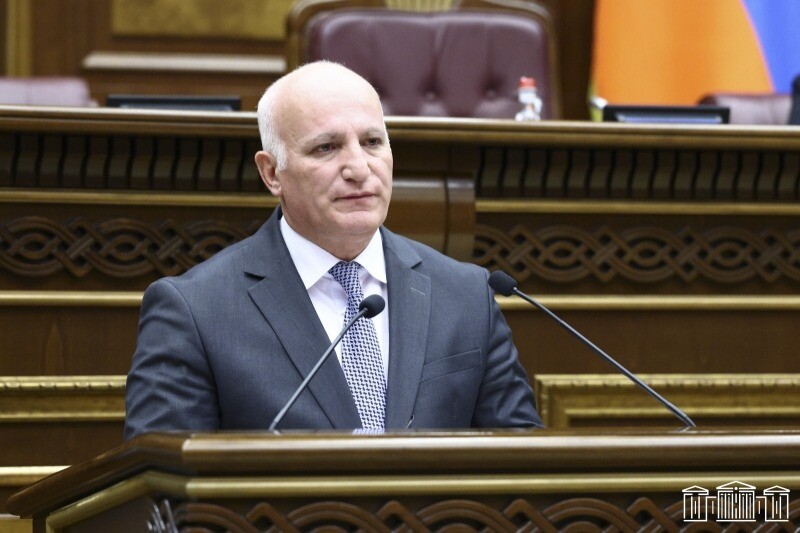
Public utilities are usually monopolies, and for that reason most states create Public Utility Commissions (PUCs) to regulate them. The idea is simple: because consumers cannot choose their electricity provider, the state must step in to keep rates justifiable, contracts transparent, and infrastructure decisions aligned with the public interest. Armenia is no exception. Its version of a PUC is the Public Services Regulatory Commission (PSRC), which carries the same formal mandate — to balance consumer protection, fair pricing, and long-term system reliability. Yet that mandate only holds if the regulator is independent. On June 18, PSRC chairman Mesrop Mesropyan, himself a Civil Contract politician, appointed Romanos Petrosyan as temporary manager of ENA, the country’s sole electricity distributor. This is not a minor personnel change: it placed a party loyalist in direct control of the grid at the exact moment a hyperscale data center was being pushed forward. The institution meant to defend Armenians against unnecessary price hikes is now positioned to facilitate them, not because the economics demand it, but because the government does.
Western firms cannot make projects of this scale work without political intervention. A 100 MW hyperscale facility in a country the size of Armenia is commercially unviable unless the state clears the field, secures the grid, and assumes the risk. That is why the arrests, the rushed appointments, and the nationalization drive matter: they transform a speculative proposal into an investment climate tailored for outside capital. Instead of the market bearing risk, the Armenian government bends its regulatory machinery to guarantee profitability for foreign partners.
This also explains why Karapetyan was such an obstacle. As a Moscow-aligned figure with control over ENA, he was unlikely to rubber-stamp confidential deals that shifted costs to households while foreign investors extracted rent. His interests were rooted in the stability of the grid and its consumers, not in facilitating Western projects designed around secrecy and socialized costs. Removing him was not about corruption or legality; it was about sidelining a counterweight to policies that privilege foreign capital over national interest.
Seen in this light, the government’s seizure of ENA is less about protecting Armenians and more about stripping them of protection. The PSRC, under party control, can now authorize private agreements with hyperscalers without resistance, locking the population into years of higher tariffs. The very institution designed to defend the public has been repurposed into a tool for shepherding Armenia into an arrangement where risks are borne locally and profits exported abroad.
And there is a deeper irony: Western officials present these projects as markers of modernization and sovereignty, yet by tearing control of the grid away from Karapetyan’s hands, the government has eroded the one line of defense against dependency. Energy is the ultimate lever of national security; placing it at the disposal of opaque contracts tied to foreign data centers only multiplies vulnerability. What is framed as “diversification” is in practice a new dependency, one that removes Russian-linked stewardship of strategic infrastructure and replaces it with a Western model of extraction dressed up as progress.
April 14, 2020

Yesayan Brothers Resign
On April 14, Ucom co-founders, brothers Hayk and Alexander Yesayan (holding 6% shares) announced that they have offered more than 34 billion drams to the remaining owners of the company for the rest of the shares, in order for them to have decisive voice in the decisions of the shareholders. On April 15 it was announced that the Board of Directors of the company has appointed a new CEO, Ara Khachatryan.
June 11, 2025

Firebird.AI and NVIDIA Announce Project
Firebird, an AI cloud company, and the Armenian government this week announced plans to launch a 100MW AI data center in 2026. Firebird, which has emerged from stealth in this announcement, said the project will funded via a $500 million public-private partnership with the Armenian government.
June 17, 2025

Samvel Karapetyan Arrested
Karapetyan was detained a day after making a statement in defence of the church in its confrontation with Prime Minister Nikol Pashinyan. Following his viral remarks, his house in Yerevan was raided and he was taken into custody and charged with calling for the usurpation of power in Armenia.
July 3, 2025

ENA Nationalized
Armenia’s parliament by a vote of 65-27, approved a government-backed bill to nationalize the country’s electricity distribution utility – Electric Networks of Armenia (ENA).
July 18, 2025

Petrosyan Appointed Interim Manager
“The Chairman of the PSRC has issued a decision to initiate administrative proceedings and implement preventive measures.
Based on a report submitted by the authorized body of the Government of the Republic of Armenia, the PSRC Chairman initiated administrative proceedings against the Electric Networks of Armenia CJSC and appointed Romanos Petrosyan as the company’s interim manager.The decision will come into force the day after the company is officially notified in accordance with the law,” states the PSRC Chairman’s decision dated July 18.
August 8, 2025

MoU on AI and Semiconductor Innovation Partnership
Pashinyan and Trump sign bilateral agreements that coincide with the aforementioned developments now creating a legal framework which to operate in.
Data centers are already forcing new fossil-fuel infrastructure in places like the United States rather than accelerating a clean-energy transition. Reporting and advocacy analysis show utilities are using projected AI demand to justify gas and other fossil builds, and Berkeley Lab / sector summaries warn that data-center electricity demand could rise from the low tens of gigawatts today to multiple-dozen-GW by 2030 — with a very large share of that current load coming from fossil sources. In short: when hyperscalers arrive, the first path taken by many incumbent utilities is to meet them with fossil capacity rather than clean-power build-outs.
Cooling these machines adds a second, underappreciated burden: water. Investigations show individual hyperscale sites can consume millions of gallons of potable water per day for evaporative and closed-loop cooling top-ups; universities and industry reporting flag entire regions where clustered data centers have materially increased local water stress. Those are not abstract risks for Armenia — they are precisely the kinds of resource pressures a small water-stressed country must weigh before signing opaque long-term deals.
Armenia’s hydrological safety net has been narrowed in recent years: a large share of the region’s storied water infrastructure — most prominently the Sarsang reservoir and its feeding rivers — sits inside what was the Artsakh Republic. Sarsang is not some remote detail; it has been a major freshwater reserve and irrigation source for the region, and changes to its management and inflows have already reduced downstream supplies and altered seasonal flows. That loss is material for any new, large industrial water demand placed on Armenia’s smaller basin.
Data centers are famously thirsty. Recent sector analyses and reporting show hyperscale sites routinely require millions of gallons a day for evaporative or makeup water in cooling systems, and clustered build-outs can materially raise local water stress in otherwise constrained basins. The University of Tulsa and climate/energy briefs document exactly this pattern: tech hubs can outcompete agriculture and municipal uses for potable water unless siting, cooling technology, and binding allocations are controlled up front. In short: a 100 MW, 24/7 data campus isn’t only an electrical shock to the grid — it is a major new claim on potable and process water.
Put those two facts together and the arithmetic is stark. With parts of Artsakh’s reservoirs no longer reliably available and with Armenia’s limited storage and groundwater constraints, adding a hyperscaler that demands continuous water for cooling forces trade-offs: who loses — farmers, city residents, or the data center? The likely near-term path, absent hard legal protections, is to allocate municipal potable water or fund new (and often fossil-fuelled) generation and water infrastructure through public or utility financing — in other words, to socialize environmental and resource costs while the profits are exported. That dynamic magnifies the colonial pattern: not only energy and tariffs, but essential water supplies become vectors of extraction.
Yerevan already suffers significant air-quality and water-supply problems, which means added fossil generation or higher local emissions will hit vulnerable communities hard. Measured PM2.5 levels in Yerevan routinely exceed WHO guidelines and local reporting documents seasonal spikes from dust, traffic, construction and heating; Armenia as a whole faces high water-stress and reservoir/management challenges noted by the World Bank and local analysis. Adding a 100 MW, 24/7 load that is met by new gas plants or by burning more imported fuel will worsen local pollution (NOx, particulates) and greenhouse emissions at the same time those same data centers will be sucking down potable water for cooling.
Because Armenia’s grid and environmental safeguards are smaller and weaker than U.S. regulators’, the marginal impact of one hyperscaler will be bigger. Metsamor’s ~400 MW of firm output and a limited generation mix mean a new 100 MW continuous customer is unlikely to be met by “excess” renewables without deliberate, binding commitments; absent credible, audited additionality and pre-funded infrastructure, the cheapest near-term option for suppliers is fossil-fired capacity and municipal water allocations — costs and pollution that will be socialized onto Armenian households. Any policy brief or op-ed that does not insist on legally binding renewables-only PPAs, upfront developer-funded grid upgrades, and strict water-use limits hands Western capital a license to extract rather than to invest.
They have sacrificed the people for capital. The swift arrest of Samvel Karapetyan and the seizure of ENA were not neutral acts of law-enforcement—they were a political operation that removed the last institutional check on who controls Armenia’s power and water. By clearing the way for a predatory data center and putting a party loyalist in the regulator’s seat, the state traded public welfare—affordable electricity, clean air, dependable water—for the guaranteed profits and operational conveniences of outside investors. That is not progress; it is dispossession dressed up as “investment.”
When the apparatus of regulation is repurposed to underwrite private rents, the social surplus that should fund schools, hospitals, and local industry is instead redirected to remote servers and foreign balance sheets. Ordinary Armenians will carry higher bills, dirtier air, and scarcer water while the beneficiaries—developers, funds, and distant shareholders—amass returns insulated from local costs. Calling this a betrayal of the public interest is not theatre; it is a plain accounting of who pays and who profits.
There can be no neutral language for what happened: the state has chosen to subordinate the commons to capital and to silence the domestic counterweights that might have defended it. That choice—legalized by emergency decrees and managerial appointments—marks a political realignment in which sovereignty is ceded not in battle but by contract. History will record whether this was a forced “modernization” or a conscious sell-off; the morality is already clear. Those who engineered and enabled this transfer of burden should be held accountable for sacrificing the wellbeing of the people to secure profits for others.