Armenia’s confrontation between Prime Minister Nikol Pashinyan and the Armenian Apostolic Church deepened over Christmas week, with Catholicos Garegin II accusing the authorities of “repression” against the Church’s leadership and the government doubling down on a drive to unseat him—even as one of the imprisoned archbishops prepares an appeal to the European Court of Human Rights (ECHR).
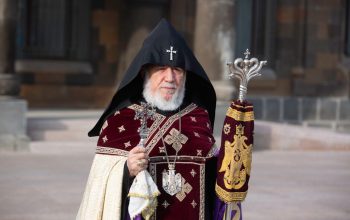
During the January 6 Christmas mass at the Church’s main cathedral in Echmiadzin, Garegin declared the Church “firm and unshaken” in the face of what he described as a continuing crackdown on senior clergy. He said the pressure campaign has struck at the authority of the state and inflicted a “deep wound” on communities and believers, condemning what he called “unlawful and anti-canonical actions.”
Pashinyan staged a competing show of force in Yerevan the same day. He attended a Christmas service at St. Gregory the Illuminator Cathedral alongside senior officials and members of the ruling Civil Contract party. The liturgy was led by one of ten bishops who broke ranks in late November and joined the prime minister’s campaign against Garegin.
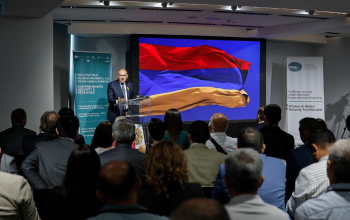
After the service, Pashinyan led several thousand people—Azatutyun reported that the crowd “reportedly included public sector employees”—on a march to another church in the city center. There, he again insisted the Church must be “liberated” from Garegin, who was elected Catholicos in 1999 by a pan-Armenian assembly of clerics and laypeople. Pashinyan framed his push as a defense of the state, saying he will not allow “some” to use the Church “as a platform against the state,” and added the line bound to inflame critics: “the church and the state are together from now on.”
That declaration landed directly on a constitutional fault line. Azatutyun noted that Armenia’s constitution guarantees the Church’s autonomy and separation—an issue that returned to the center of public debate after Pashinyan signed a joint statement with the renegade bishops pledging, in his official capacity, to continue efforts to oust Garegin. «Ազատ Եվրոպա/Ազատություն» ռադիոկայան
Arrests, Pressure, and a Growing Political Case
The escalation has unfolded alongside arrests of senior clergy loyal to Garegin. Azatutyun reported that three archbishops and one bishop aligned with the Catholicos were arrested between June and December on various charges they have rejected as politically motivated.
One of those detained figures, Archbishop Bagrat Galstanyan, led large anti-government protests in 2024, protests triggered by anger over Pashinyan’s territorial concessions to Azerbaijan. The government, in turn, accused the Church of meddling in politics during and after those demonstrations.
Azatutyun also traced the political arc of the showdown to late spring 2025, reporting that Pashinyan’s attacks on the Church leadership intensified after Garegin publicly accused Azerbaijan of ethnic cleansing in Nagorno-Karabakh, the destruction of Armenian churches, and illegal occupation of Armenian border areas. Domestic critics told the outlet they believe the prime minister’s campaign aims to please Azerbaijan and/or neutralize a major center of opposition to his unilateral concessions.
Ajapahyan’s ECHR Move: “Political Opinion” Treated as Crime
Against that background, lawyers for jailed Archbishop Mikael Ajapahyan announced on January 7 that they plan to take his case to the ECHR, challenging earlier court rulings that kept him in pre-trial detention.
According to Azatutyun, Ajapahyan was arrested on June 27, one day after Pashinyan threatened to forcibly remove Garegin from Echmiadzin. Investigators charged the 62-year-old cleric with calling for a violent overthrow of the government, citing remarks made in a June 2025 interview.
Ajapahyan rejected the accusations as politically motivated. His “unusually quick” trial ended on October 3, when a court of first instance sentenced him to two years in prison—a verdict he has appealed. His defense argues he expressed a political view and never intended to act on it, and that the authorities used detention as punishment rather than necessity.
Defense lawyer Ara Zohrabyan said they will argue in Strasbourg that the detention decisions violated European Convention protections for free expression and fair trial rights and barred discriminatory treatment by law enforcement. Zohrabyan also said the alleged offense did not require pre-trial detention and insisted Ajapahyan posed no realistic flight risk and could not influence “non-existent witnesses.”
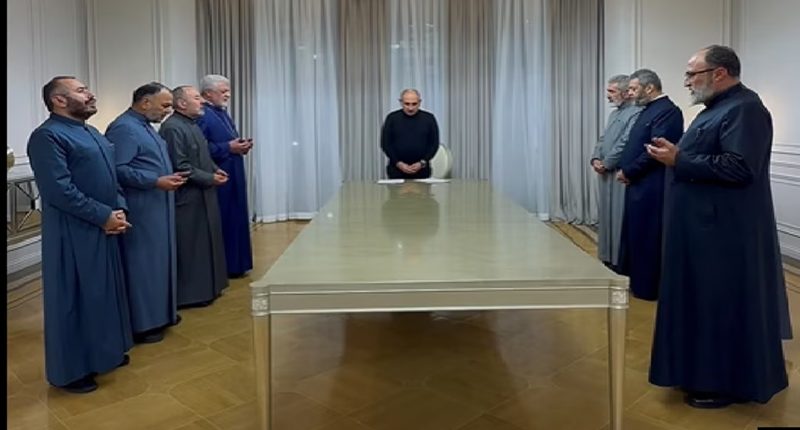
Even from custody, Ajapahyan has continued to challenge the government’s campaign against Garegin and to condemn the bishops who joined Pashinyan’s push
A Battle for Institutions Ahead of 2026
Taken together, the Christmas mobilization and the string of clergy arrests have sharpened a single political reality: the government is no longer arguing with the Church. It is moving against it.
Azatutyun reported that Pashinyan first threatened in late June to remove Garegin by force and spoke afterward about preparing supporters to rally for that purpose, prompting opposition groups to urge their own supporters to be ready to defend Echmiadzin.
With Ajapahyan’s case headed toward Strasbourg and the constitutional question of church–state separation pushed into the open, the confrontation is shifting from street pressure to institutional legitimacy—courts, law enforcement, and the state’s relationship to the one national institution that has survived every regime change in Armenian history.