Dr. Prof. M. Mkhitar Moradian, PhD, Bioanalyst
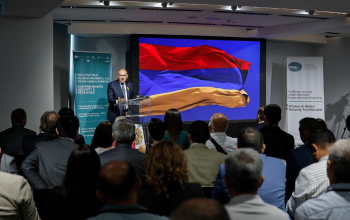
The Diaspora Mobilization Conference held in Paris on April 11–12, 2026, was not just another gathering. It was a clear and decisive demonstration that the Armenian Diaspora remains a powerful, organized, and indispensable force in shaping the future of the Armenian nation.
At a time when Armenia faces profound geopolitical, institutional, and identity crises, the conference proved that Diaspora communities are not passive observers, but active stakeholders prepared to act. As a participant and panel moderator, several nearly indisputable facts impressed me most.
An Unprecedented and Successful Mobilization
Bringing together 150 participants from 26 countries, the Paris conference represented one of the most significant mobilizations of Armenian Diaspora intellectual and activist leadership in recent years.
This was not a symbolic meeting. It was a deliberate convergence of thinkers, organizers, professionals, and community leaders who came together with a shared purpose: to demonstrate unity, capacity, and commitment to Armenia.
What made this gathering particularly important was the quality, not merely the quantity, of participation. The attendees included individuals deeply engaged in political advocacy, academia, law, and community organization. Their presence signaled something essential: the Diaspora is not fragmented or disengaged. It is organized, capable, and ready to mobilize when necessary.
The success of the conference lies in this very fact. It showed that Armenians across continents can coordinate, speak with clarity, and act collectively when the stakes demand it. That alone marks this event as unprecedented.
A Necessary Response to Political Alienation
The importance of the Paris conference must also be understood in its political context. In recent years, there has been growing concern among Diaspora communities about policies and rhetoric emanating from the Armenian government that appear to distance Armenia from its Diaspora. This perceived alienation is not a minor issue. It strikes at the core of Armenian national continuity.
When the connection between Armenia and its Diaspora weakens, the entire Armenian global system is destabilized. Historically, the strength of the Armenian people has rested on this dual structure: a sovereign homeland and a globally active Diaspora. Any effort, intentional or not, that undermines this relationship risks weakening both.
Moreover, in a region defined by strategic competition and coordinated external pressures, fragmentation within the Armenian world creates vulnerability. Whether viewed through a geopolitical lens or a national security framework, disunity serves external interests far more than Armenian ones.
The Paris conference was therefore not only a gathering. It was a counteraction. It reaffirmed that Diaspora communities will not accept marginalization and will continue to assert their role in shaping national priorities and protecting Armenian interests.
Why the Diaspora Must Recenter Armenia
A central message of the conference was clear: the Diaspora must not limit itself to preserving identity abroad. Cultural survival alone is not sufficient. The long-term viability of the Diaspora is inseparable from the strength of Armenia itself.
For decades, Diaspora communities have invested in education, culture, and identity preservation. These efforts are essential, but they must now be complemented by a renewed focus on strengthening Armenia as a state. Economic development, institutional resilience, national security, and international positioning are not abstract concerns. They are the foundation upon which the future of all Armenians depends.
A weak Armenia cannot sustain a strong Diaspora indefinitely. Conversely, a strong, stable, and strategically positioned Armenia amplifies the influence and security of Diaspora communities worldwide.
This is the shift the Paris conference began to articulate: from a Diaspora that primarily sustains itself to a Diaspora that actively contributes to building and securing the Armenian state.
The absurd notion that the Armenian Diaspora should confine its efforts solely to its own communities, detached from Armenia, is fundamentally flawed and strategically shortsighted. The Diaspora does not exist in isolation. Its identity, legitimacy, and long-term continuity are inseparably tied to the existence and strength of Armenia as a sovereign state.
To argue otherwise is to ignore both historical reality and present-day geopolitical dynamics. A Diaspora that turns inward risks becoming culturally static and politically irrelevant, while a weakened Armenia undermines the very foundation upon which Diaspora identity is built.
Sustainable Diaspora vitality depends not only on preserving language, culture, and institutions abroad, but also on actively contributing to the stability, development, and security of the homeland. Any framework that attempts to sever or diminish this relationship ultimately weakens both. One need only look to the Assyrian experience to understand the consequences of statelessness and the dangers of a homeland weakened beyond repair.
Conclusion: From Symbolism to Strategy
The Paris 2026 conference should be understood as a turning point. It demonstrated that the Armenian Diaspora retains the ability to mobilize at scale, articulate a coherent vision, and engage in serious, strategic thinking about the future.
More importantly, it sent a message: the Diaspora is not peripheral. It is central. It will not disengage, and it will not be sidelined.
The next phase must move beyond conferences and toward implementation. The strength displayed in Paris must translate into coordinated action, institutional frameworks, and sustained engagement with Armenia.
If that happens, this conference will not merely be remembered as a successful gathering. It will be recognized as the moment when Diaspora mobilization evolved into a strategic and decisive force shaping Armenia’s future.