Opposition MPs in Armenia say the country now has “more than six dozen” political prisoners, a claim the authorities categorically reject.
Speaking from the National Assembly podium at hearings titled “Political Prisoners and the Restoration of Their Violated Rights,” opposition MP Elinar Vardanyan of the “Armenia” faction presented a draft statement alleging growing pressure on citizens for their political views.
“According to our data, more than 60, and by my estimate almost 70 people are under criminal prosecution for clearly political reasons, and nearly 40 of them are in penitentiary institutions,” Vardanyan said.
The draft statement does not list names but asserts that clergymen, current and former officials, local self-government representatives, benefactors, and ordinary citizens critical of the government are being targeted. Vardanyan, however, highlighted one case in particular: that of Lidya Mantashyan, charged with attempted terrorism and preparing to usurp power. Her pre-trial detention and the ban on visits remain in force.
“Lidya Mantashyan is currently the only female political prisoner,” Vardanyan said. “Just a few days ago the court extended her detention by another three months. This cannot be described as anything other than punishment.”
Other opposition MPs and lawyers used the hearings to spotlight the cases of Archbishops Michael and Bagrat, businessman Samvel Karapetyan, former Masis mayor Davit Hambardzumyan, former Gyumri mayor Vardan Ghukasyan and others, arguing that all of them meet the criteria of political prisoners.
“A person recognized as a political prisoner is not necessarily innocent,” Vardanyan noted. “The political component may lie in the selective application of the law, in disproportionately harsh sentencing compared to others who committed similar acts without a political background, or in an unfair trial that still results in conviction.”
Government representatives deny that Armenia has any political prisoners at all, arguing that if such cases existed, at least one international organization would have raised the issue. Opposition speakers, in turn, repeatedly criticized what they called the “silence” of international bodies.
Former MP Naira Zohrabyan recalled that international organizations once followed this topic much more closely: “During any such discussion, Svitalski would lie down on a bench and not go anywhere,” she said, referring to former EU Ambassador Piotr Świtalski’s constant presence at such debates.
Representatives of international structures were formally invited to the hearings, but only the political officer of the US Embassy in Armenia attended, according to the session’s opening announcement.
The absence of Prosecutor General Anna Vardapetyan also angered the opposition.
“We are planning specific political and legal steps in response to this behavior of the Prosecutor General,” said Artsvik Minasyan, secretary of the “Armenia” faction.
To underscore their point, the organizers lined the government benches in the chamber with printed photographs of those they regard as political prisoners. No government MPs attended the session. Only the Speaker of the National Assembly briefly responded to criticism, speaking from the press gallery rather than his official seat.
“It’s good they had this idea, they put up pictures so the hall is at least somewhat full,” he remarked. “They can also hang photos in the remaining empty seats — for example, from the past, so people remember those who broke journalists’ jaws, beat people in stairwells, shut down TV channels.”
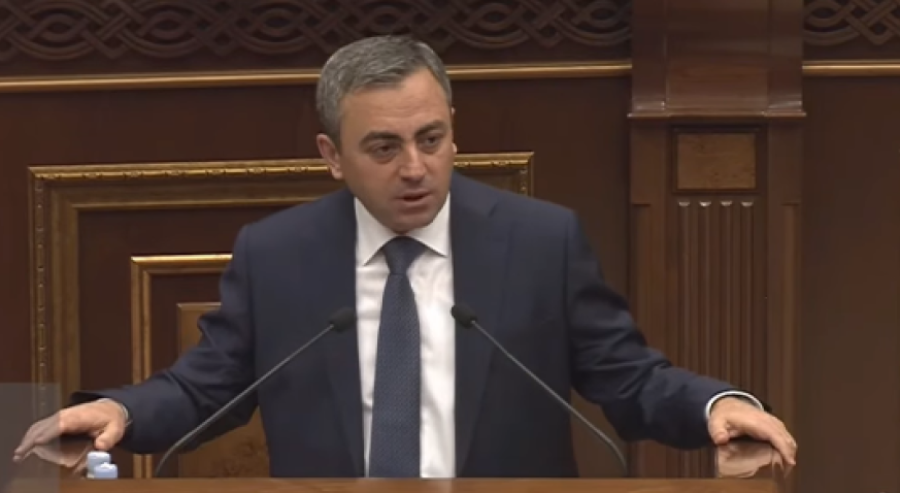
While the government insists there are no political prisoners in Armenia, the opposition says it is looking for ways to coordinate its response. Ishkhan Saghatelyan of the “Armenia” faction used his speech to call for cooperation among all opposition forces.
He proposed a common agenda that would include using every legal mechanism to counter political persecution, defending the Armenian Church and political prisoners, ending mutual smear campaigns within the opposition camp, and uniting to monitor the pre-election, election and post-election processes to prevent abuses by the authorities.
“I announce that we will begin consultations with all opposition forces in Armenia next week,” Saghatelyan said. “We must achieve full consolidation, at least around the issues I have outlined.”
Following the hearings, the draft statement on political prisoners will be revised and sent back to the parliament’s state and legal affairs committee. A previous discussion in the same committee ended without a vote.