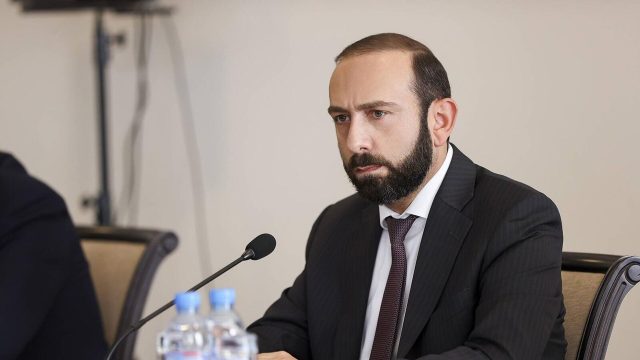
Armenia’s Foreign Minister Ararat Mirzoyan acknowledged on Wednesday that last month’s U.S.-brokered agreements with Azerbaijan have not fully resolved the decades-long conflict between the two countries.
“We are still at the beginning of the road,” Mirzoyan told lawmakers during a question-and-answer session in the National Assembly. “Peace is a long process. It requires care, concern, and caution — both in what is said and in what is signed. After all, there is a long history of feud and bloodshed between the two peoples.”
Mirzoyan stressed that even a formal peace treaty would not mark the end of all tensions. “If we sign the peace treaty soon, we still cannot claim that everything is over and that peace has been fully established,” he said. “At best, we will have a situation where the sides are not shooting at each other and the risk of escalation is close to zero. But numerous problems remain.”
Chief among those problems, he said, is Azerbaijan’s continued refusal to release at least 23 Armenian prisoners still held in Baku. The treaty, initiated during the August 8 Washington summit hosted by U.S. President Donald Trump, does not address their release.
The agreement commits Armenia and Azerbaijan to recognize each other’s territorial integrity but does not define their heavily militarized border or create a mechanism for its delimitation. Opposition leaders and critics of Prime Minister Nikol Pashinyan argue that this omission leaves Armenian border communities vulnerable to fresh Azerbaijani incursions.
Baku continues to insist that Armenia amend its constitution, which it claims contains territorial claims against Azerbaijan, as a precondition for signing a final peace treaty. While Pashinyan has rejected this precondition publicly, he has announced plans to hold a constitutional referendum — a move the opposition has vowed to block.
Pashinyan defended the Washington agreements on Wednesday, declaring that “peace has been established” between the two countries and accusing domestic opponents and “external forces” of trying to “torpedo that peace.”
Russia has cast doubt on the deal’s durability. Russian Foreign Minister Sergei Lavrov said on Monday that the agreements could turn out to be a “flash in the pan” and warned that “not everything was agreed upon.”
A key element of the Washington accords is a pledge by Pashinyan to allow the United States to oversee “unhindered communication” between Azerbaijan and its Nakhichevan exclave through Armenia’s Syunik province. The route, dubbed the Trump Route for International Peace and Prosperity (TRIPP), has drawn criticism from Armenian opposition figures, who argue that it amounts to an extraterritorial “Zangezur corridor” long sought by Baku since the 2020 war.
Pashinyan has rejected that characterization, insisting that the agreements preserve Armenia’s sovereignty over Syunik. He has suggested that modern technology will be used to avoid physical contact between Armenian border officials and Azerbaijani travelers.
Opposition MP Agnesa Khamoyan said this proves that Pashinyan has effectively conceded to Azerbaijani President Ilham Aliyev’s demand that “Azerbaijani cargo and Azerbaijani citizens should not see the faces of Armenian border guards.”
Aliyev again referred to the TRIPP as the “Zangezur corridor” earlier this week.