By Nane Avagyan
This year, the Armenian Revolutionary Federation (ARF) celebrated its 135th anniversary with great earnest, proving once again that it continues its activities in Armenia and the Diaspora—based on the ideology of preserving and building the nation—with the same vigor and energy. In November, a conference of Central Committees held in the homeland at the initiative of the ARF Bureau brought together representatives of the party’s structures from dozens of countries to discuss, propose solutions, and assume responsibility for various issues of pan-Armenian significance.
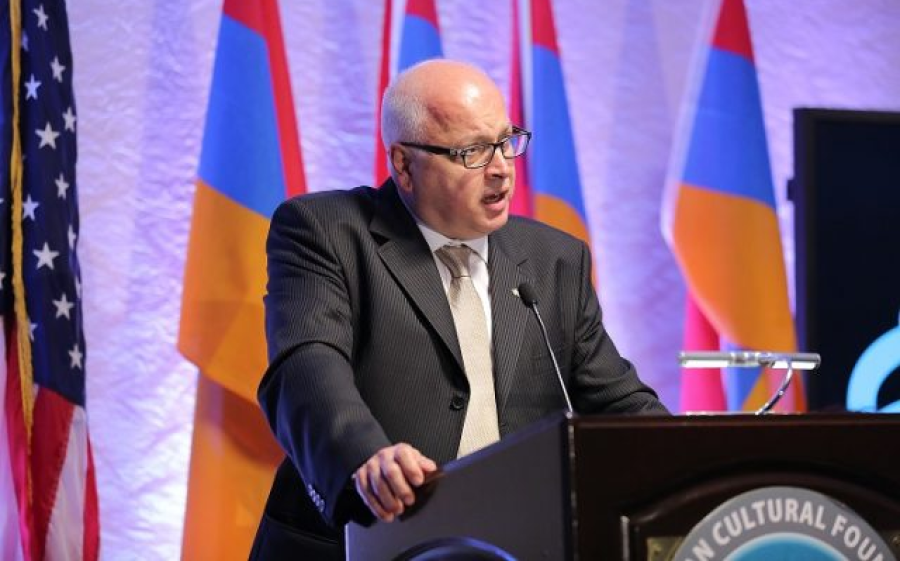
The ARF agenda is served by dedicated party members for whom working for the homeland and the nation is a sacred mission. ARF Bureau member Daron Der-Khachadourian joined the party in 1979 in Lebanon. For more than four decades, in various responsible positions, he has tirelessly served the ARF’s nation-preserving work and has made a significant contribution to the development of the party and the realization of its programs in the Middle East and the United States.
Today, in the next stage of the existential struggle for the Armenian people, Daron Der-Khachadourian is on the front lines as the ARF Bureau’s representative in the Western United States.
In a conversation with Asbarez on December 18, Khachadourian addressed the challenges facing the Armenian people, presented the ARF’s views on vital issues, and spoke about upcoming programs.
Nane Avagyan: The ARF marked its 135th anniversary in Armenia this year, and in November, at the invitation of the ARF Bureau, a conference of Central Committees was held in Yerevan with the participation of worldwide party representatives. Given that the challenges facing the Armenian people today are existential in nature, what operational priorities were established for the party?
Daron Der-Khachadourian: There were representatives from 24 countries at the conference, and it was clear to all of us that Armenia and the Armenian people are living through one of the most strictly decisive moments in our nation’s history. This was an opportunity to speak about the most pertinent issues of our present times. In this case, the main topic was the parliamentary elections scheduled for June in Armenia [2026], and the views of various regions on this matter were discussed.
Also on the agenda was the issue of strengthening and politically activating the Diaspora, considering the presence of numerous regions from different countries—from Americas, Europe, the Middle East, etc. So, this conference was an opportunity to come together once a year and have a cohesive approach to important issues. One thing is clear: the ARF is oriented toward participating in the elections, and the ARF will have a Supreme Assembly in Armenia in January, during which final decisions regarding the elections will be made.
Avagyan: The upcoming parliamentary elections will take place during a most difficult period for Armenia and the Armenian people and will be decisive for the future of Armenia and the entire nation. What is the ARF’s position on the elections?
Der-Khachadourian: According to our party’s assessment—and I want to believe, also the assessment of large masses of the Armenian people—we are standing before a major crossroads in these 2026 elections. This is especially true against the backdrop of the forced ethnic cleansing and depopulation of Artsakh two years ago, the agreement initialed by the leaders of Armenia and Azerbaijan in the United States on August 8, and the less familiar or undeclared Turkey-Azerbaijan preconditions. Accordingly, for us, these elections are very important and significant.
Considering that we are moving from defeat to defeat, from surrender to surrender, from concession to concession, the ARF’s conviction is that a leadership of this quality, character, and type cannot secure a just, stable, and lasting peace. For that reason, these elections truly have important significance because if we do not succeed in achieving a change of power in these elections, and if such an authority continues to govern from 2026–2031 under the Civil Contract or Nikol Pashinyan’s leadership, we will head toward additional concessions, additional defeats, and the loss of our nation’s and homeland’s rights.
I am referring to Armenia’s security, territorial integrity, border delimitation, Syunik, renegotiation of issues regarding the TRIPP road, the pursuit of our national rights—from Genocide recognition and reparations to the safe and collective return of Artsakh Armenians to Artsakh, and so on. Therefore, if these elections do not lead to a change of leadership, the future of the Armenian people and our statehood will be in even more dire conditions and an undesirable situation.
In this context, our conviction is that it is time to wake up. Currently, the Armenian people need to rise, because of the lethargy we have entered, the despair and hopelessness we are in—especially in view of our staged defeat in the 44-Day War, the divisive work vis-à-vis the Diaspora, the hatred sown against Artsakh Armenians by the Armenian authorities, and the security crisis in Armenia. There is disappointment everywhere, and especially in the Diaspora. Accordingly, our call to the people of Armenia and our compatriots in the Diaspora would be to emerge from this lethargy, from this dire state. The Armenian people are in a place today where, if we continue this course, we will stand before serious dangers and threats of losing our identity and endangering our statehood.
Avagyan: The current authorities of Armenia consider the establishment of peace with Azerbaijan as the guarantee for development and the way out of the current situation created around Armenia, which includes numerous preconditions from Azerbaijan. This does not at all testify that Azerbaijan is ready for peace. How does the ARF relate to the establishment of peace of this order? Must peace be paid for at any price?
Der-Khachadourian: We all desire peace; however, when peace is not built on just foundations, it is subject to collapse. France and Germany had the conflict over the Alsace regions, and they had three wars which ended as the main subject of world wars. For that reason, our people’s struggle is existential and continues. Turkey and its little brother Azerbaijan are working ceaselessly not only to neutralize us but to exterminate us, the first stage of which was the Armenian Genocide of 1915, and the second stage was the 2020 Artsakh War and the 2023 ethnic cleansing of Artsakh.
There must be peace, and we are also advocates of it. However, peace must be on just foundations, in which Armenia clearly has the capacity to defend itself and maintain its territorial integrity, the Armenian people are able to build their future in Armenia peacefully and justly, and a solution is found for the Artsakh issue—and we see its solution in the collective and safe return of Artsakh Armenians.
Simply fixing a ceasefire as “peace” while leaving numerous points unclear—starting from territorial integrity, when there are over 225 sq km of occupied regions from sovereign Armenia by Azerbaijan; when all points of the November 9 agreement are not applied; when there is talk by Azerbaijanis of unimpeded transit from Azerbaijan to Nakhichevan and elsewhere; and numerous other vulnerable issues—is not peace. And in all this, unfortunately, the Turkish-Azerbaijani tandem still has undeclared preconditions to move the peace forward, which includes forgetting the Genocide, the final burial of the Artsakh issue, the fragmentation of the Armenian Church, alongside a series of other points harmful to Armenians.
In these conditions, Armenia gains nothing except a promise on paper, which is no more than a ceasefire. The process of the last 5-7 years undertaken by these authorities of Armenia shows that we are going from concession to concession, defeat to defeat, and from surrender to more surrenders, and in return, we receive nothing. This process must not continue. A few weeks ago, when peace in Ukraine was being discussed, President Zelensky spoke about a just and durable peace. In our case, there are numerous issues that are still not resolved; therefore, we are obliged to solve those points—revise, renegotiate, and supplement—moving forward toward a long-term, just, and sustainable peace.
Avagyan: The issue of Artsakh and Artsakh Armenians is no longer on the agenda of the current Armenian authorities, and in this regard, the final blow was the dissolution of the OSCE Minsk Group with the active participation of the Armenian Prime Minister. The ARF has repeatedly declared that it pursues the establishment of Artsakh’s political status and the rights of Artsakh Armenians to a safe and collective return. What work is being carried out in this direction in Armenia and the Diaspora?
Der-Khachadourian: For us, the Artsakh issue is not resolved, just as it is not for many Armenians—be they Artsakh Armenians, Armenians from Armenia, or Diaspora Armenians. Artsakh is in the pages of the millennia-old history of Armenians. For example, in the 17th and 18th centuries, we specifically had the Melikdoms of Khamsa, and in those days, when Artsakh was a bone of contention between the Persian, Russian, and Ottoman empires, the state of Azerbaijan did not even exist. Putting a full stop to Artsakh by one authority—by Pashinyan’s authority—is not a solution. This is our 21st-century Armenian genocide, ethnic cleansing, and deportation, where we lost several thousand square kilometers of land and 150,000 indigenous people were deported from their ancestral lands.
In the case of peoples, losing land is a very difficult thing because one of the easiest ways to lose your identity is to lose land. Therefore, the ARF sees a special political settlement issue regarding Artsakh, and for that purpose, we raise the issue on various international political platforms, even though the OSCE Minsk Group was closed by mutual agreement between Pashinyan and Aliyev. Our agenda priorities are the international recognition and condemnation of the ethnic cleansing of Artsakh, and the case for the collective and safe return of the indigenous people of Artsakh.
In this regard, the ARF is an advocate and takes active steps so that the Diocese of Artsakh and its structures remain standing in Armenia, as well as the National Assembly of Artsakh and the institution of the President. At the same time, we carry out work in Armenia to care for the needs of Artsakh Armenians to keep them in Armenia, as well as raising the issue of the release of the leadership of Artsakh taken captive. This has great significance in a psychological sense; when leaders are in Baku prisons today, this is also a symbolic phenomenon to destroy the vigor and national spirit of the Armenian people, and we have work to do on this issue.
Referring to the issues on our agenda regarding Artsakh, we perform actions in various directions and in different countries, including in the parliaments of the United States, France, Spain, Switzerland, and at international organizations. We also produce publications, the latest of which is Artur Khachatryan’s two-volume work “Artsakh Negotiations.”
Avagyan: In the conditions of the official position of the Republic of Armenia regarding the Artsakh issue, how does the ARF succeed in carrying out contrary work on international platforms?
Der-Khachadourian: That is the most difficult part, when you work in an environment where your state carries out work in various countries, in this case, to finally close the page of Artsakh. Just recently, for example, in Germany, the Prime Minister of Armenia placed them on equal scales: he likened not raising the Artsakh issue to the Azerbaijanis’ fabricated narrative of “Western Azerbaijan.” This is in the case where one is a paper narrative, and the other is about the loss of ten thousand square kilometers of historical lands, about the deportation of 150,000 indigenous people where they have lived for more than 2,000 years. And the Prime Minister of Armenia, officially, in the presence of numerous media outlets, equated these issues.
This shows that your negotiator either does not have the ability to negotiate, or the defeat has affected him so much that he thinks a Damoclean sword is hanging over his head, and if he opens the subject of Artsakh, then there will be war. Let me emphasize that our desire is not to have a powerful army so that we attack Azerbaijan or Turkey to solve the Armenian Genocide issue, but that you need a powerful army to defend yourself well. If the combat readiness of your army is vulnerable, you begin to give way even to paper pressures from the adversary. At the same time, it is vital to create good relations and alliances, and not the opposite—to destroy existing good relations and place hope only on one geopolitical power, in this case, the West, and not try to balance the games of the West and the East. We see what the result of that was in Ukraine.
Although I am always happy when aid comes to Armenia, I am now pained that the European Union is donating 12 million euros for the upcoming elections in Armenia, proceeding from the concern that the elections of the Republic of Armenia should not advance by the example of Moldova. These are clear interventions in Armenia’s internal life by that same Europe which, guided by the sublime principles of democracy and human rights of the 1789 French Revolution, does not see what is happening in Armenia today, where, for example, there are more than 60 political prisoners. Imagine that 3 spiritual leaders of Armenia’s 12 dioceses are in prison today. When you speak against the authorities today, it is tantamount to going to prison. And this is happening, unfortunately, with Armenia—a victim of genocide, barely surviving, small Armenia of 30,000 square kilometers, situated on one-tenth of our ancestral lands, where, after 30 years of independence, new leaders are taking such anti-national and oppressive steps.
It is in such a situation that the ARF and the Armenian National Committee work in around 30 countries where we have structures. It is painful when we are asked on international platforms what they want to do regarding the Artsakh issue, as well as the Armenian Genocide issue, when the Prime Minister of Armenia is against these efforts, when your government sends National Assembly MPs requesting to minimize mentioning of these issues. The last case happened in Switzerland on the occasion of the Armenian Genocide. When your enemy is external, you would know how to fight; when it is inside, and the opponent has been able to wage a struggle against you within the internal walls aiming to erase your identity and weaken your statehood, then it’s an uphill battle. But the ARF is a believer in unrelenting struggle, because we are a party born for the safety of the Armenian people and the strengthening of Armenian statehood.
Avagyan: The ARF also continuously carries out work in the direction of international recognition of the Armenian Genocide—in this case, under the conditions of the differing policy of the Armenian authorities.
Der-Khachadourian: The positive thing in this matter is that the process of recognition of the Armenian Genocide, which started in 1965 from Uruguay and was followed by the governments and parliaments of 35 countries—including three of the five permanent members of the UN Security Council: the United States, France, and Russia, and the fourth, Great Britain, is in process—is ongoing. As a party, our conviction is that the Genocide issue has strategic depth, and in the issue of our national security, it can be instrumental as an advantage against Turkey. One of Turkey’s biggest obsessions in its recent history has been the process of Armenian Genocide recognition worldwide.
Any concession regarding the recognition and reparation of the Armenian Genocide harms our national security and the strengthening of statehood. Meanwhile, the narrative of today’s Armenian authorities is the opposite, reasoning that the more we speak about the Genocide, the more danger there is for Armenia. There is a difference in perception here: one is the defeatist, surrendering, and concessional approach; the other is not as they call it, the “not one inch” or maximalist approach, but the realistic approach. Let me explain why.
Whether today’s authorities pursue the Genocide issue or not, it is a reality that it is recognized by 35 countries, and it is the worst page that happened to us in 1915 during our more than three-millennia history connected with clinging to our identity, essence, and roots. Whatever this temporary authority does, it causes temporary damage, because the case of the Armenian Genocide is not only Armenia’s issue but also the Diaspora’s, where we have a disenfranchised people for whom reparation for the crime committed against them has not yet been realized. It is also an issue of all humanity and a crime against it. We want to make the work of Genocide recognition and reparation serve the strengthening of Armenia, and that is why pursuing the Genocide does not mean going to war against Turkey tomorrow.
The Armenian Genocide is the only one in the history of the world, at least in the last two hundred years, where the victims of genocide also lost their homeland. In the case of Rwanda, such a thing did not happen; in the case of Cambodia, the remnants of the people remained on their ancestral land; the Jewish Holocaust took place in Europe. The Armenian Genocide is the only case where the people were uprooted from their multi-millennia ancestral lands. The day we concede on the Genocide recognition and reparation activities—knowing, of course, that it does not endanger Armenia’s existence today in any way—in that case, something will be missing from the Armenian identity, something will be missing from the viability of the Armenian future.
Avagyan: Today, unprecedented persecution is taking place against the Holy Armenian Apostolic Church by the Armenian authorities; several high-ranking clergymen are in prisons. The ARF Bureau has declared that it considers the created situation and continued persecutions unacceptable. What steps is the party taking toward solving this problem?
Der-Khachadourian: If the pillars of any people’s identity are formed by its language, heritage, history, land, roots, and symbols, in our case, one point comes to be added: our Church. Those who hint that politics and the church are not connected with each other are probably not familiar with our history. So, Ghevond Yerets should not have gone to Avarayr with Vartan Mamigonian? Khrimian Hayrik was also wrong to go to Berlin and speak about the paper ladle? And Gevorg V was also wrong when Aram Manougian told him that Etchmiadzin must be evacuated on the eve of the Turkish advance in May 1918 and Sardarabad, and he replied that he would not leave Etchmiadzin and ordered the bells to ring, and we know the auspicious consequence of those bells?
Catholicos of All Armenians Karekin II raised the Artsakh issue in Switzerland in May, and in those same days, the Chairman of the Caucasus Muslims Office Pashazade spoke against Karekin II. This campaign against the Church has a political subtext aimed at undermining the Armenian Church, and our identity and essence are in danger. When you begin to distance yourself from your homeland and roots, and have less respect for the church, then you stand before the additional danger of assimilation, losing your rights, and realizing your enemy’s desire. A struggle against the Armenian Catholicos means a struggle against the Catholicosate, a struggle against Etchmiadzin means a struggle against the Holy Armenian Apostolic Church. The person represents the structure, and it is impossible to separate the person from the structure.
We do not judge or decide the case of Catholicos Karekin II being successful or unsuccessful; that is the internal affair of God and the church. But 26 years after the legal election of a Catholicos, in these dire conditions of ours, to raise the question of changing the Pontiff, to separate ten from the 60 bishops, and to start a separatist movement in the church? When we did not have statehood for more than six hundred years, it was this church that kept us. We are one of the few people whose church is fused with our national identity. It is impossible to say Armenian without understanding Christian, Apostolic, without understanding Etchmiadzin, which has a sacred meaning for us and has occupied a special place in the work of the survival of our nation and type. Let alone the contributions of the Catholicosate of Cilicia, the Patriarchates of Constantinople and Jerusalem, the Armenian Catholic and Evangelical churches, the Mekhitarist Abbots’ congregations of Venice and Vienna. We must treat our church and its servants with respect.
We do not judge the scribblings that take place regarding the person, because many things are said about many people; each structure has its internal toolkits to solve its issues. Is the so-called “correction” of the church one of the biggest issues facing the Armenian people today, to which the Armenian authorities are fully given over, or intervening quite a bit? We think that today’s primary issues of Armenia are security, the case of the Artsakh issue, and we are also concerned about the mass emigration taking place from Armenia in the recent period. We, who live in Los Angeles, see that there is a permanent outflow from Armenia, and the land is permanently emptying, which is the most important of national issues.
It was painful for us to see the name of the Primate of the Western Diocese of the Armenian Church of North America in the letter from ten bishops directed against Catholicos Karekin II, regarding which no official denial has been published to this day. Our conviction is that separatist approaches in any structure are not healthy. Our conviction is that difference of opinion is a healthy phenomenon, but it must not lead to separatism, division and chasm. Such a statement by ten bishops, according to us, leads to division and schism. Our message is aligned with the call made days ago by Karekin II, that these ten separatists should return and solve the issue within the family. In these days, we need additional unity and union, rather than division and fragmentation. Let us emerge from the great defeat and fall; it is time to wake up, to do the right things.
Avagyan: Against the backdrop of the large-scale struggle proceeding against Armenian identity in Armenia, here in the Western region of the USA, the ARF, together with its affiliate structures, overcoming tremendous difficulties, continues its work aimed at Armenian preservation and nation-building. Clear evidence of this is the expanding educational institutions and new cultural and athletic programs. What are the primary challenges of the Armenian-American community?
Khachadourian: We are currently in a rather decisive situation. The phenomenon of despair and hopelessness has become generalized within the circle of Diaspora Armenians in view of the backdrop of all the negative phenomena I listed, and now the struggle against the Armenian Apostolic Church is added, which is tragic. In your country, you are forced to defend your Catholicos from the government. This leaves a huge negative reflection, and unfortunately leads to Diaspora Armenians becoming alienated from their nation and identity—especially if we consider that in the Diaspora, barely ten to fifteen percent have their umbilical cord firmly tied to the homeland in their daily life. Around 80 percent live as mere individuals, the reason for which is either that we have not been able to succeed in tying them more firmly to Armenianness, or they are inclined to stay away from Armenianness, or both. When Talaat or Enver were executing their genocide plan, they knew that already by natural course, the dispersed and escaped people would have difficulty keeping their national spirit standing, and the ARF has fought in the direction of this issue in the Diaspora for the last hundred years.
In this situation, we have numerous challenges regarding how we must increase the number of people imbued with Armenianness. How we will be able, in spite of these occurrences, to keep their umbilical cord firm with Armenia and Armenianness, and the Armenian identity. And in all this, the difficulties faced by the new generation, when the classic means and paradigm we have are partly outdated, and the question is how we will be able to make the work and approaches of our structures correspond with the rapid changes. Our classic, proven means—club, community center, church, school, athletic, cultural, social, and philanthropic unions—do their maximum, and still, we reach only fifteen or twenty percent of the community, and we do not have access to the other eighty. The activity of our student, junior, youth, and party ranks gives positive results, but we also realize that this community especially has been the focal point for our compatriots emigrating from numerous countries, and the process of growing is also very fast and large. This is both a challenge and an opportunity for us.
The challenge is that there are so many subcultures, and we have so many differences from each other, that we have difficulty engaging with one another in certain cases. The opportunity is that it is an occasion for us to develop new toolkits, which we would not have been able to do with a classic approach. Consequently, we are guided in the direction of multiplying possibilities, finding the form to make Armenianness bloom in the life of every Armenian, to create the desire to remain connected with Armenianness. Our structures try to do all that, but they are not sufficient. For that reason, the call is also that every Armenian—whether a child of our classic Diaspora genocide survivors, or one who has emigrated from Armenia, or has come from another country—should invest ten percent of their life—in time, in the form of capabilities—into any national or Armenian work to do three things: Armenian preservation, nation-building, and pursuit of the Armenian Cause (Hye Tad). We are not simple people, but Armenian people—we are a disenfranchised people, and our crushing majority is not in the homeland; therefore, each of us has additional work to perform, which is Armenian preservation in the service of realizing our national aspirations.
Avagyan: How do you assess Armenia-Diaspora relations? How do you see the organization and participation of Diaspora Armenians in the work of solving pan-Armenian issues?
Der-Khachadourian: I described the attack against Holy Etchmiadzin as a tragedy, and the other part of the tragedy is Armenia-Diaspora relations. Many had dissatisfaction with the activity of the formerly operating Ministry of Diaspora, including myself, as we always strive for the best and are not satisfied with the good. Today we long for that defunct structure. I am surprised when the High Commissioner for Diaspora Affairs Zareh Sinanyan visits Los Angeles, and we only have news about it after he has gone. That, probably, has to do with the fact that when he encountered the wrath of the attendees during a gathering that took place during one of his initial visits to Los Angeles, and because of which, currently he comes and goes without giving news.
We are probably the second people in the world who have such a percentage of their nation scattered across the world that is connected to its roots in some way. In such a case, Israel stands as the owner of the Jews scattered across the world, whereas the Prime Minister of Armenia declares that he is responsible only for the citizens of 29,743 sq km of Armenia. We are a people who reside on only one small segment of our ancestral homeland, and the country has an obligation to deal with the issues of the entire Armenian people, and Armenia-Diaspora relations must be on the highest level. We must work together on the simplest things—from school textbooks and teacher training to the coordination of Armenia and Diaspora agendas, where there will be numerous common denominators where we work together.
Currently, we have a completely different, alienated reality, and the first step in that direction that the current Prime Minister of Armenia took after his election was the closure of the Ministry of Diaspora, and it was replaced by the Office of the High Commissioner for Diaspora Affairs, leaving only seven out of a hundred employees. When, as an authority, you lack vision and do not have a desire to work with Diaspora Armenians, in that case, what Sinanyan did is not surprising.
The ARF’s foresight is that we have the agenda of further politicizing and strengthening the Diaspora, certainly not at the expense of Armenia and the Artsakh Armenians, because this is not a zero-sum-game, and yes, we as a nation, with correct planning and driving execution, can strengthen the Diaspora, and Armenia too, and with them the statehood of Armenia. Regardless of the ruling force, we have work to do, because in many issues there is a need to help each other. In the Artsakh war of the 90s, the Diaspora took upon itself some responsibilities; in the failure of the policies adopted by Levon Ter-Petrosyan, the Diaspora played a role too; even during the 44-Day War, when the moto was “we will win,” the Diaspora proved to be an exemplary partner with financial support, and donated around US $150 million to the Armenia Fund.
With the anticipated Armenia elections of 2026 in perspective, we believe that we have work to do on three platforms. The first: resistance everywhere against this defeatist ”Real Armenia ideology,” the cornerstone of which is the self-styled Turkish-centric Fourth Republic. In that regard, we believe that the Diaspora must clearly show that it is against the conduct of these authorities, and the people of Armenia should also see that if they find themselves in the right place in matters of protecting their national rights and strengthening identity, the Diaspora is by their side. The other issue here is that the Diaspora has the impending need of strengthening itself. The third is the change of power, the main work of which must be in Armenia, and Diaspora Armenians who are citizens of Armenia must vote and form part of working groups during the elections. At the same time, we must raise our voices in the Diaspora to explain that democracy in Armenia has been amply breached.
Avagyan: Your New Year wish?
Der-Khachadourian: Ahead of the New Year, we all move forward with new hopes and new aspirations, despite various difficulties. I desire that we count our blessings—what we have achieved, what we have today, the work that we have succeeded in. Even though only one hundred years have passed since the days when we were victims of genocide, we exist. Let me continue with Sevag’s words: “We shall be and shall multiply?”—I do not know.
The second positive thing is that in spite of all that has happened, our homeland is ours, and God grant that in the coming years, we can shake off the black clouds, read the geopolitical data more accurately, influence many with our capabilities, develop correct relations, and despite being surrounded by hostile neighbors, be able to hold our heads high. And importantly, that we succeed in a change of power in 2026 and elect new nationally capable and effective leaders who will move forward by minimizing our losses, consolidating our advantages, and realizing our aspirations.