By William Paparian
Former Mayor of Pasadena
On the night of June 10, 2026, vandals in Gyumri tore the gilded letters bearing the names of Soviet Hero Cities from the base of the Mother Armenia memorial complex and threw them into trash containers.
This was not mere vandalism.
Russia responded with a formal diplomatic note of protest, elevating a local act into an interstate issue, while servicemen from the 102nd Military Base assisted in the restoration. Armenian authorities opened a criminal case and detained a suspect.
Yet the wound runs deeper. It was inflicted on a symbol that belongs to every Armenian, regardless of political views or where we live in the diaspora.
I have spent decades reflecting on how nations and peoples survive. We survive by remembering our history, honoring our sacrifices, and refusing to let others, or ourselves, erase what defines us. That is why the desecration of Mother Armenia in Gyumri matters to every one of us.
A Monument That Speaks to All Armenians
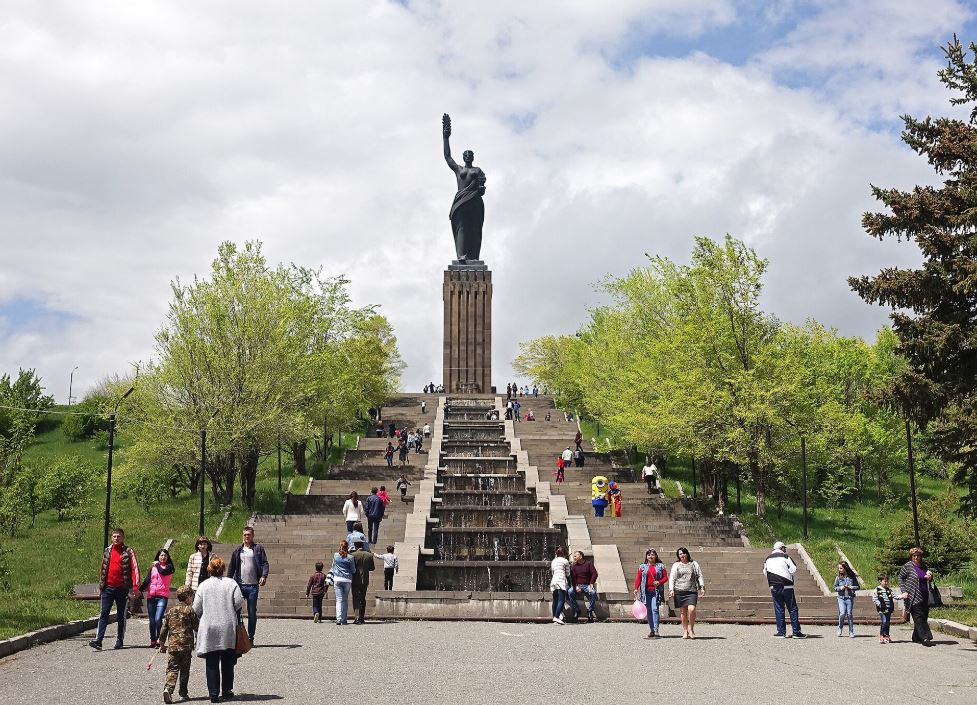
Built in 1975 on a hill near Gyumri’s historic Black Fortress, the Mother Armenia complex rises as a powerful 41-meter symbol of our people’s resilience.
The copper statue of a young woman holds in one hand the capital of the ancient Zvartnots Cathedral, representing our enduring culture and creativity, and in the other a palm branch of peace. On her reverse side, Nemesis keeps watch toward the Turkish border, reminding us that vigilance must always accompany hope.
At her feet burns the Eternal Flame beside the Tomb of the Unknown Soldier. The stone blocks once proudly displayed the names of Hero Cities — Leningrad, Stalingrad, Moscow — where tens of thousands of Armenians fought and over 100,000 died in the Great Patriotic War. That shared victory helped preserve our very existence as a people in the 20th century.
When those gilded letters were ripped away and discarded like garbage, it was not just an attack on metal and stone. It was an assault on a shared chapter of Armenian history that transcends any single government or alliance.
A Symptom of a Deeper Drift
This incident did not happen in isolation.
Armenia’s foreign policy has shifted dramatically since the tragedies of 2020 and 2023 in Artsakh. Freezing participation in the CSTO, strengthening ties with the United States and the European Union, and diversifying defense partnerships with India and France are understandable reactions to Russia’s failures as a security guarantor. Every Armenian feels the pain of those betrayals.
Yet there is a dangerous line between justified criticism and the casual erasure of historical memory. When anti-Russian sentiment becomes the dominant public mood, Soviet-era monuments honoring our own ancestors’ sacrifices become easy targets.
In Gyumri, home to Russia’s 102nd Military Base until at least 2044, this act carries extra weight and extra risk. The formal Russian protest note is clear evidence that such incidents are now actively damaging bilateral relations at a time when Armenia needs careful diplomacy, not unnecessary provocations.
We are a small nation in a harsh neighborhood. Geography has not changed. Turkey and Azerbaijan remain on our borders. Western support is valuable and should be welcomed, but it has not yet proven capable of replacing the immediate realities of energy supplies, trade routes, or the practical presence of the Russian base on Armenian soil.
Turning our backs on shared history while rushing toward new partners risks leaving us more isolated, not more sovereign.
Why This Matters to Every Armenian
This wound matters because memory is part of our national armor. Armenians have survived genocide, exile, and repeated wars by holding tightly to our history, not by selectively discarding inconvenient parts of it. Desecrating Mother Armenia weakens that collective strength.
It also harms our diaspora. Those of us in the United States and elsewhere who advocate for Armenia every day find it harder to make our case when such incidents make Armenia appear unstable or ungrateful toward historical allies. It fractures unity at home and confuses friends abroad.
The government in Yerevan must treat this seriously. We need:
- A clear, unequivocal public condemnation of the desecration.
- Full and dignified restoration of the memorial.
- Honest national reflection on how we pursue genuine multi-vector diplomacy without burning essential bridges or dishonoring our past.
- Greater engagement with the diaspora in shaping a realistic, balanced security strategy.
Restoring the Spirit of Mother Armenia
Mother Armenia does not stand with clenched fists of rage. She holds our cultural heritage in one hand and peace in the other, while remaining eternally vigilant. That balance is the lesson we must reclaim.
Desecrating her does not make us freer or safer. It makes us smaller.
As Armenians — whether in Gyumri, Yerevan, Pasadena, or anywhere else — we have a responsibility to protect the symbols that remind us who we are and what we have overcome.
Let the restoration of the Mother Armenia complex in Gyumri become more than a repair job. Let it mark the beginning of restoring wisdom, balance, and national dignity to our foreign policy.
Our children’s future depends on remembering where we have come from.