By Harut Sassounian
TheCaliforniaCourier.com
Despite their diplomatic cunning, one thing Turkish leaders have never learned is to keep their mouths shut when accused of genocide. They fail to realize that every time they deny committing mass crimes, they inadvertently draw more attention to their long criminal history.
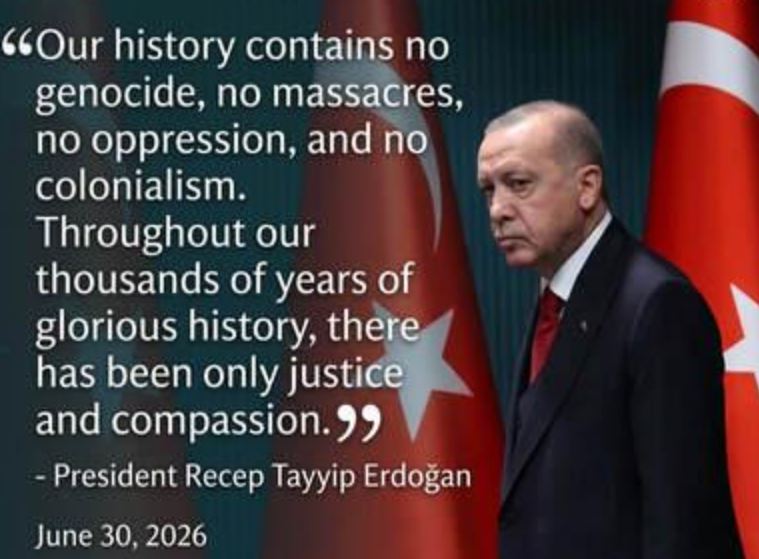
Turkey’s Pres. Recep Tayyip Erdogan made a major blunder during a speech he delivered on June 30, denying the long history of Turkish crimes. He falsely claimed: “Our history contains no genocide, no massacres, no oppression, and no colonialism. Throughout our thousands of years of glorious history, there has been only justice and compassion.” The video of his remarks was viewed by almost 100,000 times on X.
To begin with, by referring to “thousands of years of glorious [Turkish] history,” Erdogan made two errors: a) Turkey and its predecessor the Ottoman Empire have not existed for thousands of years; and b) Their history has been far from “glorious.” On the contrary, it has been shameful and criminal.
Let us now turn to the most outrageous lie in Erdogan’s remarks: “Our history contains no genocide, no massacres, no oppression, and no colonialism.” In fact, the Ottoman Empire and the Republic of Turkey have repeatedly committed every one of these massive crimes.
The Hellenic Canadian Research Institute has published an extensive list of crimes committed by the Ottoman Empire and the Republic of Turkey throughout their history. Here is a shortened version of that report:
The Historical Record of Mass Atrocities: The Late Ottoman Period Massacres and Genocides (1821 to 1923)
— The Constantinople Massacre (1821): Thousands of Greek civilians were slaughtered throughout the Empire. In April, Ottoman authorities executed the spiritual leader of Orthodox Christianity, Ecumenical Patriarch Gregory V, by hanging him from the gates of the Patriarchate.
— The Chios Massacre (1822): Ottoman troops systematically killed, enslaved, or exiled approximately four-fifths of the Greek population on the island of Chios. Up to 100,000 Greeks were slaughtered or forced into slave markets in North Africa and the Middle East.
— The Destruction of Psara (1824): Ottoman forces completely destroyed the rebel Greek island of Psara. In two days, an estimated 18,000 Greeks were killed or taken as slaves.
— The Third Siege of Missolonghi (1825–1826): Following a brutal, year-long starvation blockade by combined Ottoman and Egyptian forces, the city was overrun, resulting in the slaughter of thousands of Greek civilians and the enslavement of up to 4,000 women and children.
— The Damascus Events (1860): Following sectarian unrest in Lebanon, violent mobs and militias targeted the historic Christian quarter of Damascus. While Maronites were targeted in the mountains, the victims in Damascus were predominantly Greek Orthodox. Local Ottoman garrison forces actively colluded with the rioters, who torched the historic Greek Orthodox Mariamite Cathedral and slaughtered 3,000-10,000 Christians.
— The Hamidian Massacres (1894–1896): Sultan Abdul Hamid II targeted primarily Ottoman Armenians across Anatolia. Assyrians and, to a lesser degree, Greeks were also targeted. An estimated 300,000 Armenians and 25,000 Assyrians were killed, and hundreds of thousands were displaced or forcibly converted to Islam.
— The Adana Massacre (1909): 20,000-30,000 Armenian civilians were slaughtered in the province of Adana.
— The Massacres of Unarmed Greeks in Eastern Thrace (1912-1913): During the Balkan Wars, 15,690 unarmed Greeks were massacred in Eastern Thrace by Ottoman forces.
— The Greek Genocide (1914-1923): The systematic extermination of the native Greek subjects of the Ottoman Empire resulted in the slaughter of over 1 million Greeks.
— The Great Famine of Mount Lebanon (1915–1918): A weaponized food blockade and crop requisitioning policy overseen by Ottoman military governor Djemal Pasha starved 200,000-300,000 Maronite and other Christians.
— The Assyrian Genocide (1915-1923): The systematic extermination of the native Assyrian subjects of the Ottoman Empire resulted in the slaughter of 300,000-750,000 Assyrians.
— The Armenian Genocide (1915-1923): The systematic extermination of the native Armenian subjects of the Ottoman Empire resulted in the slaughter of 1.5 million Armenians.
Early Republican-Era State Violence (1930 to 1938)
— The Zilan Massacre (1930): The slaughter of 5,000-47,000 Kurdish civilians in the Zilan Valley during the military suppression of the Ararat rebellion.
— The Dersim Massacre (1937–1938): A massive military campaign used aerial bombardments (including chemical weapons) and widespread executions against the Alevi Kurds of Dersim (renamed Tunceli). It resulted in the deaths of up to 70,000 civilians, including Armenians.
20th-Century Sectarian Pogroms
— The Istanbul Pogrom (1955): State-organized mob attacks targeting Istanbul’s remaining Greek, Armenian, and Jewish citizens, causing massive property destruction and triggering the final mass emigration of Greeks from Turkey. It is estimated that during the two-day pogrom, 37 people were killed, over a thousand were injured, and hundreds of women and children were raped. It was widely reported that Greek men were subjected to forced circumcision. Damage was estimated at around $500 million.
— The Marash Massacre (1978): A week-long killing spree targeting leftists, Kurds, and the Alevi religious minority in Kahramanmarash, Turkey, December 19-26, 1978. Orchestrated primarily by the neo-fascist Grey Wolves and local right-wing groups with the support of Turkey’s national intelligence service, the violence resulted in the deaths of hundreds of people.
— The Sivas Massacre (1993): A massacre committed by an angry mob of radical Islamists who set fire to the Madimak Hotel in Sivas, Turkey, killing 35 people. The victims were predominantly Alevi intellectuals, writers, and artists who had gathered for a cultural festival.
(Part I)