Armenia’s parliamentary election campaign officially began Friday, opening a decisive contest that will determine whether Prime Minister Nikol Pashinyan’s Civil Contract party remains in power after eight years marked by war, territorial losses, deep domestic division, and a dramatic shift in Armenia’s foreign policy direction.
The elections are scheduled for June 7 and will be held under a proportional representation system. Seventeen political parties and two electoral alliances are competing for seats in the National Assembly. Parties must receive at least 4 percent of the vote to enter parliament, while electoral blocs must pass an 8 percent threshold.
The ruling Civil Contract party faces several major opposition challengers, including former President Robert Kocharyan’s Hayastan Alliance, the Strong Armenia bloc associated with businessman and philanthropist Samvel Karapetyan, Gagik Tsarukyan’s Prosperous Armenia Party, former Human Rights Defender Arman Tatoyan’s Wings of Unity party, former President Levon Ter-Petrosyan’s Armenian National Congress, and Edmon Marukyan’s Bright Armenia Party.
Pashinyan launched his campaign in Syunik, where he again presented his government’s policy as one that has secured “peace” and preserved Armenia’s statehood. His opponents, however, argue that this narrative conceals the disastrous consequences of his rule, including the loss of Artsakh, Azerbaijan’s continued threats against Armenia, and the likelihood of further concessions if Civil Contract retains power.
Speaking at the opening rally of the Hayastan Alliance in Vagharshapat, former President Robert Kocharyan accused Pashinyan of leading Armenia into another dangerous geopolitical “adventure.” Kocharyan criticized the Armenian authorities for hosting recent European gatherings in Yerevan that included pointed anti-Russian statements from foreign leaders, arguing that the government is attempting to pull Armenia deeper into confrontation with Russia in order to secure Western political cover.
According to Kocharyan, the authorities are using the fear of war as an election tool while seeking European support to overlook growing concerns about democracy and political persecution inside Armenia. He said the opposition is not against peace, but insists that real peace can only be built on a strong army, strong leadership, and reliable alliances.
The opposition has also accused Pashinyan’s government of creating unequal electoral conditions. Samvel Karapetyan, one of the most prominent figures behind the Strong Armenia bloc, remains under house arrest on charges he says are politically motivated. Because of his citizenship status, Karapetyan is barred under the current constitution from serving as prime minister or even becoming a member of parliament. His bloc has pledged to change that restriction if it wins power.
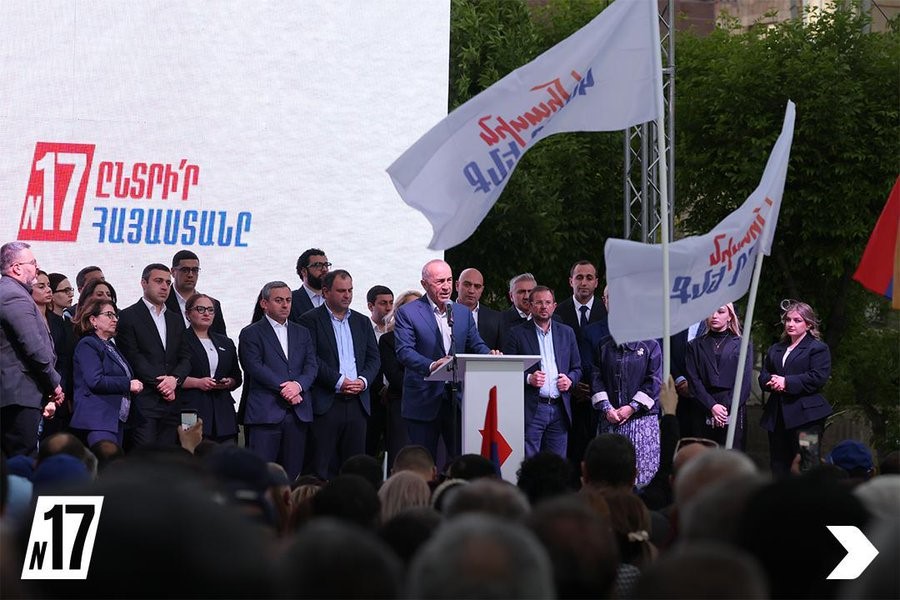
At Strong Armenia’s first campaign event near the parliament building in Yerevan, Narek Karapetyan, Samvel Karapetyan’s nephew and close associate, argued that the country has only become smaller since 2018 and said the bloc intends to fight for victory despite what it views as a politically tilted playing field.
Meanwhile, opposition forces say law enforcement agencies have intensified pressure on government critics ahead of the vote. In recent weeks, dozens of Strong Armenia members and supporters have reportedly been detained on vote-buying allegations, which the bloc denies. Opposition groups say similar scrutiny has not been applied to the ruling party, despite accusations that Civil Contract uses state resources and government-linked charitable activity to influence voters.
Former Human Rights Defender Arman Tatoyan’s Wings of Unity party has also raised concerns about intimidation. Tatoyan has accused local authorities in Armavir province of targeting young activists who attended one of his meetings. According to the party, photos from the event were circulated and used to identify participants, after which some activists and their families allegedly faced pressure through schools, workplaces, and public institutions.
One young volunteer, speaking anonymously, said her father, a civil servant, was threatened after she attended the meeting. She said volunteers continue to support the party but avoid appearing publicly or on camera because of fear of retaliation.
Armavir Governor Vahram Khachatryan, who heads Civil Contract’s provincial structure, denied the accusations and called them false. Armenia’s Investigative Committee said it could not open an investigation without a formal complaint from the party or the individuals involved.
The start of the campaign comes only days after major European events in Yerevan, which opposition figures have described as a political show of support for Pashinyan ahead of the election. French President Emmanuel Macron openly praised Pashinyan during his visit, while Russian officials warned that Armenia’s current foreign policy course could carry serious economic and security consequences.
The June 7 election is therefore unfolding not only as a domestic political contest, but as a referendum on Armenia’s post-2018 direction. For Pashinyan, the campaign is centered on his claim that he has brought Armenia into an era of peace. For the opposition, the election is about ending a government they accuse of defeat, repression, foreign dependency, and continued national retreat.
With the campaign now underway, Armenia enters a critical month in which the central question is whether the public will accept Pashinyan’s promise of “peace” or turn toward opposition forces arguing that peace without security, sovereignty, and national dignity is not peace at all.