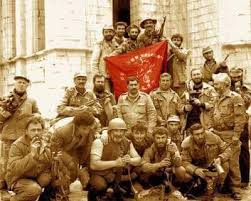
The liberation of Shushi was the first significant victory of Armenian military forces in the Artsakh Liberation War. The military operation took place on May 8–9, 1992. In terms of planning and execution, it was an almost flawless operation, unique in Armenian military art, and created a fundamental turning point in the Artsakh Liberation War.
The operation was carried out from four directions, with simultaneous attacks beginning at 2:30 a.m. in the early hours of May 8, after the military positions of Kirs had been captured and the Lachin-Shushi road had been brought under control. The military operation was led by the commander of the Self-Defense Forces, Arkady Ter-Tadevosyan.
The operational plan for the liberation of Shushi had been developed under his leadership. Military leaders began working on it immediately after the liberation of Khojaly. The plan was prepared during March and April, after reconnaissance groups clarified the enemy’s troop deployments, positions, and numerical strength. The attack front stretched approximately 25 kilometers. The enemy outnumbered the Armenian side in manpower and weaponry.
By April 28, the main directions of attack, the commanders, and the amount of available arms and ammunition had already been finalized and clarified. On the instruction of L. Martirosov, a scale model of the terrain of Shushi was prepared, on which the commanders refined their actions and operational directions.
The military operation was directed from a height north of Shosh and from four other command observation posts. The attack had originally been planned to begin on May 4, but for various reasons, including a shortage of weaponry and poor weather, it was postponed.
On the night of May 8, four assault groups and one reserve group of the Self-Defense Forces, numbering around 1,200 fighters, launched their attacks simultaneously. The outcome of the military operation had already been determined on May 8, when the units advancing from Lachin and the other directions seized favorable lines on the approaches to Shushi. The pause given toward the evening of May 8 provided the enemy an opportunity to leave the fortress-city through the designated corridor.
At around noon, one enemy military aircraft and helicopters launched an attack, bombing the battle formations of the Armenian forces, as well as Shushi and Stepanakert. It later became clear that the purpose of that air attack was to detonate the arms depots left in Shushi. By doing so, the Azerbaijanis hoped to destroy the entire city, but they failed.
By evening, the operation to liberate Shushi was largely completed. On May 9, the ancient Armenian fortress-city had been liberated.