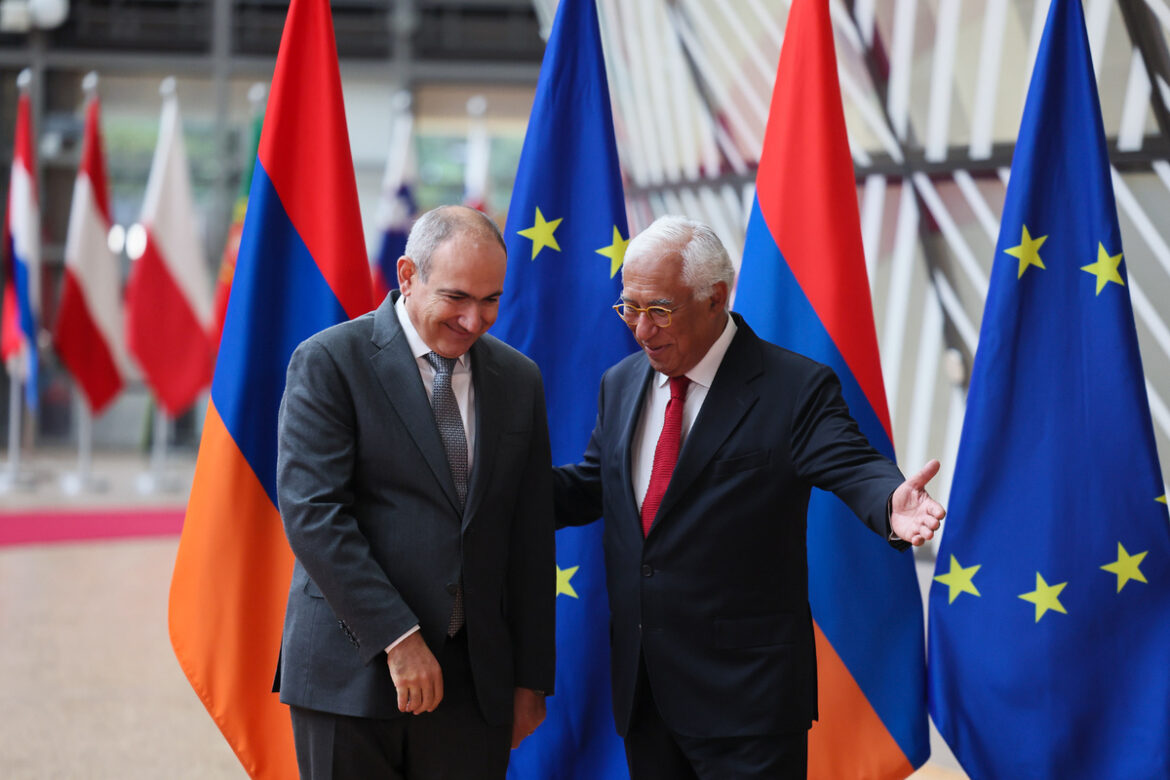
Prime Minister Nikol Pashinyan is trying to secure European Union backing to tilt Armenia’s next parliamentary elections in his favor, opposition leaders claimed on Tuesday, reacting to Yerevan’s request for EU election-related assistance.
EU foreign policy chief Kaja Kallas disclosed the request on Monday ahead of talks in Brussels between Armenia’s Foreign Minister Ararat Mirzoyan and the EU’s foreign ministers. Kallas said the Armenian government is seeking the kind of “help to fight foreign malignant interference” that the EU provided to Moldova earlier this year.
Armenia’s Foreign Ministry said on Tuesday that Yerevan wants EU support to “counter potential hybrid threats” to the proper conduct of elections, adding that the sides have already drafted joint “initiatives” in that direction without providing details.
Opposition figures and some commentators argued that the government is using the request to build international cover for manipulating the vote scheduled for June.
“This is direct interference by external forces in Armenia’s internal affairs,” said Ishkhan Saghatelyan, a senior representative of the opposition Hayastan alliance. He said the government understands it has lost public support and is looking for outside help to preserve power.
Opposition leaders focused on Kallas’s reference to Moldova, where two opposition parties described as pro-Russian were barred from participating in a recent parliamentary election won by the country’s pro-Western leadership.
The EU justified those bans by citing Russian interference in Moldovan politics. Kallas has also accused Russia of spreading pre-election “disinformation” in Armenia, a claim the Russian Foreign Ministry rejected angrily.
Kallas’s latest comments intensified opposition fears that Armenian authorities could seek to disqualify major opposition groups ahead of the 2026 vote. Saghatelyan and Levon Zurabyan, deputy chairman of former President Levon Ter-Petrosyan’s Armenian National Congress, both warned of that scenario.
“Pashinyan effectively declares all his opponents soldiers in a ‘hybrid’ war waged by Russia and asks for Europe’s support for similar anti-democratic actions,” Zurabyan said. “This is an unprecedented disgrace, if not treason.”
Pashinyan regularly portrays his political rivals as Russian proxies, but he and other senior officials have not publicly endorsed EU allegations of Russian meddling in Armenia’s elections. Ruben Rubinyan, a deputy speaker of parliament, declined on Tuesday to say whether Russia is the source of the “hybrid threats” cited by the government. He said the EU assistance will be used to counter “fake news” and “illegal financing” of election campaigns.
“We see the possibility that there could be an attempt at interference, and we are increasing our toolkit to prevent that interference,” Rubinyan told reporters.
Hayk Mamijanyan, the parliamentary leader of the opposition Pativ Unem bloc, mocked the government’s framing. “If by external interference they mean that the elections in Armenia are organized by a person desirable for Azerbaijan and Turkey, I mean Pashinyan, then yes, there is external interference in Armenia,” he said.
Armenian opposition groups have long accused the EU of overlooking government pressure on dissent and other rights concerns for geopolitical reasons. In recent months, dozens of opposition activists and supporters, along with four senior clergymen critical of the government, have been jailed on charges they describe as politically motivated.
The government rejects claims that they are political prisoners. EU officials, meanwhile, have continued to praise Armenia’s “democratic reforms.”