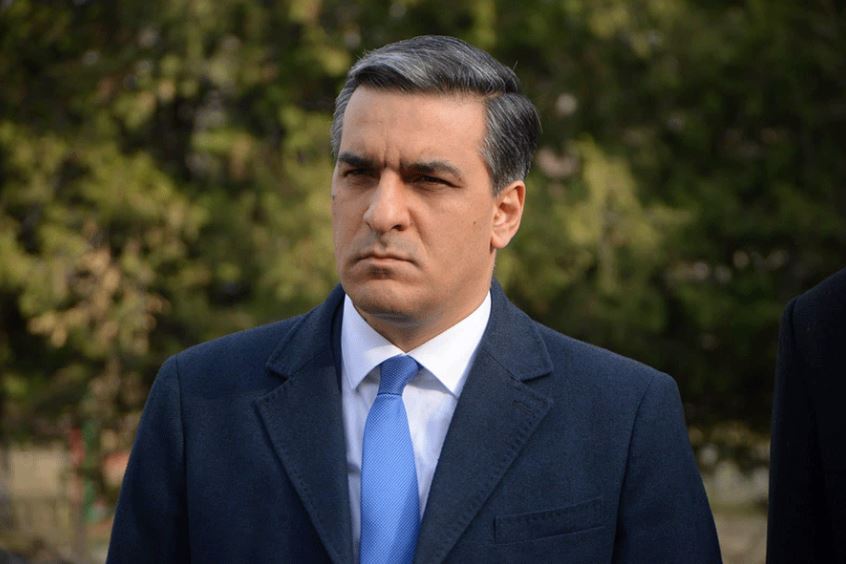
Arman Tatoyan, the former Human Rights Defender who has recently attempted to transition into national politics, unveiled the program of his new “Wings of Unity” party on Wednesday. Despite the ambitious name, Tatoyan’s initiative has yet to show the organizational structure, public support, or political backing required to make an impact in Armenia’s 2026 parliamentary elections.
At his press conference, Tatoyan urged former presidents Robert Kocharyan and Serzh Sargsyan to stay out of the upcoming race, arguing that their participation would supposedly secure another victory for Prime Minister Nikol Pashinyan. He said that when elections are framed as a contest between Pashinyan and former leaders, “Pashinyan will always win.” His remarks appeared targeted toward figures who, unlike him, command established constituencies and functioning political machines.
Tatoyan repeated general themes of “security,” “sovereignty,” and “balanced foreign policy,” but offered no concrete mechanisms for building a nationwide political force. He stated that Armenia needs “functional and effective relations with Russia” while reducing long-term dependency on any single partner. Asked whether his position reflected an anti-Russian stance, Tatoyan insisted he is “pro-Armenian,” a formulation that has become common among candidates seeking to avoid taking firm geopolitical positions.
While Tatoyan called for broad opposition unity, current polling data shows no measurable grounds for such unity forming around him. According to recent findings by the International Republican Institute, public trust in Pashinyan has dropped sharply, but no alternative figure—including Tatoyan—has emerged as a competitive challenger. The political landscape remains polarized between the ruling party and established opposition blocs, with Kocharyan continuing to retain the only consistent base of supporters within the opposition field. No data suggests that Tatoyan’s new party has penetrated these voter segments.
Tatoyan challenged Pashinyan to a public debate, a move viewed by analysts as an attempt to elevate his profile in the absence of a demonstrable electorate. Pashinyan has not responded.
Nearly a month after its formation, “Wings of Unity” has yet to announce a candidate list, regional offices, campaign leadership, or any alliances with existing political groups. The party has not demonstrated the logistical capacity typically associated with viable electoral campaigns, particularly in Armenia’s regional communities where election outcomes are often determined.
With longstanding opposition structures still dominating the anti-government space and retaining operational networks across the country, Tatoyan’s ability to position himself as a unifying figure remains doubtful. For now, “Wings of Unity” appears to be a political brand without a movement behind it—launching a national campaign without the wings required to lift it off the ground and without the unity needed to challenge the country’s entrenched political players.
Tatoyan said his party will continue outlining its vision in the coming months, though no details were provided about forthcoming organizational steps or national outreach efforts.