Armenia’s parliamentary opposition is moving to confront what it calls Prime Minister Nikol Pashinyan’s slide into open authoritarianism, launching a coordinated push in the National Assembly and on the streets to demand the release of dozens of jailed government critics.
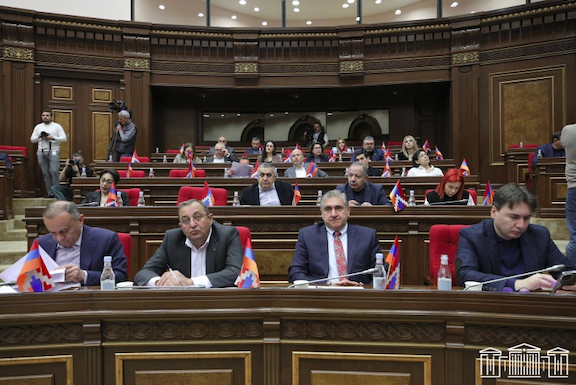
The two opposition alliances represented in parliament, Hayastan and I Have Honor, announced that they will introduce a joint resolution declaring the detainees — including three bishops of the Armenian Apostolic Church, two opposition mayors, a billionaire philanthropist and two podcasters — to be political prisoners and calling for an immediate end to the crackdown.
“Democracy in Armenia is regressing, and the unprecedented number of political prisoners is a manifestation of that,” reads the draft resolution, which also demands an end to “political persecution” against a growing circle of opponents of the ruling Civil Contract party.
Hayastan MP Kristine Vartanyan said opposition deputies will insist that the National Assembly debate the text next week.
The ruling party has already signaled it will use its numeric dominance in parliament to shield the government from any accountability.
Civil Contract deputy Hasmik Hakobyan bluntly stated that the pro-government majority will block the resolution and flatly denied the existence of political prisoners.
“All those people they call political prisoners are being questioned under specific articles of the Criminal Code, or are detained, or are going through a judicial process,” Hakobyan said, echoing the government’s line that any critic under arrest is simply a common defendant.
Opposition forces counter that it is precisely this instrumental use of the Criminal Code against priests, elected officials, businessmen and media figures that exposes the political nature of the prosecutions.
Church and opposition in the crosshairs
A leading Hayastan figure, Ishkhan Saghatelyan, called on citizens to rally outside the Prosecutor-General’s Office in Yerevan on Thursday in support of the detainees. From there, opposition leaders plan to march to a district court where Archbishop Bagrat Galstanyan and 17 of his mostly jailed supporters are standing trial on coup charges they categorically deny.
Galstanyan, who led months of mass anti-government protests in Yerevan last year, was arrested on June 25 — one day before Pashinyan publicly threatened to forcibly depose Catholicos Karekin II, the supreme head of the Armenian Apostolic Church, which has been in open conflict with the government.
Two days after Galstanyan’s arrest, another outspoken archbishop, Mikael Ajapahyan, was detained for allegedly calling for violent regime change. In a trial denounced by the Church and the opposition as a disgrace to justice, Ajapahyan was sentenced on October 3 to two years in prison.
Earlier in June, billionaire businessman and philanthropist Samvel Karapetyan was arrested and accused of advocating the violent overthrow of the government just hours after he publicly condemned Pashinyan’s campaign against the clergy. For the opposition, this sequence of arrests makes clear that the real “crime” in today’s Armenia is criticizing the ruling party.
In what is widely seen as a continuation of the same pressure campaign, law-enforcement bodies rounded up at least 13 clergymen on October 15. One of them, Bishop Mkrtich Proshyan, a nephew of Catholicos Karekin, was remanded in custody on charges of forcing his subordinates to attend opposition rallies — accusations he firmly rejects.
Targeting elected mayors and ordinary supporters
The wave of arrests has not been limited to church figures and prominent businessmen. Five days after the clergy sweep, security forces detained Vartan Ghukasyan, the opposition mayor of Gyumri, Armenia’s second-largest city, on corruption charges he insists are fabricated and politically motivated.
Ghukasyan’s arrest triggered angry street protests in Gyumri. More than 40 of his supporters are now being prosecuted for what the authorities label “mass disturbances.” Defense lawyers say the bulk of the accusations rest almost entirely on testimony from police officers, a pattern opposition activists say has become standard practice in politically sensitive cases.
Armenia’s Court of Appeals ordered the release of three of Ghukasyan’s supporters — including a well-known local opposition activist — from custody late on Tuesday, reducing to 23 the number still behind bars. The Prosecutor-General’s Office immediately announced it will challenge the decision, reinforcing opposition claims that prosecutors are acting less like neutral legal officials and more like an extension of the ruling party’s political machine.
A regime nervous about 2026
The scale and character of the arrests mark a sharp break even with the government’s own previous record. Anti-government protests in recent years have rarely been followed by so many criminal cases, such heavy-handed charges, or such a broad targeting of clergy, mayors, businessmen, activists and media figures at once.
For Pashinyan’s critics, this is no coincidence. They argue that the sweeping crackdown exposes a government deeply unsure of its own mandate ahead of the high-stakes general elections expected in June 2026 — and determined to neutralize the most vocal centers of opposition before voters return to the polls.
The prime minister, for his part, has publicly expressed confidence that his Civil Contract party will win again. But the opposition insists that a government that truly trusted the people would not need to keep bishops, elected mayors, philanthropists and protesters behind bars in order to face them.