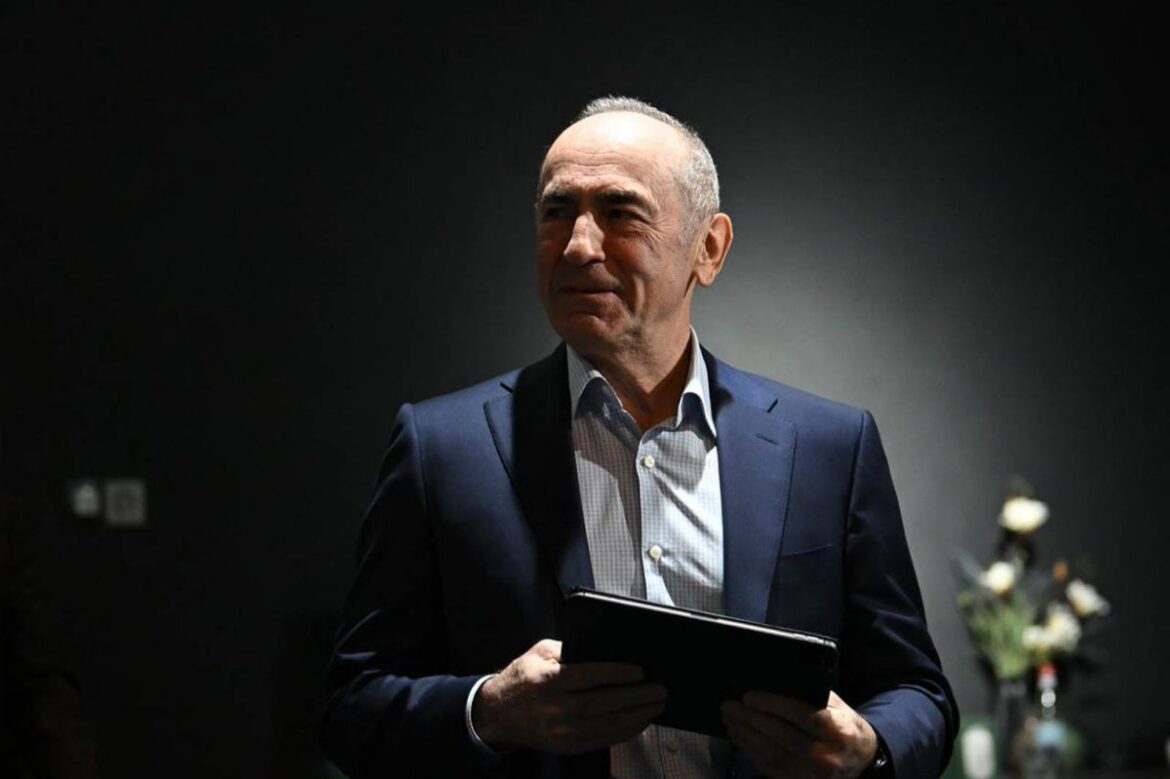
Robert Kocharyan, the Second President of the Republic of Armenia, delivered an extensive assessment of the emerging global order and Armenia’s strategic choices during meetings with journalists and a press conference, outlining what he described as a new era of power politics and heightened risk for small states.
Kocharyan argued that the previous international system has given way to a new, still-forming framework shaped by rivalry among major powers. He emphasized that the United States is actively reshaping the international order it once built, and he described a shifting security concept that recognizes multipolarity, prioritizes competition with China, and leaves space for pragmatic engagement with Russia. In his view, European Union appears implicitly weakened within that new concept, and the absence of the South Caucasus from core strategic priorities signals limited fundamental U.S. interest in the region.
Kocharyan framed this moment as a period in which force is increasingly used to settle disputes and diplomacy operates with less ceremony and fewer restraints. He called for Armenia to pursue a policy that protects sovereignty and keeps the country from becoming a venue for clashes between larger powers.
Lessons from regional miscalculations
Pointing to recent history, Kocharyan drew a cautionary line through cases where leaders attempted complex geopolitical balancing and paid heavy costs. He cited Mikheil Saakashvili’s Georgia, Volodymyr Zelenskyy’s Ukraine, and Nikol Pashinyan’s Armenia as examples of states that faced war and territorial loss after misjudging the room for maneuver among great powers. Armenia, he argued, benefits from a disciplined diplomatic posture grounded in realism and institutional competence.
TRIPP and the security architecture of the region
A central part of Kocharyan’s remarks focused on the TRIPP project, which he described as an Armenian–American initiative driven primarily by geopolitical objectives rather than Armenian national interest. He said the project’s structure favors Azerbaijan and Turkey and places Armenia in a sensitive corridor of competing interests, with Iran and border control serving as Washington’s primary strategic motivation.
Kocharyan stated that Armenia’s strongest position would come from broadening any such project to include major stakeholders capable of balancing conflicting interests. He said participation by Russia or China would reduce tensions and address Iran’s concerns through a more stable configuration. He also expressed confidence that Russia would stay out under current conditions, given the U.S. incentive to exclude partners with close ties to Iran.
Kocharyan characterized TRIPP as a top-tier national security concern, calling it a potential “greatest security threat” if it advances in a form that magnifies external pressures on Armenia without producing concrete gains.
Artsakh: Right of return as a realistic diplomatic objective
On Artsakh, Kocharyan described the right of return for the Karabakh population as the practical focus for Armenian diplomacy at this stage. He emphasized legal and political entrenchment of the right itself as the immediate goal, with return connected to corresponding property rights and longer-term developments.
He argued that sustained, active diplomacy offers a viable path because the international community would face difficulty rejecting the principle of a right of return. He also insisted that durable peace requires a system of guarantees rather than a framework dependent on the will of a single individual, citing Ilham Aliyev in that context.
Defense procurement and the “weapons zoo” problem
Kocharyan addressed defense procurement by rejecting claims that Collective Security Treaty Organization membership prevented arms acquisition. He said Armenia procured weapons from multiple sources while benefiting from favorable pricing and logistics with Russia.
He criticized fragmented procurement that produces a “weapons zoo,” warning that incompatible systems generate long-term burdens in maintenance, training, logistics, and financing. He presented standardization and coherent planning as the basis for sustainable defense capacity.
Domestic politics: Identity, the Church, and a path to consolidation
Kocharyan argued that Armenia’s domestic political landscape has entered a new phase where foundational issues—national identity, the Armenian Apostolic Church, and historical continuity—shape political alignment. He said these questions create conditions for broad opposition coordination and larger electoral alliances.
He stated that opposition forces could enter elections with three or four major blocs instead of dozens of fragmented parties, and he said polling suggests he currently stands as the strongest potential leader of such a bloc. He described a decision timeline extending into February, with final choices guided by professional sociological surveys and the team’s overall effectiveness. He also said lists would be renewed with new figures while maintaining an experienced core.
Addressing his business background, Kocharyan stated that he resigned from the board of AFK Sistema ahead of the 2021 elections and holds a small shareholding acquired during his tenure as an independent director. He presented his corporate governance experience as complementary to a state career that included leadership roles connected to Karabakh, the premiership, and the presidency.
Economic pressure and fuel-price claims
On fuel prices, Kocharyan dismissed the claim that Azerbaijani gasoline imports drove price changes in Armenia, calling it “propaganda gasoline.” He tied price declines to global oil market movements and pointed to Azerbaijan’s refining limitations as a practical barrier to large-scale supply that could shape Armenia’s market.
He also warned that Armenia remains exposed to major-power economic leverage. He emphasized Russia’s ability to impose restrictive measures and recalled pressure tools used in the region in earlier periods. He argued that anti-Russian messaging designed to win Western support ahead of elections carries strategic risk and invites retaliation that Armenia can ill afford.
Institutions, constitutional balance, and the Church
Kocharyan described a governance crisis defined by excessive concentration of power in the prime minister’s office. He said judicial independence has suffered and proposed constitutional reforms, including mechanisms such as a popularly elected president or higher parliamentary thresholds for judicial appointments.
He strongly criticized remarks by Ararat Mirzoyan concerning the Armenian Apostolic Church, calling accusations against the Church “absurd” and “immoral.” He framed the Church as a pillar of national identity and said attacks on that foundation weaken statehood itself.
A strategic horizon beyond limits
Concluding, Kocharyan argued that Armenia benefits from a broader understanding of national resources that includes the diaspora, the Church, and cultural inheritance alongside geography and population. He cited Singapore, Qatar, and the United Arab Emirates as examples of small states that built durable influence through strategic clarity and disciplined statecraft.
He presented Armenia’s path as a program of pragmatic sovereignty: a confident foreign policy, an institutional reset that strengthens checks and balances, and a security posture designed for an increasingly hard-edged international environment.