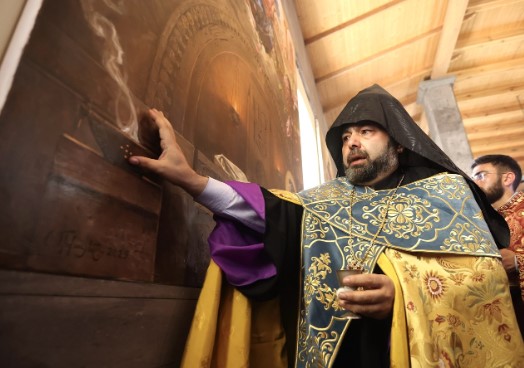
Armenia’s confrontation between state power and the Armenian Apostolic Church deepened Wednesday as Bishop Mkrtich Proshyan and at least twelve priests were detained in coordinated law-enforcement raids that Church officials and legal representatives described as politically motivated and procedurally unlawful.
Raids and Detentions
Investigators searched the headquarters of Bishop Proshyan’s Aragatsotn diocese and the private homes of his subordinates before taking them into custody. For most of the day, authorities refused to disclose where the bishop and several priests were being held or to permit immediate access by their attorneys.
By late afternoon, attorney Ara Zohrabyan—representing the detained clergy—confirmed that Bishop Proshyan had been formally indicted and that prosecutors would seek his pre-trial detention. “The accusations leveled against him are fabricated,” Zohrabyan said. One priest, Father Paren Arakelyan, was released without charge that evening; the legal status of the remaining detainees remains uncertain.
Basis of the Investigation
According to official statements, the criminal case was opened following accusations made by Father Aram Asatryan, another priest from the Aragatsotn diocese. In a September state-television interview, Asatryan alleged that he had been compelled to attend opposition rallies in 2021 and accused unnamed senior clergy of corruption and misconduct. His remarks were swiftly followed by a formal “crime report” filed by civic activist Daniel Ioannisyan, whose Western-funded NGO has previously prompted politically sensitive investigations. Ioannisyan denied any coordination with government officials but reiterated that coercing individuals to attend rallies “is a crime in Armenia.”
This mechanism—activist complaints followed by rapid prosecutorial action—has become a pattern in the government’s handling of politically charged clergy. A similar report by Ioannisyan earlier this year preceded the arrest and conviction of Archbishop Mikael Ajapahyan, who was sentenced to two years in prison on October 3 for allegedly inciting regime change.
Background of Political and Religious Tensions
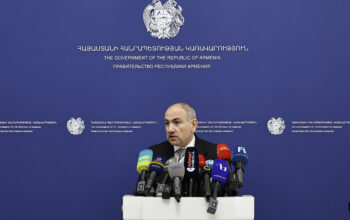
Since spring 2024, Prime Minister Nikol Pashinyan has engaged in an escalating public dispute with the Armenian Church’s hierarchy. He has accused Catholicos Garegin II and other senior clerics of corruption and secret sexual misconduct, demanding the Catholicos’s resignation and even threatening to remove him forcibly from the Holy See of Echmiadzin. The Church’s leadership and opposition figures view these accusations as retaliation for the Catholicos’s criticism of the government’s concessions to Azerbaijan.
Two other senior bishops—Bagrat Galstanyan and Ajapahyan—were detained in June during anti-government protests. Both arrests were denounced by the Church as politically motivated attempts to neutralize dissent within religious ranks.
Church and Opposition Responses
The Mother See of Echmiadzin condemned the latest detentions as “another manifestation of the systematic anti-church campaign instigated by the authorities,” warning that the raids were designed “to disrupt the Church’s normal functioning and to spread fear among clergy and believers.”
Father Yesayi Artenyan, a Church spokesperson, called the episode part of “a continuing campaign against the Church,” emphasizing that Bishop Proshyan is a nephew of Catholicos Garegin II.
Former Human Rights Ombudsman Arman Tatoyan drew a direct link between the arrests and hostile rhetoric from Baku’s top Shia cleric, observing that “Nikol Pashinyan’s political persecution and Azerbaijani statements against the Armenian Church go hand in hand.”
International Reaction
The World Council of Churches, representing more than 350 Christian denominations, warned in July that the Armenian government should “refrain from actions or statements undermining religious freedom and due process.” Despite that appeal, the pattern of arrests, raids, and public accusations has persisted, underscoring what observers now describe as a deliberate state campaign to subordinate the Church to political authority.
With Bishop Proshyan’s indictment, Armenia’s conflict between government and Church has entered its most serious phase yet—transforming a long-standing institutional rivalry into an unprecedented confrontation over the boundaries of faith and power.