By Areg Gharabegian
Air pollution is the potential cause of various diseases, including bronchitis, pneumonia, asthma, lung cancer, and others. Particularly dangerous are particles in the air with a diameter smaller than 2.5 microns (PM2.5). According to the World Health Organization (WHO), unlike larger particles that the body can filter out, these fine particles penetrate deep into the lungs and enter the bloodstream, where they can cause serious health problems.
According to the air quality monitoring stations installed in Yerevan, PM2.5 levels exceed the permissible limit by up to 4.8 times.
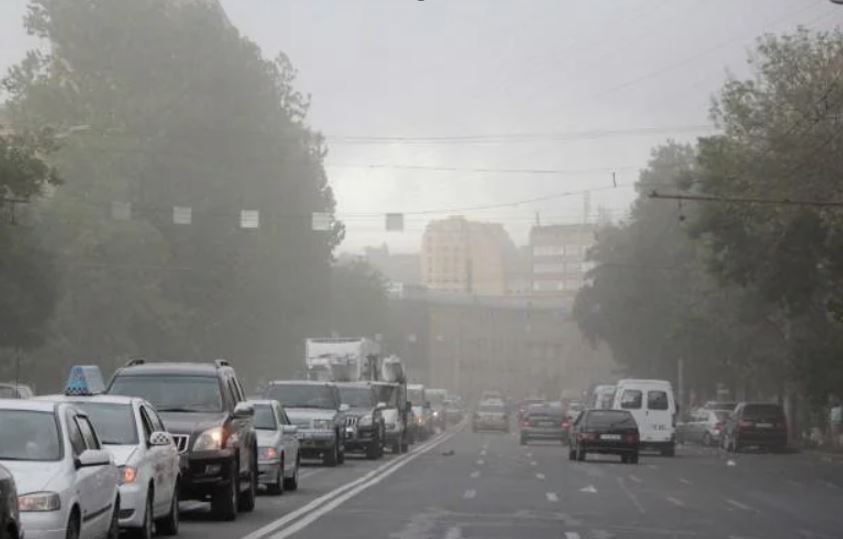
The main sources of air pollution in Yerevan are transportation, construction, mining, as well as the Nubarashen landfill. In addition to these sources, the city’s geographical location has a significant negative impact. Yerevan, being in a subtropical climate zone, is naturally somewhat dusty. This is especially exacerbated during the winter months by inversion layer processes, when condensation of moisture occurs at the boundary between cold and warm air. It appears as cloudiness or fog, which prevents dust and other pollutants in the air from dispersing.
During inversion layer events, typically there are no winds, which contributes to air pollution, as emissions continue at the same rate but the air does not move, resulting in increased concentrations of toxic substances in the air.
Although the geographical conditions and inversion layer phenomena are not new, the large amount of construction dust and poorly regulated vehicle emissions in recent years are new.
Smog is rapidly becoming a seasonal phenomenon that Yerevan residents now expect as regularly as water outages, which can have fatal consequences for those forced to live for long periods with various airborne pollutants.
Although natural factors are real, city municipal authorities use them to divert attention from human-made sources, since geography does not create pollution but rather traps gases emitted by human activity.
There are five permanent fixed-location air quality monitoring stations in Yerevan, which were installed in the 1980s. They are located in the Kentron (2), Nor Nork, Shengavit, and Arabkir administrative districts. These outdated air quality monitoring devices need to be updated, as they do not meet today’s accepted standards.
Endless Construction
Over the past 10 years, there has been a construction boom in Yerevan, largely driven by a government program that allows citizens to deduct mortgage interest payments for new apartments from their income tax. Some construction projects can also be considered a form of money laundering.
Alongside the increase in construction permits, the number of completion certificates issued has not grown. Of approximately 680 high-rise building permits issued in Yerevan, only 30% have received final occupancy permits, leading to project delays and unfinished or abandoned construction sites, which are major sources of air pollution, particularly dust.
During building construction, developers are required to cover structures with protective mesh at an appropriate height. Currently, violations result in only a 70,000 dram ($186) fine, while the mesh itself costs between 2 to 4 million drams ($5,000–$10,000), making it more worthwhile for developers to simply pay the fine.
Developers and construction site managers are required to organize tire washing at site exit points to ensure that trucks leaving construction sites and entering the streets have clean tires. Almost all construction companies ignore this requirement, resulting in large amounts of dust leaving construction sites.
Transportation
The continuously increasing number of vehicles on Yerevan’s streets is a significant contributing factor to the air pollution crisis. Of Armenia’s 954,000 vehicles, more than one-third—around 343,000—are registered in Yerevan, though the actual number is likely higher since many vehicles registered elsewhere are driven in Yerevan. According to Yerevan’s Development Program, the number of vehicles in the city is around 600,000.
Data from the Ministry of Environment show that air pollution in the capital has increased by up to 40% over the past five years, about 70% of which is directly caused by vehicles.
Most cars are privately imported used vehicles. Despite stricter legislation regarding vehicle inspections and emissions standards, many are imported without catalytic converters that reduce emissions, while others have theirs stolen or removed and sold because they contain valuable metals.
The growing number of electric vehicles is promising. Since 2023, more than 22,500 electric vehicles have been imported into Armenia. In just the first eight months of 2025, 27% of newly registered vehicles were electric. This growth is driven by two government incentives: an annual exemption of a limited number of electric vehicles from customs duties, and exemption from value-added tax (VAT). However, electric vehicles make up only 2% of the total, which does not have a significant impact on reducing air pollution.
While experts have been raising alarms about the growing consequences of vehicle pollution for more than a decade, city authorities have been slow to adopt laws and even slower to enforce those that have been adopted.
Nubarashen Landfill
Nubarashen is not a sanitary landfill and does not meet any applicable standards. Continuous underground self-ignition occurs at the site, resulting in the continuous release of toxic gases into the atmosphere.
Nubarashen has been in operation since the 1950s. Covering 52 hectares, the landfill receives approximately 300,000 tons of waste annually. It was not originally designed or constructed according to any accepted standard and does not meet international, technical, environmental, or sanitary-hygienic criteria; it simply serves as a waste accumulation site. In recent years, fires at the landfill have become frequent, polluting the air further with toxic substances.
In 2015, the government signed loan agreements with the European Bank for Reconstruction and Development and the European Investment Bank to implement the “Yerevan Solid Waste Management Program.” The program envisioned the reclamation of the Nubarashen landfill and the construction of a new landfill. In the spring of 2024, the program was canceled. It has been announced that a new program is being discussed with the World Bank.
Mining
Although it may come as a surprise to many, 17 non-metallic mines operate in Yerevan. These mines extract basalt, gypsum-bearing rock, clay, and sand. They are located in various parts of the city, particularly in Nor Nork, the western outskirts of Ajapnyak, Erebuni, and Avan. These mines are operated using open-pit methods, and nearly all are located close to residential areas.
Permits require operators to protect the subsoil, atmosphere, and other environmental factors from harmful impacts caused by mining activities. However, these requirements are not enforced, leading to significant adverse environmental impacts on the city.
Although Yerevan is surrounded by these quarries, there is no data quantifying the level of pollution they generate. These quarries operate with virtually no oversight, even though they are within the capital, and most companies ignore dust mitigation measures specified in their permits and are not fined for violations.
The municipality has designated only the Jrvezh gypsum-clay and basalt quarry as a restoration priority. The area is close to residential and forested zones, and the municipality is considering converting 50 hectares into a buffer zone.
Conclusion
Despite increasing pressure, the municipality has done little to address air pollution, stating in a press release that the smog covering the city is essentially a meteorological phenomenon and therefore cannot be resolved. Environmental experts and urban planners disagree, arguing that the municipality has many tools to address the issue immediately, as well as policy changes that could reduce the frequency of smog-related pollution in the city.
Air pollution in Yerevan is a long-standing and well-documented issue that requires systemic solutions, but institutional dysfunction and the failure to utilize scientific expertise hinder significant progress.