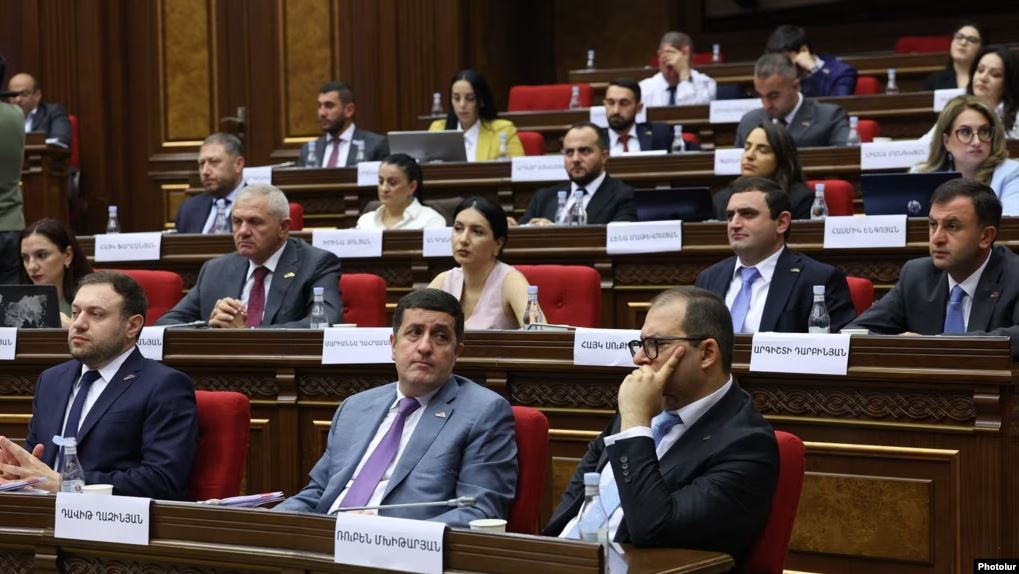
YEREVAN — Armenia’s parliamentary opposition has firmly rejected Prime Minister Nikol Pashinyan’s efforts to introduce a new constitution, accusing his government of attempting to satisfy Azerbaijani President Ilham Aliyev’s demands at the expense of Armenian sovereignty.
The confrontation intensified after Pashinyan suggested on October 22 that he could call snap parliamentary elections if opposition lawmakers refuse to support the proposed constitutional overhaul.
Both the Strong Armenia alliance, led by businessman Samvel Karapetyan, and the Hayastan alliance, headed by former President Robert Kocharyan, have declared that they will not support the initiative.
“Aliyev must not decide whether our country’s constitution must be changed or not,” said Narek Karapetyan, parliamentary leader of Strong Armenia and nephew of Samvel Karapetyan.
Responding to Pashinyan’s suggestion of early elections, Karapetyan declared that his alliance was prepared for the challenge, calling on Armenians to reject the government’s continuing concessions to Azerbaijan.
Anna Grigoryan, who heads the Hayastan parliamentary faction, similarly accused Pashinyan of attempting to blackmail opposition lawmakers by threatening their parliamentary seats.
“Does he think we could vote for Aliyev’s constitution for the sake of retaining our parliament seats? Never,” Grigoryan declared.
Azerbaijan’s Demands at the Center of the Dispute
The constitutional controversy stems from Azerbaijan’s insistence that Armenia amend its constitution before Baku will sign a final peace agreement.
Aliyev’s government objects particularly to the Armenian Constitution’s reference to the 1990 Declaration of Independence, which recognizes the historic connection between Armenia and Artsakh.
Although Pashinyan publicly maintains that constitutional reform is an internal Armenian matter, his administration has continued advancing the process while Azerbaijan openly conditions the signing of a peace treaty on constitutional changes.
The government is expected to publish its proposed new constitution before the end of the year.
However, Pashinyan’s ruling Civil Contract party failed to secure the two-thirds parliamentary majority necessary to advance the proposed constitution to a national referendum following the June 7 parliamentary elections.
The opposition’s refusal to cooperate has therefore created a major obstacle to the government’s plans.
Pashinyan Raises Prospect of New Elections
Faced with parliamentary resistance, Pashinyan has indicated that early elections remain an option if he cannot persuade opposition lawmakers to support the constitutional initiative.
The suggestion has drawn sharp criticism from opposition figures, who view it as an attempt to pressure parliament into facilitating changes sought by Azerbaijan.
Strong Armenia lawmaker Tigran Abrahamian expressed confidence that fresh elections would result in defeat for Pashinyan’s Civil Contract party.
Grigoryan acknowledged that the opposition had suffered setbacks following the June elections, including the arrests of opposition figures, but insisted that these difficulties would not weaken its resistance to the constitutional changes.
The dispute has placed a fundamental question at the center of Armenian politics: whether the country’s founding constitutional principles should be revised under pressure from a neighboring state.
For the parliamentary opposition, the answer remains unequivocal. Armenia’s constitution must be determined by the Armenian people—not by Ilham Aliyev.
With the government preparing to unveil its constitutional proposal and the opposition refusing to yield, the confrontation could trigger another political crisis and potentially send Armenians back to the polls.